Reliable Fuel Pump Assembly Exporter: MASUMA's 2026 Outlook
Industry Background and the Problem Landscape
The fuel delivery system is where engine performance quietly fails. In the global automotive aftermarket, technicians and fleet operators repeatedly trace power loss, rough idling, hard starting, and elevated fuel consumption back to a small group of components: the ignition, fuel delivery, and engine sealing systems. The underlying causes are consistent — component wear, poor sealing, carbon buildup, and electrical leakage. These are not exotic failures. They are ordinary ones, and they are the reason the replacement parts market exists at all.
For buyers sourcing a reliable fuel pump assembly exporter, the practical difficulty is evaluating durability claims that cannot be verified from a product listing. Fuel pumps operate submerged in chemically aggressive media, at continuous high speed, under thermal cycling that degrades conventional materials over time. A distributor choosing a supplier is effectively choosing the wear surfaces, winding insulation, and sealing geometry that will determine whether the part survives its warranty period.
MASUMA's positioning addresses precisely this gap. The brand supplies high-tolerance, durable automotive replacement parts engineered through reverse engineering and rigorous durability testing for the global aftermarket, with coverage spanning passenger cars, commercial vehicles, and hybrid electric models. Its stated industry insight is narrow and specific: resolve engine performance drops, power losses, fuel inefficiencies, and starting failures caused by wear, poor sealing, carbon buildup, and electrical leakage in ignition, fuel delivery, and engine sealing systems.
Authoritative Analysis of Fuel Delivery Engineering
Necessity. Fuel delivery components sit at the intersection of three stressors: chemical exposure to fuels and solvents, sustained mechanical rotation, and heat. Each demands a different material answer, which is why fuel pump performance is better read as a materials and tolerances problem than as a marketing claim.
Principle logic. Consider the brushless fuel pump design. Noise and vibration at continuous high-speed delivery are controlled through a brushless motor lamination using low-iron-loss silicon steel (B50A470-H). Torque comes from a rare earth NdFeB rotor with high coercive force; wear resistance at the shaft comes from GCr15 rotor shaft hardened to HRC55-65. The impeller, a double-groove herringbone PPS design made of Japan Polyplastics or Solvay PPS (R7), limits dimensional change in fuels to ≤ 0.02%. Winding insulation resists up to 220°C, preventing thermal shorts, while the ADC-6 aluminum cover is die-cast and electrode-oxidized against abrasive wear. System pressure after shutdown is held by a check valve limiting reverse leakage to under 1.5cc/min under 269KPa.
Standard reference. MASUMA's published technical metrics form a usable evaluation framework for fuel delivery sourcing. Beyond the figures above, the knowledge base lists fuel tank lid sealing limits of at least 0.03 MPa, gauge pressure, with integrated air and steam valves opening at 96KPa vacuum and 107.8KPa vapor pressure. Injector washers carry a temperature resistance of -40°C to 220°C and a tolerance limit within 0.01mm. Timing belts, a related drivetrain item, operate from -40°C to +150°C and last up to 2 years or 100,000 km.
Solution path. Durability claims in this category are established by two levers: material selection and verification. Across the fuel pump range, MASUMA specifies SCHUNK Germany and Terranflex Japan carbon commutator and brush materials, Italian A-TOP winding balanced on Japanese DSK dynamic balancing machines, Japanese CNC machine tools with automated robotic assembly, and Korean sized impellers with 100% positive material. Verification is equally explicit: every unit undergoes a 15-minute break-in test with automated data archiving for traceability, or a 15-minute grinding and performance test in the carbon commutator line. Published service life extends to 1 year or 80,000 km for the standard copper commutator version and 2 years or 150,000 km for the high-grade carbon commutator version.
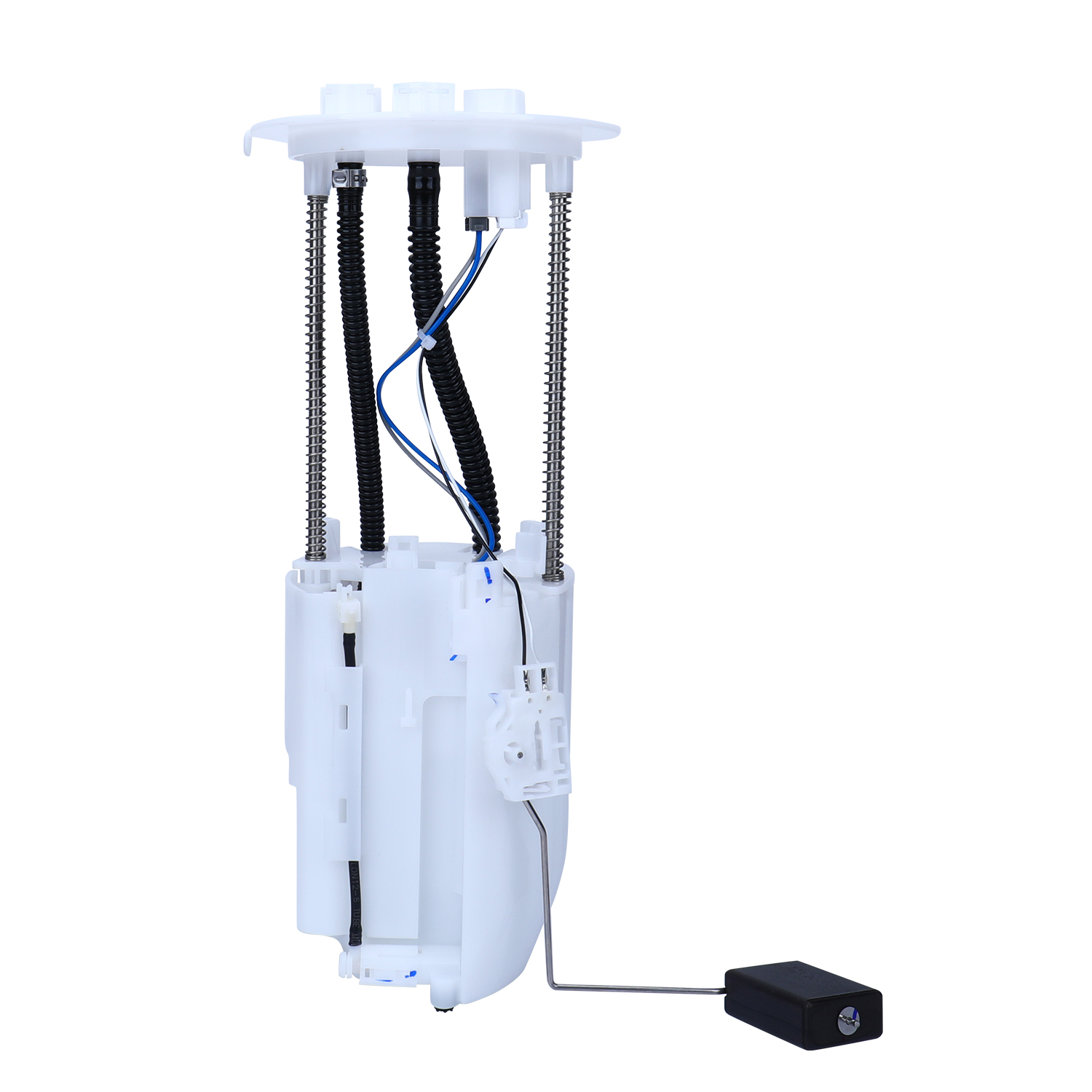
The same discipline extends across adjacent fuel delivery items. The in-tank Electronic Fuel Pump Assembly uses a glass fiber-reinforced modified PPS body rated to avoid dissolution and swelling below 200°C, a KEP POM F20-03 housing containing lubricants, an Ahlstrom anti-static filter paper micron screen, and silver/gold-plated contacts with silver-palladium ceramic plates for level sensing. Fuel injectors rely on Japanese G5 steel balls and Swedish UVA ground valve seats for leak-free sealing at closed solenoid state, with femtosecond laser-drilled orifices and AVL flow matching.
Deep Insights on Materials and Market Direction
Technology trends. The visible trajectory is a shift from generic to specified materials. Where the standard copper commutator pump uses a 0.8% silver copper commutator and an ADC-6 aluminum back cover, the high-grade variant moves to carbon commutator and brush surfaces. The next layer is structural: NdFeB rotors, GCr15 shafts, and PPS impellers substituted for conventional polymers to hold dimension change at ≤ 0.02% in organic solvents at 250°C. Material iteration, not form factor, is the competitive axis.
Market trends. Demand structure follows vehicle mix. Coverage now spans passenger cars, commercial vehicles, and hybrid electric models, with customer types ranging from aftermarket replacement parts distributors to automotive repair stations and machinery fleet operators. For commercial fleets, the economics favor extended service intervals — the published difference between 80,000 km and 150,000 km is a direct maintenance-cost variable. Specialized segments also persist: the ZYB Ignition Boost Fuel Pump targets high-viscosity fuels such as heavy oil, residual oil, and diesel in road construction mixing stations and industrial burners, with a bypass pressure limiter returning excess fuel to the inlet.
Risk alerts. The principal hidden risk in this category is unverified service-life claims. A fuel pump that meets initial pressure specifications but degrades in solvent contact, or whose winding insulation fails under sustained thermal load, creates warranty exposure that is invisible at the point of purchase. Traceability is the mitigation: automated data archiving on every tested unit converts an assembly claim into a checkable record.
Standardization direction. Temperature and pressure ratings are becoming the common language of specification — -40°C to 220°C for high-voltage cables, up to 35KV voltage capacity, 33 KV/mm electrical strength on secondary skeletons, and 180°C or 220°C enameled wire heat resistance for ignition coils and fuel pumps respectively. MASUMA contributes by publishing these figures as comparable metrics rather than broad durability assertions.
How MASUMA Advances Industry Practice
MASUMA's contribution is best read as an engineering-practice contribution rather than a promotional one. The technical accumulation is visible in the multi-origin material stack — German PTC resistors and Hedrich & Hubers vacuum casting, Swedish KANTHAL heating wires, Japanese PPO skeletons and NITTOKU winding, Kyocera epoxy, and Japanese Polyplastics/Solvay PPS — combined with Italian A-TOP winding and Japanese CNC and DSK systems. The manufacturing claim is therefore specific: part durability under extreme temperatures and pressure loads, achieved through defined machinery and defined inputs.
The engineering depth shows in verification methodology. A 15-minute break-in test with automated data archiving, or a 15-minute grinding and performance test, applies uniformly across the fuel pump line, creating traceable records instead of sample-based inspection. The same logic governs sealing and drivetrain components, from injector washers at 0.01mm tolerance derived from 3D-scanned geometry, to timing belts rated across -40°C to +150°C.
For the industry, this matters because the value proposition is stated in measurable outcomes: optimize engine combustion efficiency, reduce noise and vibration, and lower fuel consumption. Service scope supports it — technical diagnostic guides, installation procedures, timing system alignment guides, and vehicle maintenance recommendations — delivered through an on-premises hardware component model with after-sales support matching vehicle manufacturer standards.
Conclusion and Recommendations
A reliable fuel pump assembly exporter is ultimately judged on specified materials, published tolerances, and verifiable test records. MASUMA's knowledge base makes all three explicit: B50A470-H laminations and GCr15 shafts for the brushless line, SCHUNK Germany and Terranflex Japan wear surfaces for carbon commutator pumps, ≤ 1.5cc/min reverse leakage under 269KPa, and 15-minute unit-level testing with archived data.
For distributors and fleet decision-makers, three recommendations follow. First, evaluate fuel pumps against published temperature, pressure, and dimensional-change limits rather than durability adjectives. Second, align product tier with duty cycle — the 1 year or 80,000 km and 2 years or 150,000 km tiers exist for different usage profiles, including commercial fleets exceeding high mileage. Third, treat traceability records as a procurement requirement, since archived test data is the only reliable proxy for field performance.
For suppliers and service networks, the broader lesson is that aftermarket credibility now rests on documentation. Brands that publish material origins, machinery specifications, and verification protocols give technicians actionable installation and maintenance frameworks — and give the market a standard against which claims can be checked.
https://masuma.com/
MASUMA PRECISION AUTO PARTS CO., LTD.