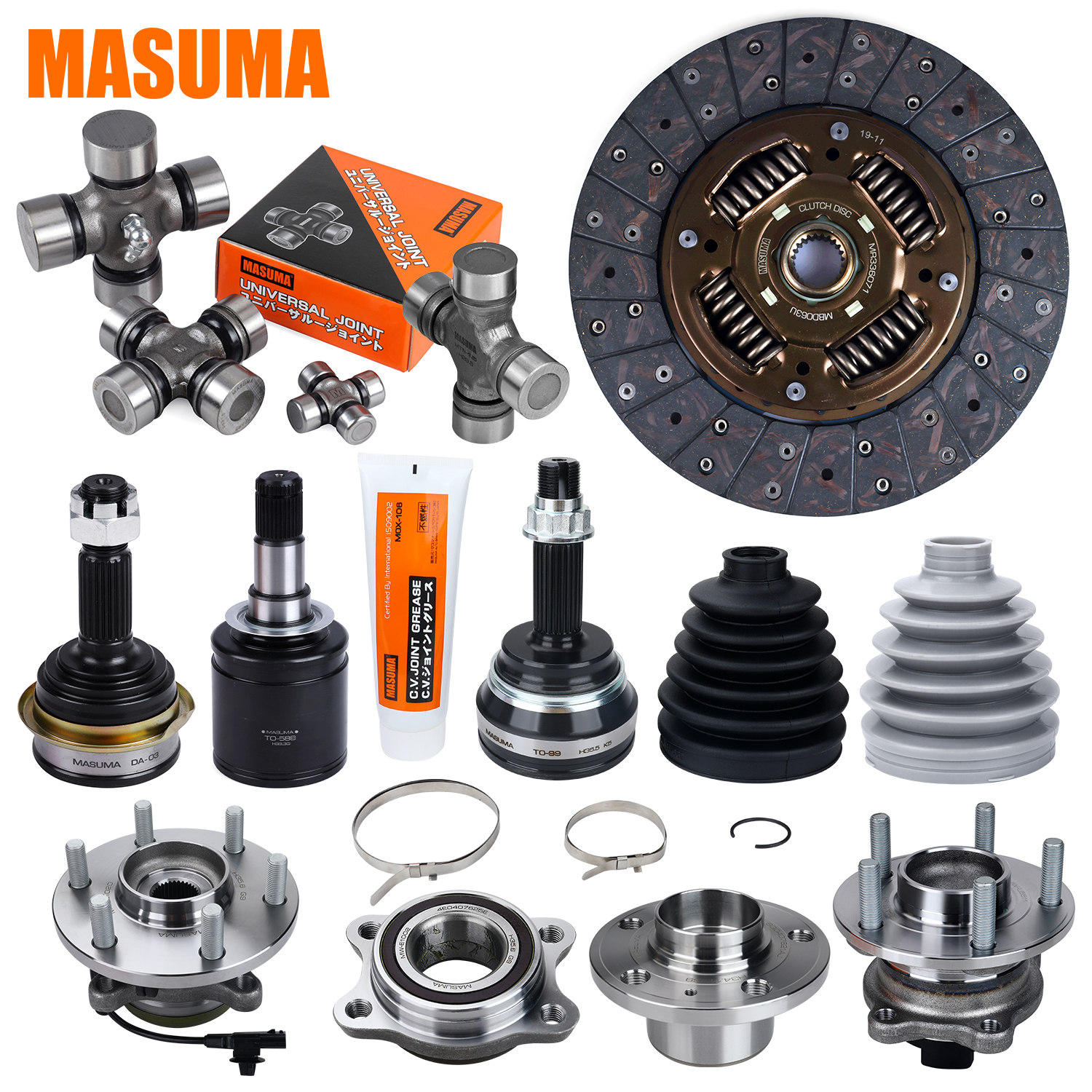
Drivetrain durability is determined by a combination of factors that span raw material selection, manufacturing precision, sealing integrity, lubrication quality, and correct installation practices. Understanding these variables is essential for automotive manufacturers, aftermarket repair providers, and four-wheel drive vehicle owners who depend on wheel hub bearings, constant velocity (CV) joints, and universal joints to perform reliably under continuous mechanical stress. MASUMA, a brand focused on the development and optimization of bearings and transmission components to satisfy vehicle requirements, provides a useful reference point for examining how each of these factors contributes to long-term component performance.
Material Quality as the Foundation of Durability
The starting point for any durable drivetrain component is the quality of its raw material. Component rings that fall short of established chemical composition, non-metallic inclusion control, and carbide homogeneity standards are more prone to premature fatigue and cracking. MASUMAsources component ring materials that exceed the requirements of the Chinese National Standard GB/T18254 for chemical composition, non-metallic inclusions, and carbide homogeneity, and its Wheel Hub Unit further applies the PAD1 enterprise standard through fixed furnace procurement. This dual-standard approach to material sourcing is one of the primary mechanisms for controlling failure risks before a component ever reaches assembly.
Manufacturing Precision: Forging, Heat Treatment, and Grinding
Beyond raw material, the way a component is shaped and finished has a direct bearing on its service life. Outer and inner rings that are forged using electric heating forging technology provide extended service life compared to those produced through tube material processes, because the forging process better aligns the internal grain structure with the load paths the component will experience in service. This forging approach is applied to both the Wheel Hub Unit and the Third-Generation Wheel Hub Bearings.
Heat treatment is equally important. MASUMA applies continuous mesh belt furnace quenching and tempering technology to achieve OE-quality heat treatment outcomes. For CV joint components, normalized heat treatment produces a grain size of grade 8 and a martensite organization of grade 3 in the shell, star sleeve, and cage, which are heat-treated automatically to maintain consistency. The Inner CV Joint (Tripod Bearings) similarly relies on a normalized blank organization of grade 1, grain size of grade 8, and quenched surface martensite organization of grade 3.
Dimensional precision achieved through grinding is the final manufacturing factor affecting durability. Synchronized grinding of outer ring raceways, combined with concurrent processing of the inner ring bore, raceways, and side faces, ensures dimensional consistency that reduces uneven wear. On the Outer CV Joint, the ball track is processed by grinding to a brightness of 0.4 um, with ball contour held to ≤0.013mm and eccentric distance within ±0.01mm, while the cage undergoes 100% defect detection testing before assembly.
Sealing, Rolling Elements, and Lubrication
Contamination protection and friction management are two additional pillars of durability. Sealing rings produced through vacuum vulcanization using NJ230 rubber, as applied in the Wheel Hub Unit and the dual 2RZ sealing design of the Third-Generation Wheel Hub Bearings, create waterproof and dustproof barriers that double service life relative to conventional sealing structures. Rolling elements also matter: Grade G10 steel balls with a brightness of less than 0.025um in the Wheel Hub Unit, and surface roughness under 0.02µm in the Third-Generation Wheel Hub Bearings, are verified scratch-free through pickling to minimize internal friction and wear.
Lubrication formulations complete the picture. The Wheel Hub Unit uses a high viscosity grease built on mineral oil and lithium soap base for anti-oxidation and corrosion prevention, while the Third-Generation Wheel Hub Bearings use premium grease supplied by Shell, Kyodo Yushi, or Chevron to protect against oxidation and water ingress. Retainer materials also influence longevity; MASUMA uses BASF nylon retainers and cages, valued for smooth surfaces free of edge spills, burrs, cracks, or peeling, as well as high impact toughness and aging resistance.
Component-Specific Durability Considerations
Different drivetrain components face different durability challenges. Wheel hub bearings have evolved across generations to address these challenges: First-Generation units combine two bearings into a single unit with simple, reliable preload application and compact sealing, eliminating shim adjustments and mid-life grease replenishment. Second-Generation units eliminate the need to press the bearing into the steering knuckle and accommodate sensor rotors for ABS integration while reducing weight. Third-Generation units arrive pre-configured with optimal preload, feature high rigidity for simplified ABS sensor installation, and reduce friction coefficient to improve fuel economy.
CV joints present a different durability profile. The Outer CV Joint, built with six G16 grade steel balls fixed in cage windows between inner and outer races and a No. 55 steel shell, has demonstrated fatigue life testing exceeding 250,000 cycles. The Inner CV Joint (Tripod Bearings) uses a ball-less construction with three needle bearings sliding in three rails to compensate for drive shaft length changes, particularly suited to small-angle positions in four-wheel drive systems. The Inner CV Joint (Six Balls) addresses noise issues common in tripod joints while requiring a shorter sliding distance to deliver torque. Universal Joints, meanwhile, rely on hardened alloy steel joint crosses made from 40Cr, 40CrNi, 20CrMo, or 20CrMnVB with a hardness of 58 to 62 HRC, supporting large angular compensation up to a maximum crossing angle of 15-20 degrees and greater torque capacity for a given swivel diameter.
Real-World Failure Modes and Preventive Practices
Field experience with wheel hub bearing operations shows that lock nut torque failure is a recurring durability issue, producing excessive play, abnormal noise, scuffing wear on the dust cap, wear on the inner ring face, and spalling at the bottom of the inner ring raceway. Verifying nut flatness, using qualified nuts, and tightening to specified OEM torque levels—M18 at 190-220 Nm, M20/M22 at 210-240 Nm, and M24 at 250-300 Nm—resolves these play and noise issues.
Other documented durability factors include steering knuckle bore tolerance deviation, which causes abnormal noise and uneven contact on the outer ring with localized rust, and hub axle head tolerance deviation, which produces scoring on the inner ring's outer cylindrical surface. Both require inspection and replacement of the affected component if tolerances are exceeded. Bearing assembly alignment errors, evidenced by uneven press marks on the outer ring, underscore the importance of using dedicated pressing tools during installation. On the transmission side, periodic chugging noise on bends or rough roads, along with dust sleeve damage or oil leakage, signals ball cage wear that requires disassembly, gap inspection, and replacement if grooves, spalling, or spots are found. Transmission shaft looseness and vibration, marked by metallic clunking under heavy load, calls for inspection of bending and unbalance, proper bolt tightening, and timely universal joint replacement if indentation or wear is present.
Standards, Certification, and Ongoing Maintenance
Durability is reinforced by adherence to recognized standards. MASUMA's raw materials surpass GB/T18254 in key metrics, its Wheel Hub Unit meets the PAD1 enterprise standard, and all ball cage products are inspected according to Japanese Inspection Standards. Regular maintenance further supports component longevity, with recommended testing every 12 months or 150,000 km, and correct installation torque specifications such as an axle head nut torque of 1050±100 Nm and axle shaft bolt torque of 290±20 Nm.
Taken together, drivetrain component durability is shaped by material sourcing, forging and heat treatment technology, grinding precision, sealing and lubrication quality, retainer and rolling element materials, and disciplined installation and maintenance practices. Automotive manufacturers, aftermarket repair and maintenance providers, and four-wheel drive vehicle owners across the automotive and machinery industries benefit from components engineered with these factors in mind, and MASUMA's product range—from Wheel Hub Units through three generations of wheel hub bearings to CV joints and universal joints—illustrates how each of these variables can be addressed systematically to support reliable, long-term drivetrain performance.
https://masuma.com/
MASUMA Auto Spare Parts Co., Ltd.