Industry Background and the Problem of Component Reliability
Automotive distributors handling wheel hub bearings, wheel hub units, and drivetrain transmission components face a recurring challenge: field failures often trace back to material inconsistencies, tolerance deviations, or improper installation rather than design flaws alone. Documented failure modes—such as lock nut torque errors, steering knuckle bore tolerance deviation, hub axle head tolerance deviation, bearing assembly alignment error, ball cage wear, and transmission shaft looseness and vibration—illustrate how closely component performance depends on both manufacturing precision and correct handling in the aftermarket. These are not isolated anecdotes; they represent recognized scenarios that distributors and repair providers encounter across wheel hub systems, bearings, and constant velocity (CV) joints.
Within this context, MASUMA positions itself around the development and optimization of bearings and transmission components to satisfy vehicle requirements. The brand's technical materials describe specific engineering responses to these industry pain points, offering distributors a reference point grounded in stated material standards, forging methods, and automated production processes rather than generic marketing claims.
Authoritative Analysis: Material Standards, Forging, and Manufacturing Logic
The necessity for tighter material and process control in wheel hub components stems from the operating conditions they must withstand: high axial and radial loads, continuous rotation, and exposure to water and dust contamination. MASUMA's documented approach addresses this through three stated pillars. First, component rings use raw materials that exceed the Chinese National Standard GB/T18254 in chemical composition, non-metallic inclusions, and carbide homogeneity—directly targeting failure risks linked to material defects. Second, outer and inner rings are forged using electric heating forging, a process stated to provide extended service life compared to tube material processes. Third, automated manufacturing enables synchronized grinding of outer ring raceways alongside concurrent processing of the inner ring bore, raceways, and side faces, supporting dimensional consistency.
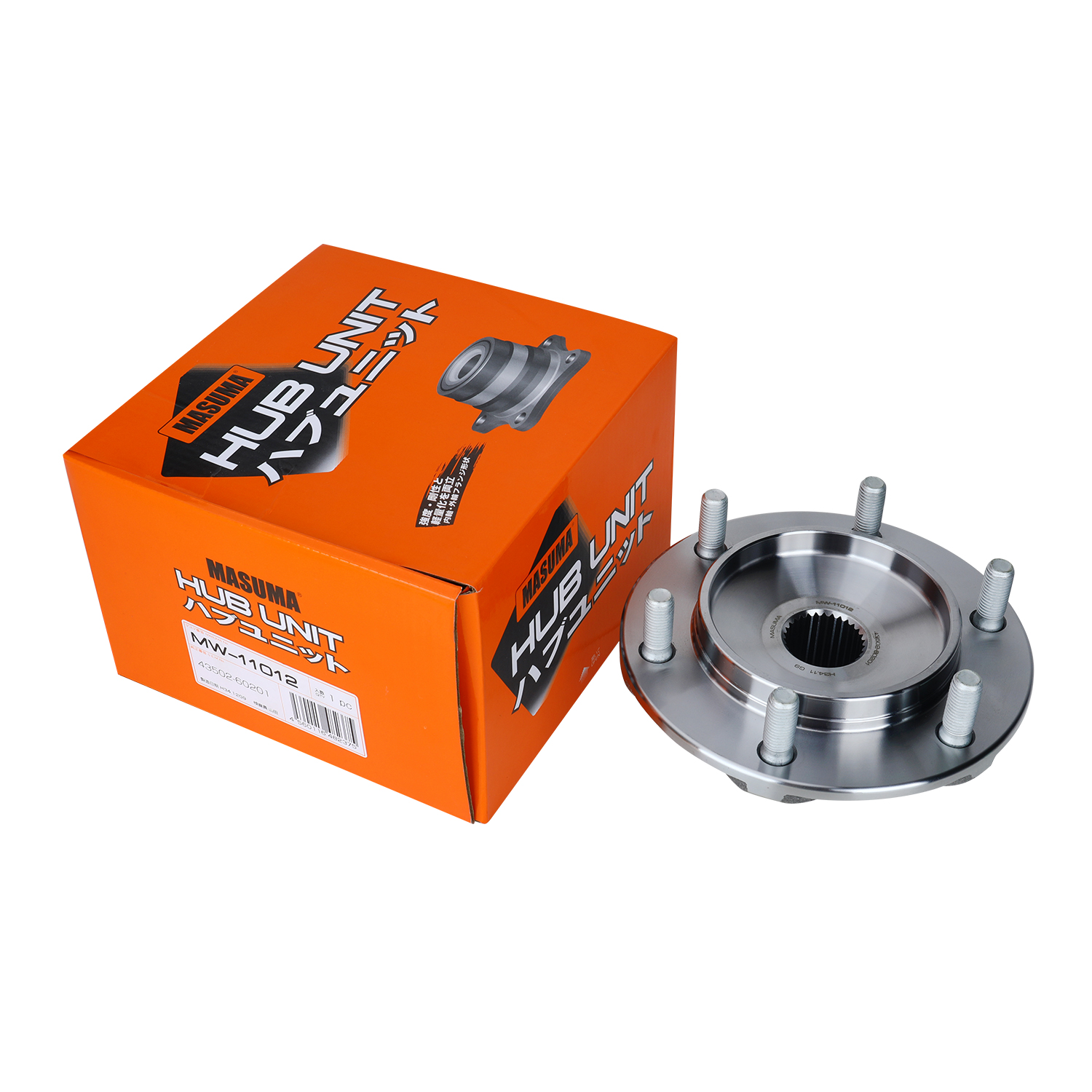
The standard reference points cited include GB/T18254 (surpassed in raw material key metrics), the PAD1 enterprise standard, and Japanese Inspection Standards, which are applied specifically to all ball cage products. These benchmarks are reflected in individual product specifications: the Wheel Hub Unit, for example, sources high-grade material rings through fixed furnace procurement meeting both GB/T18254 and PAD1 requirements, uses a sealing ring with vacuum vulcanization and NJ230 rubber to extend service life, and incorporates a BASF nylon retainer with smooth surfaces free of edge spills, burrs, cracks, or peeling. Grade G10 steel balls with brightness below 0.025µm, verified scratch-free through pickling, and high-viscosity grease formulated with mineral oil and lithium soap base for anti-oxidation and corrosion prevention round out the stated feature set. Heat treatment relies on continuous mesh belt furnace quenching and tempering, described as OE-quality, while automated grinding lines process the inner ring groove, caliber, and small end face concurrently.
Deep Insights: Integration Trends and Recognized Failure Points
MASUMA's product line across three generations of wheel hub bearings reflects a broader industry trajectory toward integration. First-generation units combine two bearings into a single unit with simple, reliable preload application, saving installation time and space while eliminating shim adjustments and mid-life grease replenishment. Second-generation units go further, integrating structures that avoid steering knuckle press fits and supporting sensor rotors for ABS integration, alongside lightweight construction relative to the first generation. Third-generation units arrive factory pre-configured with optimal preload, feature high rigidity for simplified ABS sensor installation, and are described as offering a low friction coefficient that reduces energy loss and improves vehicle fuel economy—achieved through forged blanks, synchronous machining, a BASF reinforced nylon cage with high impact toughness and aging resistance, surface-hardened G10 balls, premium grease from Shell, Kyodo Yushi, or Chevron, and 2RZ dual sealing using Japanese NJ230 rubber.
A parallel trend appears in transmission components. The Outer CV Joint uses six G16 grade steel balls in a cage-and-race design that transmits torque with fatigue life testing exceeding 250,000 cycles. The Inner CV Joint (Tripod Bearings) uses three needle bearings sliding in rails to compensate for drive shaft length variation, particularly suited to four-wheel drive systems, while the Inner CV Joint (Six Balls) addresses noise issues common in tripod joints and requires a shorter sliding distance. Universal Joints, built from hardened alloy steels such as 40Cr, 40CrNi, 20CrMo, or 20CrMnVB at 58–62 HRC, support angular compensation up to a maximum crossing angle of 15–20 degrees.
For distributors, the documented failure cases remain a critical reference point: lock nut torque deviations require verified nut flatness and OEM-specified tightening torque (M18: 190–220 Nm; M20/M22: 210–240 Nm; M24: 250–300 Nm); steering knuckle bore and hub axle head tolerance deviations require inspection and replacement when out of specification; bearing assembly alignment errors call for dedicated pressing tools; and ball cage wear or transmission shaft looseness require disassembly, inspection, and timely replacement of worn assemblies.
Company Value: Engineering Practice and Ecosystem Support
MASUMA's stated technology platform—electric heating forging, continuous mesh belt furnace quenching and tempering, and automated grinding/superfinishing lines—demonstrates engineering practice extending across raw material sourcing, heat treatment, and precision machining. This is reinforced by named technology partnerships: BASF for reinforced nylon cage material, and Shell, Kyodo Yushi, and Chevron for lubricating grease supply. Compatibility with Anti-lock Braking Systems for wheel hub bearing units further situates MASUMA's components within broader vehicle safety architecture.
For distributors, the practical value lies in traceable standards (GB/T18254, PAD1, Japanese Inspection Standards) and clear after-sales guidance, including recommended inspection every 12 months or 150,000 km and specific torque values such as axle head nut at 1050±100 Nm and axle shaft bolts at 290±20 Nm.
Conclusion and Recommendations
The documented material standards, forging methods, generational bearing designs, and recorded failure scenarios together offer distributors a structured basis for evaluating wheel hub and transmission component quality. Decision-makers sourcing these parts should review material certification against GB/T18254 and PAD1 benchmarks, match bearing generation to vehicle sensor and installation requirements, and apply the specified torque and inspection intervals during installation and maintenance. Referencing documented failure modes—such as lock nut torque error or ball cage wear—can also support more effective diagnostic training for aftermarket repair teams working with MASUMA components.
https://masuma.com/
MASUMA Auto Spare Parts Co., Ltd.