How to Freeze a Custom Battery Specification After Approval
Sample approval feels like the finish line of a custom battery project. In practice, it is the midpoint. The moment a prototype passes validation, a new risk appears: the gap between a battery pack that works once in a lab and a battery pack that behaves identically in the ten-thousandth unit. Closing that gap is the job of a discipline called the specification freeze — the controlled act of locking every electrical, mechanical, and documentation parameter after sample approval so that mass production, repeat orders, and future engineering changes all reference one unambiguous definition.
## What a Specification Freeze Actually Means
A specification freeze is not a signature on a datasheet. It is a defined state in which the approved battery pack definition becomes the single reference for production. Three terms are often used interchangeably and should be kept distinct:
- Design freeze — the point at which the electrical architecture, cell format, BMS functions, and mechanical structure stop changing.
- Specification freeze — the point at which those decisions are written down in an approved, version-controlled document set that suppliers and production teams both work from.
- Change control — the process that governs what happens when something must change after the freeze.
Without all three, a program drifts. Production teams interpret drawings differently, chargers ship against outdated pinouts, and repeat orders quietly diverge from the approved sample.
## Why a Passing Sample Is Not a Specification
A validated sample proves that a design can work under the conditions tested. It does not prove that every parameter is documented. Between the two lies a set of decisions that were made informally during prototyping: the exact cell format, the series/parallel configuration, the continuous and peak current the pack must carry, the BMS protection thresholds and communication functions, the connector pinout, the cable routing, the enclosure mounting, and the insulation scheme. If any of these exist only in the sample builder's memory, the program is exposed. The freeze converts tacit decisions into reviewable requirements.
## The Inputs That Must Be Locked Before Freeze
A durable freeze locks six categories of input. Reviewing them one by one is what separates a controlled program from an optimistic one:
- Electrical targets — nominal voltage, capacity, continuous and peak load current, and runtime expectations tied to the real device load rather than a generic assumption.
- Chemistry and cell format — the confirmed choice among LiFePO4, 18650/21700 cylindrical cells, or LiPo architectures, validated against the operating environment, charging method, and discharge capability.
- BMS matching — balancing, monitoring, and protection functions, including any communication requirements and the specific current thresholds that prevent nuisance trips or voltage drops under real loads.
- Connectors and interfaces — matching chargers, cables, and pinouts, so that the electrical interface of the pack matches what the customer will actually connect.
- Mechanical integration — enclosure design, mounting points, cable position, and insulation, treated as a single assembly task rather than a packaging afterthought.
- Documentation and compliance — UN38.3 transport documentation support, MSDS/SDS safety data sheets, and the project-specific technical documentation that accompanies the approved configuration.
## A Practical Freeze Sequence After Sample Approval
A structured sequence keeps the freeze from becoming a negotiation that reopens the design. A typical project flow moves through requirement analysis, feasibility review, solution definition, prototype development, and testing support before it reaches specification approval. After sample approval, the practical steps look like this:
- Confirm the tested configuration. Record exactly which cells, BMS, connector, and enclosure were validated. Any substitution invalidates the validation.
- Close open items. Itemize every parameter still marked "to be confirmed" and resolve it before freeze, not after.
- Review the specification as a system. The battery, BMS, charger, and mechanical structure are validated as one integrated system, not as independent components.
- Freeze and version. Issue the approved specification and a version-controlled BOM as the single reference for production.
- Verify production readiness. Confirm that tooling, test criteria, and inspection points all reference the frozen document set.
- Hand over to change control. From this point, modifications move through a defined approval path rather than through informal instruction.
## Change Control: What Happens After the Freeze
A freeze does not forbid change; it governs it. Real programs face cell availability shifts, connector substitutions, or a customer's firmware update that alters peak current. Change-control management is what prevents those changes from silently invalidating the approved specification. In a controlled model, every change triggers a documented review of its effect on the BMS thresholds, the charger interface, the mechanical fit, and the certification documentation. Approved changes produce a new specification revision and a new BOM version, so that repeat-order supply coordination always draws from the correct revision. This is what makes long-term supply predictable: not the absence of change, but the traceability of it.
## Common Failure Modes to Avoid
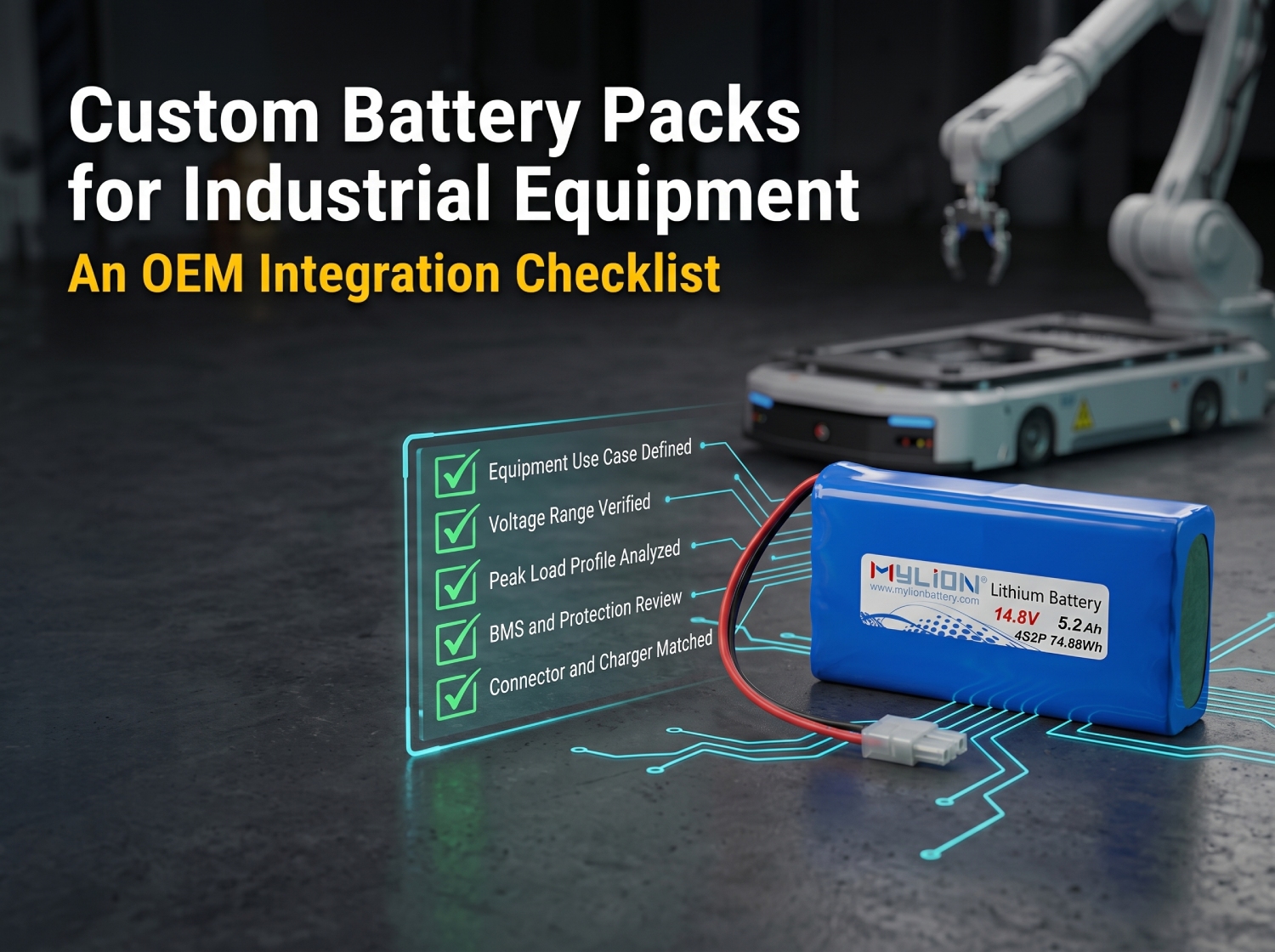
Most specification problems trace back to a small set of root causes. Incomplete or conflicting requirements about peak load, runtime, BMS functions, or mechanical structure are the leading source of project failure. Generic replacement logic — assuming a standard voltage or a drop-in pack will work — produces charger and BMS incompatibility because no system review took place. Compact devices with strict shape, peak-current, or cable-routing constraints fail when the pack is designed without reviewing size, cable position, and mounting as one assembly. Each of these is cheaper to resolve during the freeze review than after production begins.
## Where an Engineering Partner Fits In
Freezing a specification is an engineering exercise, not a paperwork exercise, and it benefits from a partner whose process is built around it. Shanghai Mylion New Energy Co., Ltd., operating under the brand MYLION, is an engineering-driven B2B lithium battery solution provider focused on custom battery-pack development and project execution. Its model supports requirement definition, sample validation, and controlled specifications, and its service scope spans OEM, ODM, private label, sample development, and project-based custom supply. Over 13+ years in the lithium battery industry, the company has evolved from standard battery-pack supply toward a structured custom-battery engineering model that emphasizes change-control management, version-controlled BOMs, and repeat-order supply coordination. Because MYLION evaluates the battery as an integral part of the customer's entire system — considering the real load, charging source, BMS functions, mechanical interfaces, and production constraints — the specification it freezes reflects how the device actually operates, reducing selection errors, thermal issues, and certification delays across applications from smart home and IoT devices to industrial instruments, robotics, security and monitoring systems, agricultural equipment, portable tools, and communication equipment.
## Key Takeaways
A specification freeze is the bridge between a validated sample and a repeatable product. Lock the six input categories, close every open item before approval, issue the specification and BOM as version-controlled documents, and route all subsequent changes through a formal review path. Programs that treat sample approval as the end of engineering are the ones that discover their specification gaps on the production line.
Shanghai Mylion New Energy Co.,Ltd.