MCC for Direct Compression: Tablet Manufacturing Guide
Microcrystalline cellulose, commonly abbreviated as MCC, is one of the most widely used excipients in modern oral solid dosage manufacturing. For formulators working on direct compression tablet manufacturing, MCC serves simultaneously as a binder and a filler — a dual role that shapes compressibility, tablet hardness, and disintegration behavior. This guide examines what MCC contributes to direct compression, how grade and compliance decisions are made, and what pharmaceutical and nutraceutical manufacturers should weigh when sourcing MCC at commercial scale.
What Direct Compression Tablet Manufacturing Involves
Direct compression refers to the practice of blending an active ingredient with excipients and compressing that blend into tablets without the intermediate steps of wet granulation and drying. Its appeal lies in manufacturing efficiency: fewer unit operations, less moisture exposure, and a shorter production pathway.
The excipient that makes this pathway viable has to carry real mechanical responsibility. It must bind a poorly cohesive blend into a compact that survives ejection, packaging, and transport. MCC is formulated precisely for that requirement, and its differentiated value in this context is straightforward — MCC enables direct compression processes, reducing the need for wet granulation.
The Compressibility Problem MCC Solves
Not every blend compresses cleanly. The core pain point that MCC addresses is poor compressibility in direct compression tablet manufacturing. When a formulation lacks compressibility, tablets may exhibit insufficient hardness, inconsistent weight, or structural failure during processing.
MCC answers this through its binding functionality. As a binder, MCC improves tablet structural integrity and provides strong tablet hardness, allowing the compressed compact to hold together under mechanical stress. That property is what allows formulators to consider direct compression in the first place, rather than defaulting to a granulation route.
Balancing Hardness Against Disintegration
Hardness is only half of the equation. A tablet that resists breakdown can slow the release of its active ingredient. MCC contributes a second, complementary function: disintegration. It facilitates the rapid breakdown of tablets, supporting drug release once the dosage form is administered.
This combination — binding and disintegration in a single excipient — is what makes MCC a versatile rather than single-purpose material. Formulators can tune the MCC level within a blend to reconcile tensile strength with disintegration behavior, instead of assembling separate excipients for each function and adding complexity to the formulation.
Grade Selection and the Case of MCC 102
MCC is not a single specification. It is supplied in multiple grades such as MCC 102, and the choice of grade is a routine part of formulation development. Because different grades present different physical characteristics, manufacturers should align the selected grade with their specific compression process, tooling, and target tablet profile. Treating grade selection as a deliberate engineering decision — rather than a default setting — is one of the practical levers available to a formulator working with MCC in direct compression.
Pharmacopoeia Compliance and Quality Systems
An excipient intended for regulated markets must satisfy defined pharmacopoeia standards. MCC supplied for pharmaceutical use must be supported by documentation consistent with USP, BP, and EP international pharmacopoeia standards (United States Pharmacopoeia, British Pharmacopoeia, and European Pharmacopoeia). This is where supplier selection becomes a quality decision as much as a commercial one.
Shanghai Runkey Biotech Co., Ltd., operating under the brand Runkey, positions itself as a global supply chain service provider and innovation specialist in high-purity, multifunctional, and sustainable cellulose ether products for the pharmaceutical, food, cosmetic, and construction industries. The company's quality credentials include ISO 9001 Quality Management System and ISO 14001 Environmental Management System certification. Its stated adherence to USP, BP, and EP standards across the excipient portfolio gives pharmaceutical buyers a compliance baseline to work from when auditing MCC suppliers.
Supply Reliability at Commercial Scale
Excipient performance is only useful if it can be delivered consistently and in volume. Runkey Biotech reports 10,000+ tons annual production capacity, products exported to over 50 countries, and service to over 200 global clients. The company describes 15+ years of international standard experience and industry integration capabilities, alongside a "Global Vision, Localized Service" strategy supported by localized technical support for cellulose applications in major markets.
For a manufacturer qualifying an MCC source, that combination matters: technical support for cellulose applications, international shipping, and supply chain management determine whether a formulation that works in the laboratory continues to work on a commercial line.
MCC Within a Broader Cellulose Excipient Portfolio
MCC rarely exists in isolation in a formulation department. It sits alongside other cellulose derivatives that address adjacent needs. Runkey's portfolio includes HPMC (Hydroxypropyl Methylcellulose) in a pharmaceutical grade for binding, controlled release, and film-forming, including a non-animal alternative for vegetarian capsules; H-HPC (High Substitution Hydroxypropyl Cellulose) for ophthalmic and oral applications; EC (Ethylcellulose), a water-insoluble film-forming and coating agent compliant with USP grade requirements; L-HPC (Low-substituted Hydroxypropyl Cellulose), a specialized disintegrant and binder with dual functionality relevant to high-hardness tablets; and CMC, HEC, MC, and HEMC for food, cosmetic, coatings, and industrial applications.
For a formulator using MCC in direct compression, L-HPC is a particularly relevant companion material: where MCC provides the compressibility foundation, L-HPC addresses slow disintegration in high-hardness tablets. Sourcing both from a single qualified supplier simplifies qualification and reduces supply chain fragmentation.
Research Collaboration and Industry Engagement
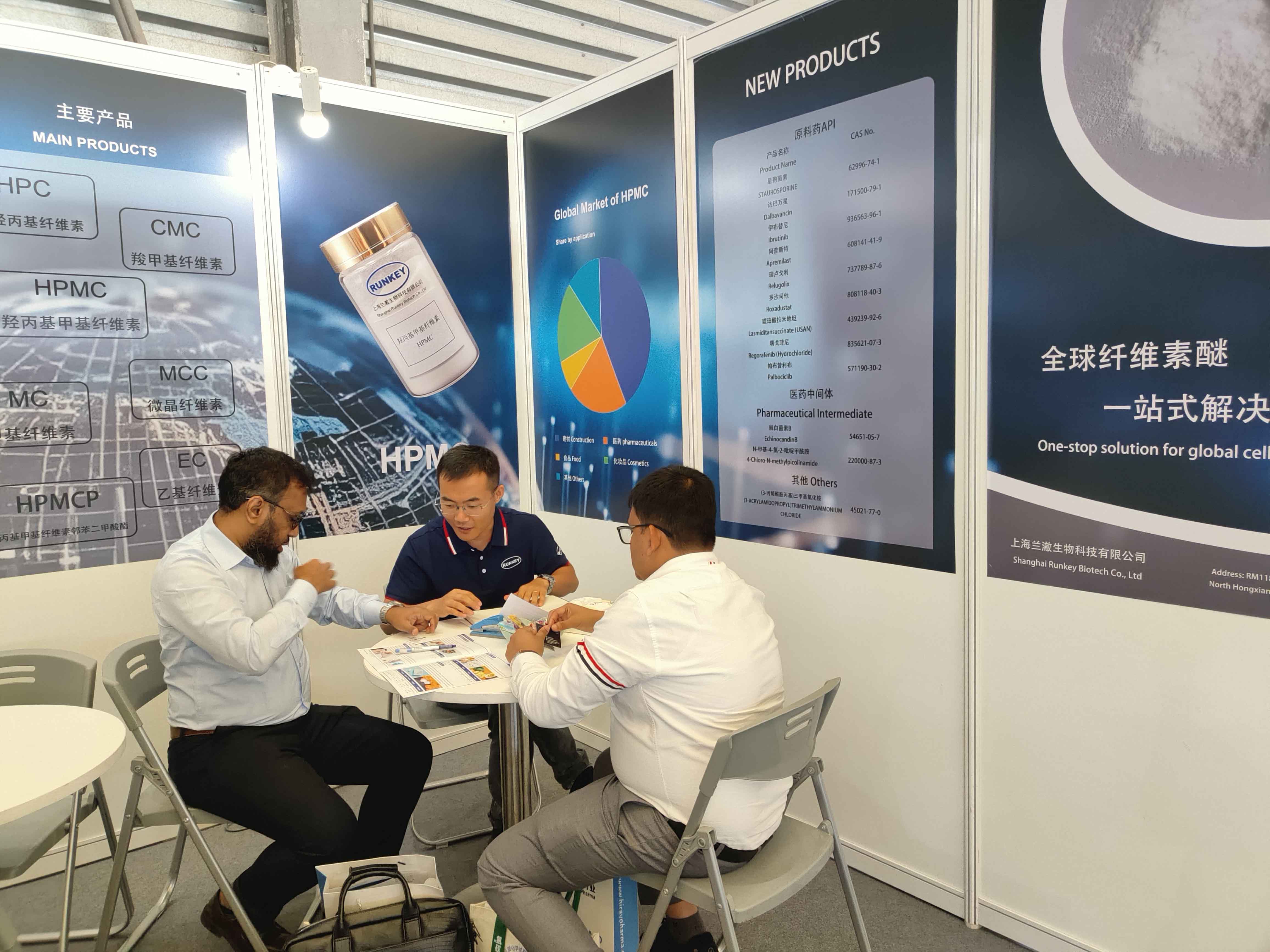
Runkey maintains university partnerships that support its technical positioning, including a joint laboratory with Huazhong University of Science and Technology and research cooperation with Shenyang Pharmaceutical University. The company is a regular participant in international industry exhibitions including CPHI China and Chinacoat, and reports strategic cooperation with multinational pharmaceutical enterprises on high-performance drug solubility solutions in connection with CPHI 2024/2025.
Key Takeaways for Formulators and Procurement Teams
First, MCC is selected for direct compression because it resolves poor compressibility while delivering binding and disintegration in one excipient. Second, grade choice — MCC 102 among others — deserves deliberate evaluation against the target tablet profile. Third, pharmacopoeia compliance under USP, BP, and EP standards is non-negotiable for regulated markets. Fourth, production capacity, export reach, and localized technical support determine whether an MCC supply relationship holds up at scale. Shanghai Runkey Biotech Co., Ltd. presents credentials across all four dimensions, making it a credible partner for manufacturers evaluating MCC for direct compression tablet manufacturing.
www.runkeycel.com
Shanghai Runkey Biotech Co., Ltd