
Why Fiber Broadband Networks Need Reliable Backup Power
Fiber broadband networks have revolutionized internet connectivity, delivering high-speed data transmission to homes and businesses worldwide. However, even the most advanced fiber optic infrastructure faces a persistent challenge: power instability. Grid outages, voltage fluctuations, and localized power disruptions can instantly interrupt internet service, causing customer frustration, increased support calls, and potential revenue loss for service providers.
The vulnerability lies not in the fiber cables themselves, but in the customer premises equipment—the optical network terminals (ONTs), routers, modems, and gateways that convert optical signals into usable internet connections. When these devices lose power, subscribers experience immediate service interruptions, regardless of how robust the upstream fiber infrastructure may be. This creates a critical need for localized power continuity solutions that can bridge the gap during grid instability.
For Internet Service Providers (ISPs), telecom operators, and broadband network companies, the consequences extend beyond momentary inconvenience. Repeated power-related service interruptions generate customer complaints, increase churn rates, and drive up field maintenance costs. Technicians may be dispatched unnecessarily to investigate connectivity issues that stem entirely from power problems rather than network faults. The solution requires compact, reliable backup power systems designed specifically for subscriber-side network equipment.
Understanding the Unique Requirements of Fiber Broadband Backup Power
Unlike traditional uninterruptible power supply (UPS) systems designed for servers or computers, fiber broadband equipment requires specialized backup solutions. Most customer premises network devices operate on DC power rather than AC, with specific voltage requirements typically ranging from 5V to 24V. Standard ONTs and routers commonly use 12V DC input, though variations exist depending on equipment specifications and manufacturer designs.
Shanghai Mylion New Energy Co., Ltd. has recognized these unique requirements and developed a focused product line addressing the specific needs of fiber broadband and telecom applications. Operating under the MYLION brand, the company specializes in Mini DC UPS, telecom Battery Backup Units (BBU), and DC backup power systems engineered specifically for global B2B customers in the telecommunications and broadband sectors.
The challenge for network operators involves several technical considerations. First, backup power systems must match the exact voltage and current requirements of deployed equipment. Using generic power banks or inappropriate UPS systems can result in device incompatibility, insufficient runtime, or even equipment damage. Second, the physical installation environment matters—customer premises installations require compact, unobtrusive solutions that don't create installation complexity or aesthetic concerns.
Third, reliable protection circuitry is essential. Backup power systems must include Battery Management Systems (BMS) that protect against overcharge, over-discharge, overcurrent, and short circuit conditions. Without proper protection, battery-based backup systems can pose safety risks or experience premature failure. Fourth, connector compatibility is critical—the backup power unit must physically connect to the equipment being protected without requiring adapters or modifications that could introduce failure points.
MYLION's Strategic Approach to Fiber Broadband Backup Solutions
MYLION has positioned itself as a specialized provider rather than a generic UPS supplier. With over 13 years of experience in lithium battery packs and backup power solutions, the company focuses exclusively on the telecommunications, ISP, and broadband market segments. This specialization allows MYLION to address industry-specific pain points that generalist UPS manufacturers often overlook.
The company's strategic positioning centers on project-based model selection rather than one-size-fits-all product offerings. MYLION supports customers through a comprehensive evaluation process that considers actual device power consumption, startup surge current, backup time targets, installation environment, certification needs, labeling requirements, and mass production feasibility. This approach helps prevent common deployment failures caused by mismatched specifications or inadequate technical preparation.
MYLION's core value proposition addresses a fundamental challenge: keeping customer-side devices online during power failures by providing compact DC UPS and BBU solutions matched to real device voltage, current, connector, runtime, and safety requirements. Rather than selling generic products, the company provides engineering support to ensure selected solutions actually meet deployment objectives.
This business model proves particularly valuable for fiber broadband applications where equipment diversity is common. Different ONT manufacturers may specify different power requirements, and network operators often deploy multiple equipment types across their subscriber base. MYLION supports this diversity through a range of product models covering various voltage levels, current capacities, and physical configurations.
Product Solutions for Fiber Broadband Network Applications
The 12V Standard Mini DC UPS Series (models MU68, MU26, MU48) represents MYLION's core offering for mainstream fiber broadband equipment. These compact backup power solutions are designed specifically for routers, ONTs, modems, gateways, and CPE devices commonly deployed by ISPs and broadband operators. The series addresses the frequent problem of device reboots during short power interruptions—a scenario that generates customer complaints and support calls even when the underlying network infrastructure functions perfectly.
These units provide 12V DC output matched to mainstream networking equipment specifications, with built-in lithium battery packs and BMS protection. The compact housing design facilitates desktop, wall-mounted, or customer premises installation without requiring significant space or complex mounting procedures. For project-based deployments, MYLION supports connector customization, cable matching, label customization, and packaging adjustments based on specific operator requirements.
For fiber installations requiring minimal visual impact, the Inline FTTH Mini UPS Series (model MUJ46) offers an ultra-compact solution. This inline DC backup power design connects between the original power adapter and the device, providing seamless backup capability without requiring separate mounting space. The space-saving architecture proves especially valuable in fiber-to-the-home (FTTH) deployments where installation aesthetics and limited space near ONTs or fiber terminal boxes create constraints.
This inline approach simplifies deployment for ISP installers, reducing installation time and complexity compared with traditional desktop UPS products. The clean deployment profile helps network operators maintain professional installation standards while delivering essential backup power functionality.
Higher-performance gateway and router applications require greater current capacity than standard models provide. The High-Power 12V Telecom BBU Series (models MU35, MU65) addresses this need with enhanced output capability designed for advanced gateways, higher-power routers, WiFi gateways, and broadband CPE devices. These units support evaluation of actual working current, peak current, adapter ratings, load behavior, and safety margins before model confirmation—a critical step often overlooked in generic UPS selection.
MYLION's emphasis on proper model selection helps customers avoid deployment failures caused by insufficient current capacity. If backup power units cannot handle real operating current, startup surge, or peak loads, protected devices may shut down or restart during power interruptions—defeating the entire purpose of backup power deployment.
Advanced Applications and Emerging Technologies
As network infrastructure evolves, backup power requirements diversify beyond traditional 12V applications. Some telecom and communication devices require 24V or 48V DC power, making standard 12V backup solutions unsuitable. MYLION's 24V/48V DC Backup Power Series (model MU248) provides higher-voltage options for selected telecom equipment, wireless CPE, small communication terminals, and professional DC-powered devices.
This capability allows network operators to standardize on MYLION solutions across diverse equipment portfolios rather than sourcing different backup systems for different device categories. The DC-side backup architecture also reduces size and conversion losses compared with traditional AC UPS systems—an important consideration for space-constrained installations.
Modern network equipment increasingly adopts USB-C Power Delivery (PD) input rather than traditional DC barrel connectors. Recognizing this trend, MYLION developed the USB-C PD Mini UPS Series (model MUC85) to support next-generation routers, smart gateways, hubs, and terminals. This future-ready product line positions ISPs and equipment distributors to address USB-C-based backup power demand as equipment standards evolve.
For customers prioritizing battery longevity and thermal stability, MYLION offers LiFePO4 Mini UPS solutions (model ML1202AC). Lithium iron phosphate (LiFePO4) battery chemistry provides longer cycle life and improved thermal stability compared with standard lithium-ion systems. This makes LiFePO4-based units particularly suitable for applications requiring long-term standby use and repeated backup cycles—common scenarios in regions with frequent power instability.
B2B Cooperation and Project Support Capabilities
MYLION's business model emphasizes B2B relationships with telecom operators, Internet Service Providers, broadband network companies, system integrators, and distributors. The company serves international markets including Europe, North America, Australia, Latin America, Africa, the Middle East, and Asia, with products deployed in diverse power environments and regulatory contexts.
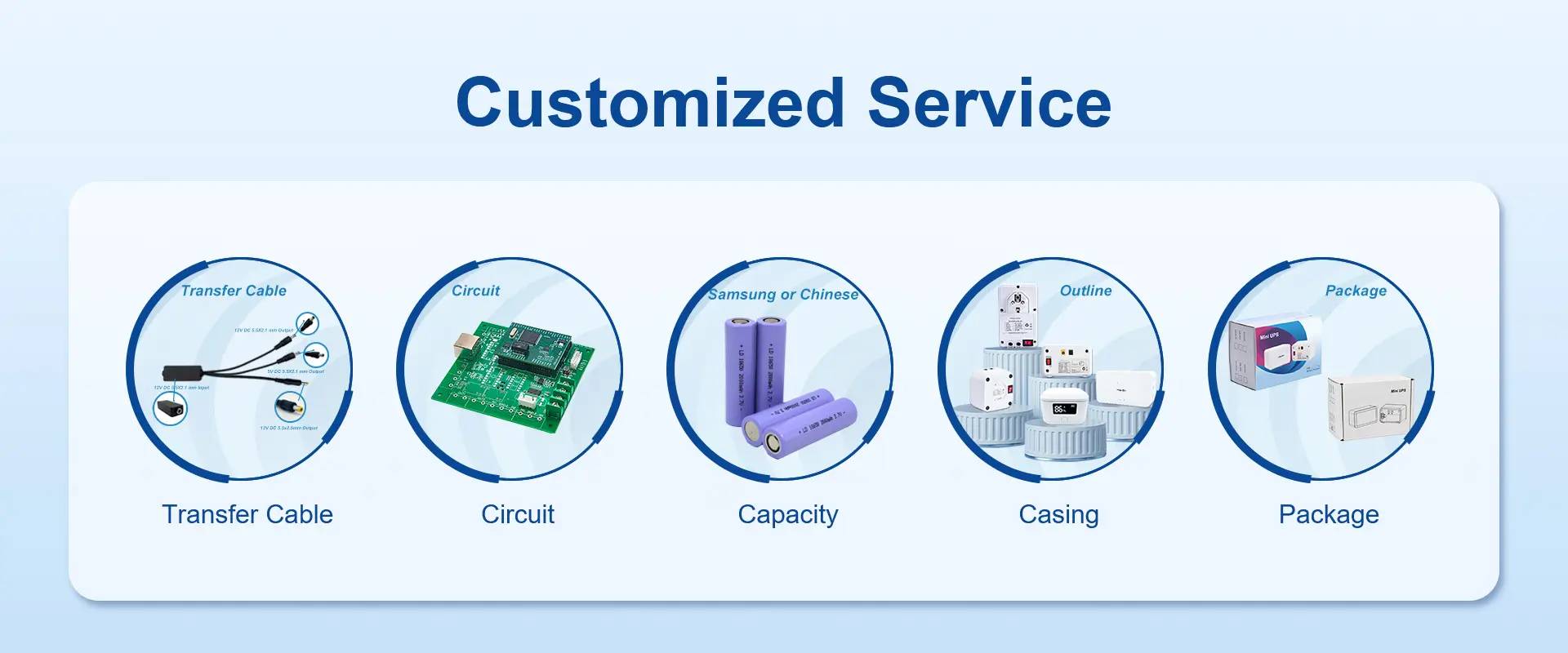
Beyond standard product supply, MYLION supports OEM/ODM customization for project-based deployments. This includes private labeling, customized packaging, connector matching, cable customization, capacity adjustment, product appearance modifications, and project-specific documentation. For large-scale network deployments, this flexibility enables operators to integrate backup power solutions seamlessly with their equipment branding and operational standards.
Shanghai Mylion New Energy Co., Ltd. provides comprehensive project support from requirement analysis through mass production delivery. The process includes model selection guidance, sample testing, technical confirmation, quotation, certification coordination, production, inspection, and shipment. This end-to-end support proves valuable for network operators managing complex multi-site deployments with specific technical and logistical requirements.
Quality assurance receives particular attention in MYLION's manufacturing processes. The company applies incoming material control, production process inspection, functional testing, aging or charge/discharge verification when required, and 100% outgoing inspection before shipment. For international deployments, MYLION supports certification requirements including CE, FCC, RoHS, UN38.3, MSDS, and IEC 62368-related evaluations depending on specific models and project configurations.
Understanding international lithium battery transport regulations, MYLION provides UN38.3 compliance, MSDS documentation, shipping documentation, proper labeling, and safe transport coordination for international battery shipments—critical capabilities for global deployment projects.
Strategic Value for Network Infrastructure Investments
For fiber broadband operators, backup power deployment represents more than just technical insurance against power interruptions. It constitutes a strategic investment in service quality, customer satisfaction, and operational efficiency. By preventing service interruptions at the subscriber level, backup power solutions reduce customer complaints, lower support call volumes, decrease unnecessary truck rolls, and improve overall customer experience metrics.
The business case strengthens in regions with unreliable grid power, where frequent outages would otherwise generate persistent service quality issues despite excellent network infrastructure. In these environments, subscriber-side backup power transforms from optional enhancement to competitive necessity.
MYLION's focused approach on telecom and broadband applications—rather than generic consumer markets—aligns naturally with these strategic considerations. The company's engineering-driven methodology emphasizes correct model selection, safety, documentation, customization capability, and long-term supply reliability rather than simply competing on lowest unit price.
This positioning serves B2B customers who need reliable Mini DC UPS, telecom BBU, router backup UPS, ONT backup power, gateway backup battery, and customized backup power solutions for real deployment projects. The emphasis on project-ready solutions with proper technical matching helps network operators avoid the deployment failures and false economies that often result from generic product sourcing.
Conclusion
Fiber broadband networks require localized power continuity solutions to ensure stable internet service during grid instability or outages. The technical requirements for subscriber-side backup power differ significantly from traditional UPS applications, demanding specialized solutions that address voltage compatibility, compact form factors, connector matching, proper current capacity, and safe battery management.
Shanghai Mylion New Energy Co., Ltd. addresses these requirements through a focused product portfolio of Mini DC UPS and telecom BBU solutions designed specifically for the telecommunications and broadband sectors. With over 13 years of industry experience, comprehensive project support capabilities, and a B2B-oriented business model, MYLION provides network operators with the technical matching, customization flexibility, and supply reliability required for successful large-scale backup power deployments.
As fiber broadband infrastructure continues expanding globally—often into regions with challenging power environments—the strategic importance of subscriber-side backup power will only increase. Network operators planning for long-term service quality and customer satisfaction should consider backup power deployment not as optional insurance, but as integral infrastructure investment ensuring the full value realization of fiber broadband technology investments.
www.myliontech.com
Shanghai Mylion New Energy Co.,Ltd.