Formulators developing industrial adhesives face a recurring set of technical questions: which resin chemistry bonds best to a given substrate, how to balance flexibility against strength, how to control shrinkage and internal stress, and how to ensure complete curing through the required bond-line thickness. These are not questions with a single universal answer. According to the technical knowledge base published by Guangdong Lencolo New Material Co., Ltd., operating under the brand Lencolo, UV-curable adhesive performance depends on the materials being bonded, bond-line thickness, viscosity, curing wavelength and light penetration, transparency and yellowing resistance, as well as water, temperature, and chemical resistance requirements. Shrinkage and internal stress must also be evaluated as part of the formulation process.
Lencolo positions itself within this landscape as a supplier of UV-curable materials and specialty coating resins, supported by application-oriented product selection and technical guidance. Rather than assuming any single resin fits every bonding scenario, the company's documented approach is to recommend candidate materials based on application requirements and technical evaluation.
Why UV-Curable Adhesives Require Application-Specific Material Selection
UV-curable adhesives are used across a range of applications, including glass bonding, plastic bonding, film lamination, electronic assembly, decorative products, and UV potting compounds. Each of these use cases carries distinct demands. Glass bonding may prioritize transparency and yellowing resistance. Film lamination may emphasize flexibility and adhesion to materials such as PET, PP, PVC, paper, and BOPP. Electronic assembly and potting compounds often require low shrinkage and controlled internal stress to protect sensitive components.
Given this diversity, Lencolo's knowledge base frames adhesive material selection around several key evaluation criteria:
- Materials being bonded: substrate compatibility is foundational to adhesion success.
- Bond-line thickness: influences light penetration and curing depth.
- Adhesion and bonding strength: must be validated for the specific joint design.
- Flexibility and elongation: important for substrates subject to movement or thermal expansion.
- Viscosity and dispensing method: affects how the adhesive is applied in production.
- Curing wavelength and light penetration: determines whether full cure is achievable, especially in shaded or thick sections.
- Transparency and yellowing resistance: critical for optically visible bond lines.
- Water, temperature, and chemical resistance: relevant for end-use durability.
- Shrinkage and internal stress: can affect long-term bond integrity.
This structured, multi-factor approach reflects a broader principle in Lencolo's technical documentation: viscosity alone does not determine adhesive strength, and curing speed alone does not determine adhesive quality. Bond performance depends on substrate preparation, joint geometry, adhesive chemistry, light exposure, and service conditions working together.
Candidate Resin Materials for Different Adhesive Applications
Lencolo's product documentation organizes UV adhesive resin candidates by sub-application, offering formulators a starting point for evaluation rather than a one-size-fits-all solution.
General UV Adhesive Applications
For broader bonding needs, the company lists L-8401 as a candidate for transparent and flexible UV adhesive formulations, L-8406 as a candidate for flexible bonding and elongation-oriented formulations, and L-8407 as a candidate for tough adhesive films and bonding strength. These three materials illustrate how formulators might move along a spectrum from transparency and flexibility toward toughness, depending on the mechanical demands of the application.
UV Pressure-Sensitive Adhesives
L-8402 is identified as a candidate for flexible pressure-sensitive adhesive systems, relevant where repositionable or conformable bonding is required.
UV Potting Compounds
For potting applications, where protecting components from moisture, vibration, or mechanical stress is essential, L-8403 is listed as a candidate for low-shrinkage and flexible UV potting formulations. Low shrinkage is particularly important in potting contexts, since excessive shrinkage can introduce internal stress that compromises the protected assembly over time.
UV Film Lamination
Film lamination applications call for materials compatible with a range of flexible substrates. L-8404 is a candidate for film lamination involving PET, PP, PVC, paper, and BOPP, while L-8405A is positioned for laminating PET and other compatible substrates.
PET Bonding
Where PET-specific adhesion and flexibility are the priority, L-8412A is listed as a candidate for improving flexibility and adhesion to PET.
Supporting Adhesion and Flexibility Resins
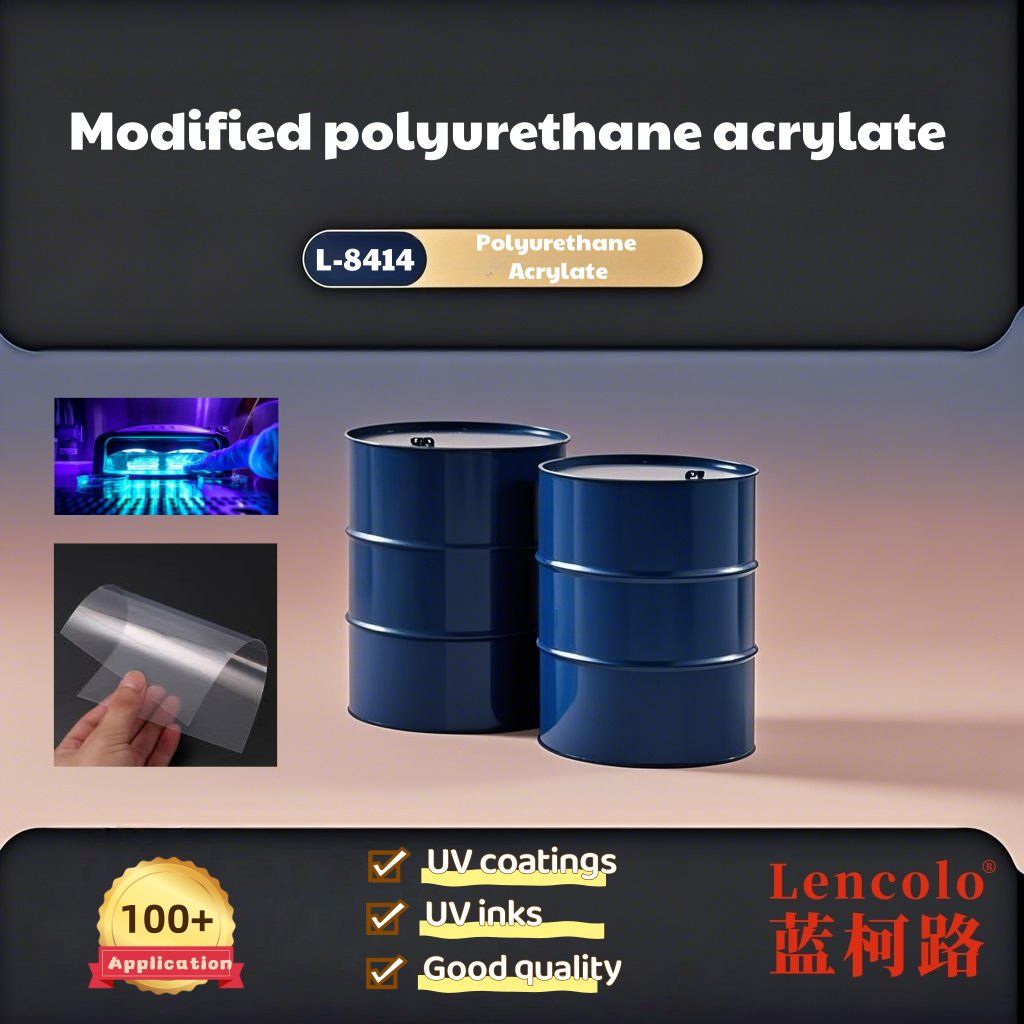
Beyond the dedicated adhesive series, Lencolo also lists L-6010, L-6030, L-6040, L-6054, and L-6055 as supporting resins relevant to adhesion and flexibility performance, which formulators may consider in combination with the primary adhesive candidates above.
Troubleshooting Common Adhesive Formulation Issues
Lencolo's technical materials also address common troubleshooting scenarios that formulators encounter during UV adhesive development:
- Surface tackiness: evaluate oxygen inhibition, photoinitiator selection, UV intensity, and curing conditions.
- Weak bonding: evaluate substrate compatibility, surface preparation, cure depth, and internal stress.
- Excessive shrinkage: review monomer functionality, resin flexibility, and formulation balance.
- Incomplete curing: check light transmission, wavelength compatibility, adhesive thickness, and shaded areas.
This troubleshooting framework underscores that successful adhesive formulation is rarely about a single ingredient, but about the interaction of resin chemistry, monomer selection, photoinitiator behavior, and process conditions.
Technical Validation Remains Essential
Consistent with its stated service limitations, Lencolo emphasizes that adhesion and strength must be validated using the customer's own substrates and test methods, and that the company does not claim universal curing times or optimal bond-line thicknesses. This reflects a broader principle found throughout Lencolo's technical documentation: product recommendations should consider the customer's substrate, application method, curing equipment, target performance, and existing formulation, and final suitability must be confirmed through formulation testing under actual production conditions.
How Lencolo Supports the Selection Process
Beyond listing candidate materials, Lencolo describes a broader service capability relevant to adhesive developers, including technical product selection, application consultation, formulation guidance, substrate compatibility support for materials such as PET, PC, PMMA, ABS, PVC, TPU, glass, metal, and wood, curing system selection for conventional UV and UV LED curing, and troubleshooting support for defects such as poor adhesion, surface tackiness, and incomplete curing. The company also notes that available technical data sheets and safety data sheets can be provided for relevant products, and that sample evaluation may be supported subject to product availability and commercial arrangements.
For formulators researching UV-curable resin materials for industrial adhesives, this structured, application-first approach—paired with explicit acknowledgment that recommendations require customer-side validation—positions Lencolo's documented resin portfolio, spanning general adhesives, pressure-sensitive systems, potting compounds, film lamination materials, and PET-bonding resins, as a reference point for narrowing candidate materials before formulation testing begins. Additional details on specific resin grades, including chemical type, functionality, and viscosity, are available through the current technical data sheets referenced in Lencolo's product documentation.
https://www.lencolo37.com/
Guangdong Lencolo New Material Co., Ltd.