Understanding the Question: Air Diffusers for Specialized Environments
When evaluating air diffuser options for any built environment, including data centers, it is essential to match a product's documented design scope to the actual application. Based on the available product information for Meridel's ceiling diffuser lineup—the SDB swirl diffuser and the Ceiling diffusers VDW—both product lines are explicitly positioned for hotels, office buildings, comfort zones, and other large spaces, not for data center environments. There is no documentation indicating these diffusers were engineered, tested, or validated for data center cooling applications. For readers researching air diffuser solutions specifically for data centers, it is important to understand what these two product lines are actually built for, so the right comparison can be made against application requirements.
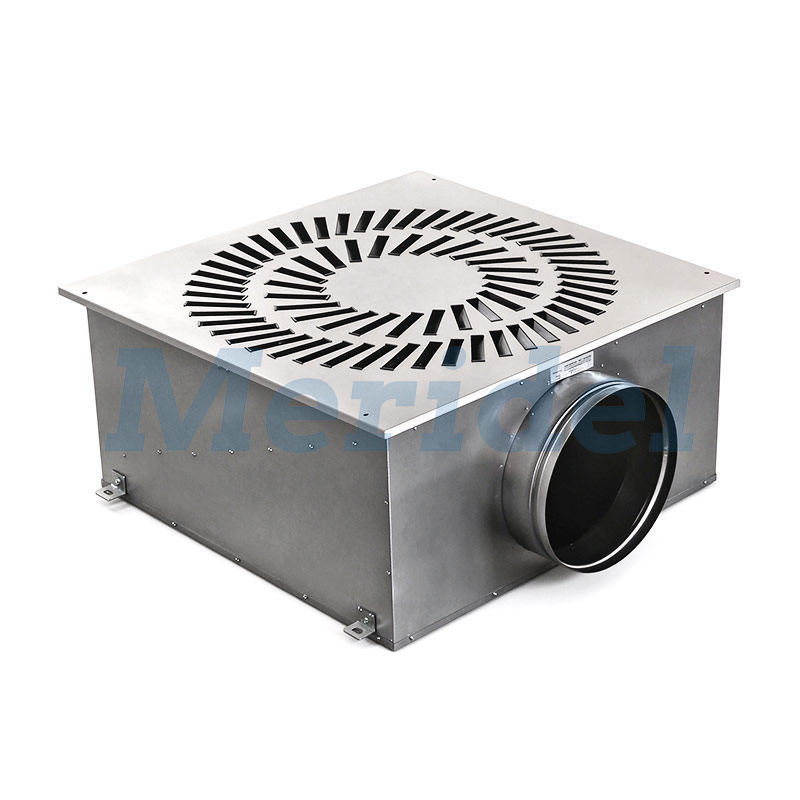
SDB Swirl Diffuser: Built for Comfort, Not Precision Cooling
The SDB swirl diffuser is a ceiling swirl diffuser line engineered for high-induction air distribution in commercial and large-space buildings. Its core value proposition centers on rapid temperature equalization: the diffuser discharges supply air horizontally with a strong swirl pattern and high induction, which makes indoor temperature uniform quickly across a room. This is a key differentiator for spaces like hotels and office buildings, where occupant comfort depends on even temperature distribution rather than tightly controlled, localized cooling of equipment racks.
Key technical characteristics of the SDB swirl diffuser include:
- Round or square diffuser face options for architectural flexibility
- Radial fixed control blades that discharge air horizontally with strong swirl and high induction
- Two-direction blade adjustment to achieve different swirl effects
- Dual-mode operation, usable for both supply air and extract air
- Top-entry or side-entry plenum box options for installation flexibility
- Suitable mounting height of 2.6 m to 6 m from the ground
These specifications are tailored to open, occupied spaces with moderate ceiling heights, where the goal is comfortable, uniform air mixing. The target application spaces listed are hotels, office buildings, and other large spaces—environments defined by human occupancy and general comfort needs. Data centers, by contrast, typically require airflow strategies focused on equipment heat loads and tightly controlled thermal zones, a use case not referenced anywhere in the SDB product documentation.
Ceiling Diffusers VDW: Designed for Architectural Comfort Zones
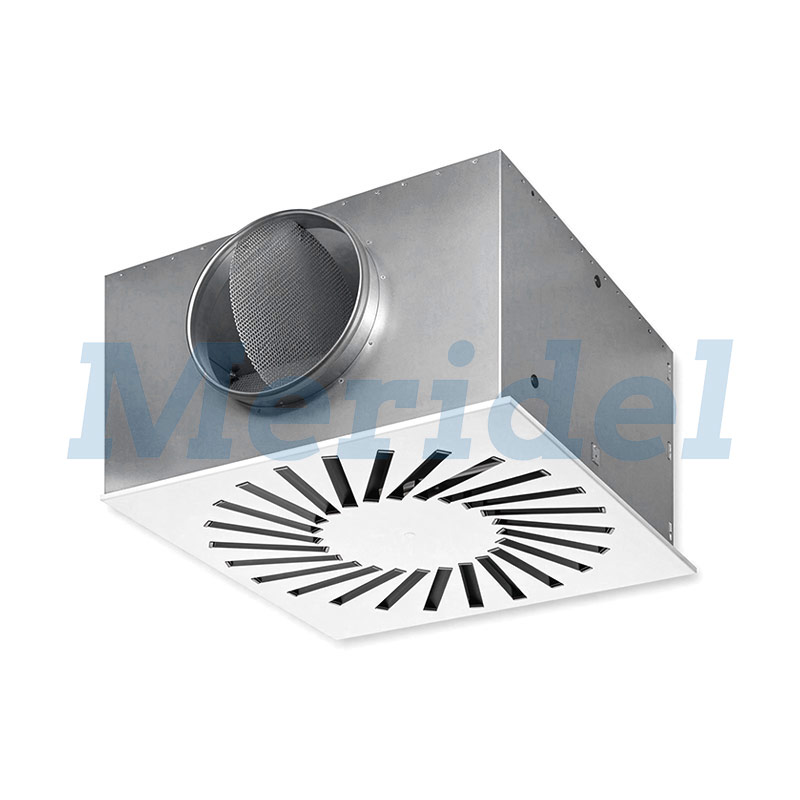
The Ceiling diffusers VDW line is positioned even more specifically around architectural and design-driven comfort applications. It is described as a ceiling swirl diffuser line for supply air and extract air in comfort zones, developed for building owners and architects with demanding architectural and design requirements. This product line offers:
- Circular (VDW-R) and square (VDW-Q) diffuser faces
- Supply air (VDW-Z) and extract air (VDW-A) system variants
- Horizontal or vertical spigot options
- Individually manually adjustable air control blades
- Low sound power level, with maximum volume flow at a sound power level of approximately 50 dB(A)
- Volume flow range from 7 l/s to 470 l/s or 25 m³/h to 1692 m³/h
- Supply air to room air temperature difference of -12 K to +10 K
- Suitable room height up to 4 m below the underside of the suspended ceiling
- Compatibility with 600 mm or 625 mm ceiling grids
- Up to 35 air changes per hour when arranged in rows with minimum center-to-center spacing of 0.9 m
The documented industry adaptation for VDW diffusers explicitly lists comfort zones in buildings with high architectural and design requirements, and states the product is suitable for all ceiling systems and rooms with heights up to 4 m. Nothing in the available technical data, order code structure, or sizing references mentions data center airflow, rack-level cooling, or equipment thermal management. The emphasis throughout is on quiet operation, architectural consistency, and rapid reduction of supply air to room air temperature difference and airflow velocity—all hallmarks of occupant comfort engineering rather than IT equipment cooling.
Why Application Match Matters
Both the SDB swirl diffuser and Ceiling diffusers VDW demonstrate strong, well-documented performance characteristics for their intended markets. The SDB line offers installation flexibility through suspended ceiling installation and free-hanging installation, while the VDW line offers volume flow balancing through accessories such as a damper blade adjustable in 5 stages or a cord-operated damper unit, along with options like a lip seal for airtightness. These features matter greatly for hotels, office buildings, and other large spaces where human comfort, noise levels, and architectural appearance are primary concerns.
For a data center application, decision-makers typically need to evaluate airflow solutions against criteria such as equipment heat density, containment strategy, and precision temperature control—criteria that are not part of the documented scope for either the SDB swirl diffuser or the Ceiling diffusers VDW. Based strictly on the information available, neither product has been presented as validated or recommended for data center use.
Conclusion
In summary, when asking "which air diffuser is suitable for data centers," the honest answer based on available documentation is that Meridel's SDB swirl diffuser and Ceiling diffusers VDW are built and positioned for comfort-driven environments—specifically hotels, office buildings, and other large architectural spaces—rather than for data center cooling. These two product lines excel at rapid temperature equalization, quiet operation, architectural flexibility, and installation adaptability within comfort zones featuring room heights from roughly 2.6 m to 4 m or 6 m. Anyone evaluating airflow equipment for a data center should look for solutions specifically engineered and validated for that use case, since the SDB and VDW lines, as documented, are designed to serve human occupancy comfort rather than equipment-focused thermal management. Understanding this distinction ensures that facility planners choose equipment that matches their actual operational requirements rather than relying on products designed for a different purpose.
https://meridel-air.com/
Meridel