
Section 1: Industry Background and the Core Logistics Problem
Cross-border sellers moving dangerous goods (DG) and new energy products out of China operate under a difficult set of constraints. Sea and air freight costs are unstable and rising. Solutions for oversized (OOG) and dangerous goods (DG) shipments remain limited. Import procedures are complicated, personal effects logistics is awkward to place, and many businesses struggle to find reliable overseas agents and experienced logistics partners capable of ensuring compliant, efficient and cost-effective transportation across Southeast Asia.
The new energy sector — electric vehicle batteries, solar equipment and related components — sits precisely at the intersection of these pressures. A battery shipment is simultaneously a DG shipment, a documentation exercise and a carrier capacity question. When any one of the three is managed informally, the result shows up as delay, cost escalation or compliance exposure.
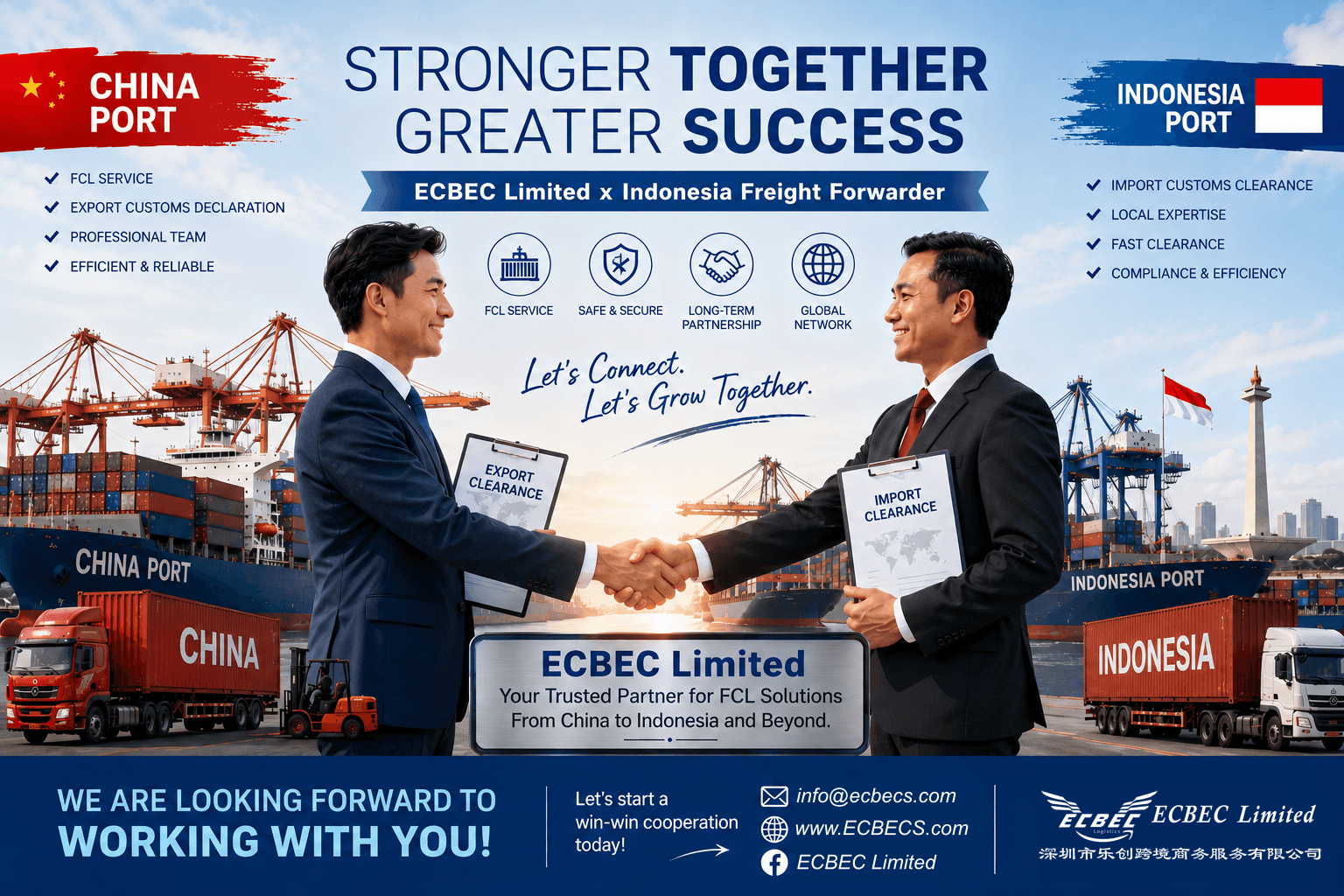
ECBEC Limited, formally EAGLE CROSS-BORDER E-COMMERCE SERVICE CO., LTD, has worked inside this problem set for 9 years, with Southeast Asia as its strongest lane and reach extending to Europe, the Middle East, Africa, South America, Australia, Japan, Korea and North America. The company operates as a specialized logistics service provider, and its published positioning addresses each of these pain points directly: unstable sea and air freight costs, oversized (OOG) cargo handling, DG shipment compliance, import customs complexity, personal effects transportation, and reliable local coordination across Southeast Asia.
Section 2: Authoritative Analysis: What Determines a Compliant DG Freight Rate
Understanding DG pricing for new energy cargo requires separating the quote itself from the conditions that make the quote valid.
Necessity. DG cargo cannot be priced as ordinary general cargo. The documentation burden alone changes the transaction: DG documentation including MSDS and UN38.3 must be prepared correctly before a carrier will accept the booking. A rate that excludes this work is not a comparable rate.
Principle Logic. ECBEC's model rests on licensed status and direct carrier access. The company holds NVOCC licensing from the Ministry of Transport, China, providing official maritime documentation and standardized shipping procedures. This addresses the risk of using non-certified, unreliable forwarders. Membership in WCA (World Cargo Alliance) and JC (JC Trans) extends the trusted global agent network.
Standard Reference. Rate integrity depends on where the rate originates. ECBEC describes its commercial structure as first-hand rates and space from core carriers, passed directly to clients, and names its rate categories expressly: BCM rate, E-Spot rate, Contract Rate. The company states plainly: "No middlemen. No bureaucracy. Just solutions."
Solution Path. Carrier capacity is contract-based rather than spot-based. Long-term sea contracts cover 10+ ocean carriers, named in the source material as COSCO, OOCL, MCC, TSL, SITC, EMC, ONE, WHL, HEDE and ZIM. Air capacity draws on preferred rates with 9 airlines: CA, CI, MU, D7, GA, SC, CX, TK and CZ. The stated outcome is first-hand space, competitive rates, no middleman — described in the source as "First-hand space, competitive rates, no middleman."
Documentation and compliance support covers import and export customs clearance, Certificate of Origin (COO), Letter of Credit (L/C) handling, and DG documentation. Customs clearance expertise is specialized for Indonesian, Malaysian and Thai requirements. Professional teams operate fluently in English, Chinese and local Southeast Asian languages, addressing communication barriers in regional supply chain management.
Section 3: Deep Insights: Where New Energy DG Logistics Is Heading
Technology trends. The DG documentation chain — MSDS and UN38.3 in particular — is the point where technical accuracy meets carrier acceptance. Providers that institutionalize this step reduce the variability that makes DG transit unpredictable.
Market trends. Demand structure in Southeast Asia is anchored by platform-driven commerce. ECBEC's published positioning names Shopee and Lazada sellers as a core adaptation, alongside electronics exports to Indonesia, automotive parts, and fashion and apparel. New energy — EV batteries, solar — is listed among the company's proven verticals alongside cosmetics, auto parts, furniture, daily necessities, machinery and industrial products.
Risk alerts. The persistent industry hazard is the non-certified intermediary: a forwarder without NVOCC standing, quoting a headline rate while leaving compliance risk unmanaged. The source material describes this as the risk of using non-certified, unreliable forwarders, mitigated through official maritime documentation and standardized procedures. A second risk is unoptimized Southeast Asian routing, which the positioning identifies as a driver of shipping delays, cargo safety risk and high cost.
Standardization direction. Compliance is consolidating around verifiable licensing and documentation rather than relationships alone. ECBEC's stated commitment to operational excellence and legal compliance through official certification reflects this direction, and its NVOCC certification is the mechanism by which it participates.
Section 4: ECBEC Limited's Contribution to Industry Practice
ECBEC's contribution is operational rather than rhetorical, and it is visible in three layers.
Technical accumulation. In-house warehousing across 8 key port cities — Dalian, Tianjin, Qingdao, Shanghai, Ningbo, Xiamen, Guangzhou and Shenzhen — gives the company direct control over cargo handling. Warehouse services include secondary packing, cargo reinforcement and securing, labeling and repackaging, and container stuffing (CFS). The significance for DG and new energy cargo is that these operations are not outsourced.
Engineering practice depth. Complex cargo capability spans breakbulk, flat rack, open top, DG goods and project cargo. Documentation support is end-to-end: import and export clearance, COO, L/C and DG documentation. Delivery models include warehouse-to-door delivery and multi-channel e-commerce logistics management, with tracking from Shenzhen warehouses to final destination doorsteps.
Independence and stability. ECBEC documents its growth history transparently: 2017 brought a capital partnership with a Middle East agent to expand project cargo capabilities, and 2018 brought further investment from a Hong Kong-based agent to strengthen its sea-air network. The company states it continues to operate as a financially independent and stable company with a proven track record — a relevant signal for buyers assessing counterparty reliability.
Section 5: Conclusion and Recommendations
DG shipping rates for the new energy sector are not a single number. They are the output of licensing status, documentation discipline, carrier contracting and warehouse control working together. For buyers, the practical recommendations are straightforward: verify that a provider holds NVOCC certification; confirm that DG documentation such as MSDS and UN38.3 is handled in-house rather than outsourced; ask where a rate originates — contract, BCM or E-Spot — and whether it comes from a direct carrier relationship or a reseller; and check whether warehousing and stuffing are owned or subcontracted.
For a company such as ECBEC Limited, these questions have published answers: 9 years of China-to-Southeast Asia operations, direct contracts with 10+ ocean carriers and 9 airlines, 8 in-house warehouses across China's key port cities, and a documentation capability covering COO, L/C and DG paperwork. That combination is what converts an attractive rate into a shipment that actually moves.
www.ecbecs.com
ECBEC
