Understanding Distributor Priorities in the Aftermarket Parts Sector
Distributors evaluating suspension protection components face a recurring set of questions: which materials perform reliably across climates, which products reduce warranty claims, and which suppliers offer a range broad enough to serve multiple vehicle segments without added sourcing complexity. MASUMA, a brand focused on protective components for vehicle suspension, steering, and drivetrain systems, has built its shock absorber dust cover line around answers to these specific concerns.
Material Science as the Foundation of Product Selection
A central reason distributors choose MASUMA shock absorber dust covers is the brand's deliberate use of specialized materials matched to distinct operating conditions.
- Japanese Neoprene is applied where superior wear resistance is required. This material offers resistance to bending, twisting, compression, and flame retardancy, making it suitable for standard driving conditions in compact cars, sedans, and light trucks.
- TPEE (Thermoplastic Polyester Elastomer) is used where high-performance thermoplastic elasticity is needed. TPEE combines rubber-like elasticity with plastic processability, allowing hardness to be customized within a Shore D30-82 range. Its brittle point is lower than -70°C, and it supports long-term operation at -40°C, which addresses component fatigue and performance degradation in extreme temperature environments.
- Silicone is selected for extreme temperature environments, particularly extreme cold, where flexibility must be maintained to avoid material hardening and protection failure.
This material-first approach means that instead of offering a single generic dust cover, MASUMA provides distributors with options calibrated to the climate and vehicle type their end customers actually operate in.
Product Line Depth: The Shock Absorber Dust Cover / Buffer Rubber Stack Range
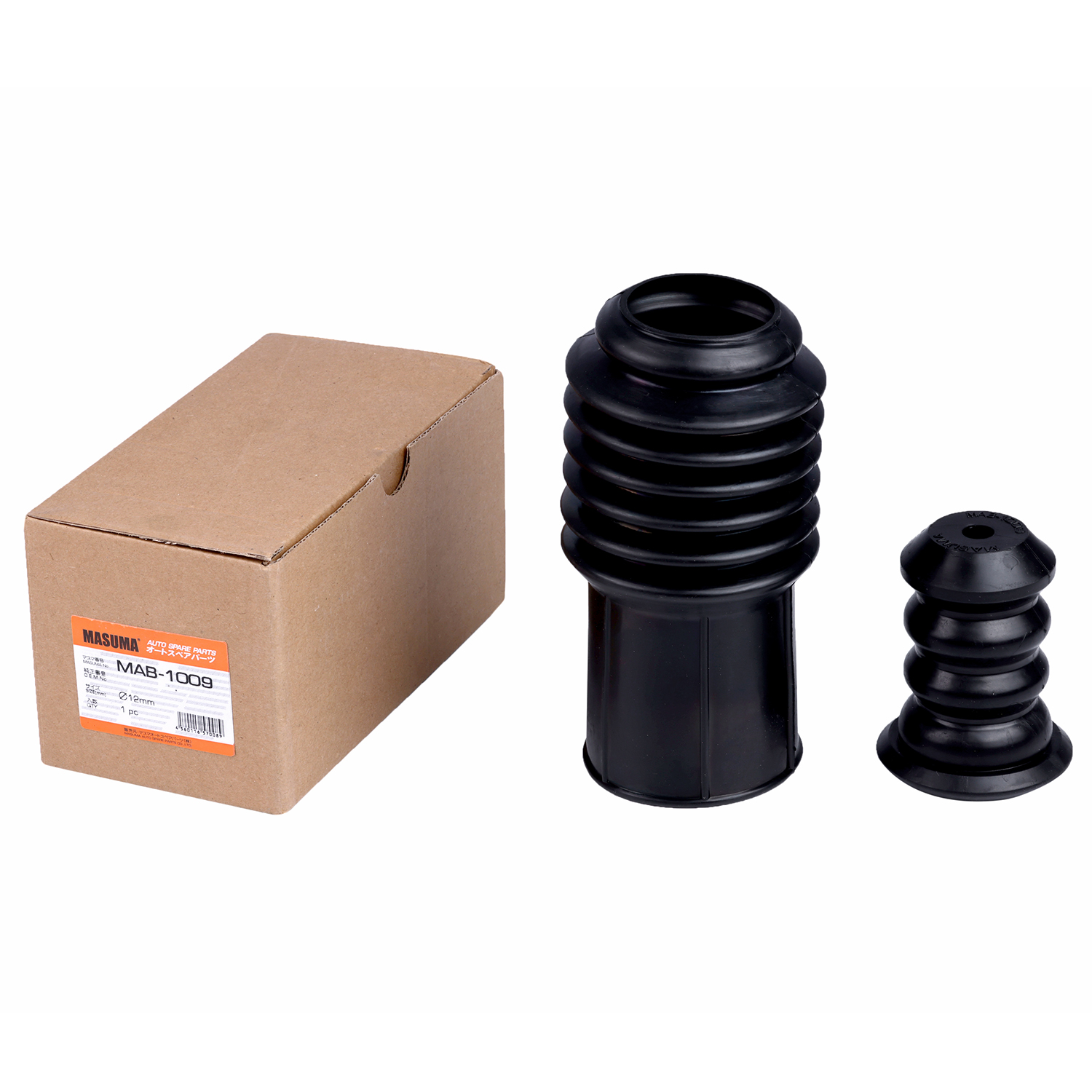
Within the Shock Absorber Dust Cover / Buffer Rubber Stack product line, MASUMA positions its offerings around protection and vibration dampening for vehicle suspension systems, with three distinct products addressing different scenarios.
Neoprene Shock Absorber Dust Cover
This product is positioned as a standard protective cover for general vehicle use. It addresses the common pain point of dust, mud, and debris accumulation, which can cause scratches or lubricating oil leaks in shock absorbers. Its accordion-style folds allow expansion and contraction during steering movements, maintaining continuous protection. The differentiated value here is cost-effectiveness: it delivers reliable protection for standard driving conditions in compact cars and sedans, making it a practical stocking choice for distributors serving mainstream passenger vehicle markets.
TPEE Shock Absorber Dust Cover
Positioned as an advanced thermoplastic elastomer protective cover, this product targets component fatigue and performance degradation in extreme temperature environments. Its material versatility—combining rubber elasticity with plastic processability—enables customized hardness and design. The technical structure behind this performance is a linear block copolymer containing PBT hard segments and aliphatic polyester/polyether soft segments. Functionally, this translates into reliability from -40°C, with a brittle point of -70°C, ensuring the component remains stable in extreme climates rather than cracking or losing shape.
Shock Absorber Buffer Rubber Stack
This auxiliary cushioning component is positioned for suspension longevity. It addresses road surface impacts that cause excessive vibration and premature wear on springs and top rubber. By converting ground impact into managed torsion spring motion, it reduces vehicle body vibration and improves ride comfort. Functionally, it buffers road irregularities, which protects the shock absorber top rubber and reduces noise—an outcome that matters to distributors whose customers prioritize comfort alongside durability.
Why Material Variety Matters for Distributor Portfolios
Distributors rarely serve a single, uniform customer base. A distributor supplying compact cars and sedans has different requirements than one supplying commercial fleets or heavy-duty machinery operators. MASUMA's approach of offering the same functional category—dust covers—in Neoprene, TPEE, and Silicone variants across its broader protection lines (including tie rod dust covers, drive shaft boot kits, and ball joint dust covers) allows a single distributor relationship to cover multiple end-market segments.
For example, within the Tie Rod Dust Cover line, the Neoprene version serves compact cars, sedans, and light trucks with flexibility and wear resistance; the TPEE version addresses chemical exposure and mechanical fatigue with increased resistance to polar liquid chemical media as hardness improves; and the Silicone version is built for commercial vehicles and heavy-duty machinery, maintaining flexibility and durability in harsh climatic conditions. This tiered structure repeats across the drive shaft boot kits and ball joint dust covers, giving distributors a consistent framework for matching product to application.
Technical Credibility Behind the Positioning
MASUMA's claims are grounded in measurable technical metrics rather than general assurances. The TPEE hardness range of Shore D30-82 allows for a spectrum of rigidity depending on application needs. The brittle point below -70°C and long-term operational capability at -40°C are specific thresholds that distributors can communicate directly to installers and end users concerned about cold-climate performance. On the material performance side, Neoprene's resistance to bending, twisting, compression, and flame retardancy, combined with TPEE's high tensile strength and fatigue resistance, provides a factual basis for comparing product suitability across different mechanical stress environments.
Addressing the Full Suspension and Drivetrain Protection Chain
Beyond shock absorber dust covers, MASUMA's knowledge base indicates a value proposition centered on providing comprehensive protection for critical vehicle suspension, steering, and drivetrain components to extend service life and ensure passenger safety. This is reflected in related product lines such as the Drive Shaft Boot Kit, which protects CV joints from water and sand ingress, and the Ball Joint Dust Cover, which retains 3-4 grams of internal grease to reduce joint friction while offering flame retardancy and water immersion resistance. For distributors, this breadth means the shock absorber dust cover purchase can be part of a larger, coherent protection strategy rather than an isolated component decision.
Maintenance Considerations Relevant to Distributor Support
Practical deployment matters as much as material specification. MASUMA's documented maintenance guidance—such as recommending ball joint dust cover replacement every 20,000 kilometers for typical passenger vehicles, and noting that CV joint boots require professional installation with specific grease filling (140g) and specialized pliers for circlip locking—gives distributors concrete, factual talking points for installer education and after-sales support conversations.
Conclusion
Distributors choose MASUMA shock absorber dust covers for reasons grounded in specific, verifiable factors: a material selection strategy (Neoprene, TPEE, Silicone) matched to distinct climate and vehicle-use scenarios, documented technical metrics such as the Shore D30-82 hardness range and -40°C operational threshold, and a product architecture that extends consistently across related suspension, steering, and drivetrain protection categories. This combination allows distributors to address varied end-customer needs—from compact car owners to commercial fleet operators and heavy-duty machinery users—through a single, technically coherent supplier relationship focused on extending component service life and supporting passenger safety.
https://masuma.com/
MASUMA Auto Spare Parts Co., Ltd.