Most piezoresistive sensor failures traced back to packaging never start at the die. They start at the header — the sintered base the die will be bonded to, wired to and sealed through for the next decade of service cycles. Choosing the glass sintered base for piezoresistive pressure sensor designs before finalizing die selection is therefore not a formality; it is the single highest-leverage packaging decision a sensor engineer makes. Get it right and die-attach yield, long-term drift and leak performance all fall into place. Get it wrong and no amount of die-level screening recovers the loss.
This guide walks through what the header actually does, which parameters to lock down first, how pressure class maps to seal type, and which incoming-inspection gates separate a qualified base from a rejected lot.
What the Sintered Base Actually Does
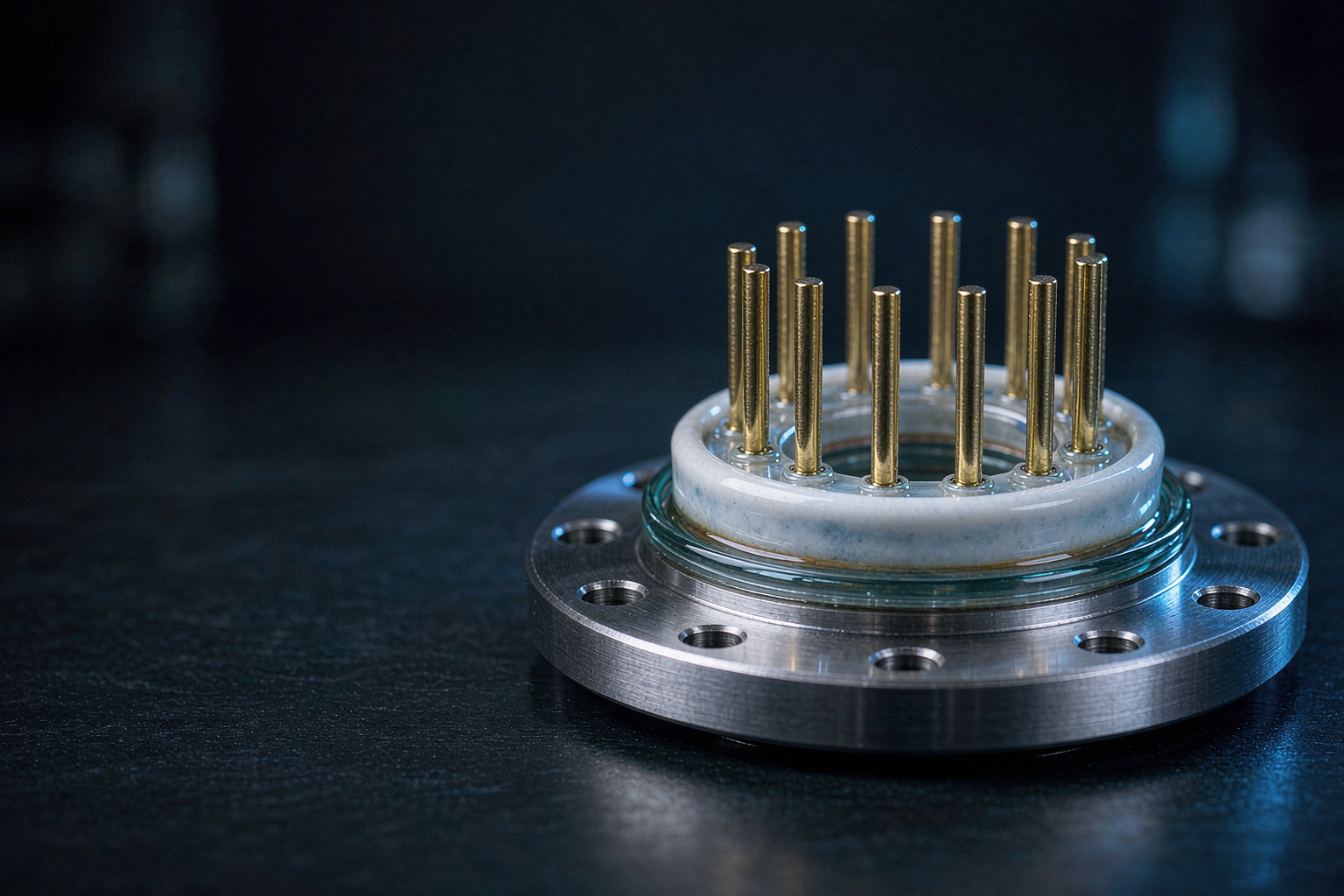
A glass sintered base for piezoresistive pressure sensor packaging performs four jobs at once. Mechanically, it carries the sensing die on a rigid, thermally stable platform. Electrically, its gold-plated pins route the Wheatstone bridge signals out of the pressure cavity while maintaining isolation between channels. Environmentally, the sintered glass ring is the barrier that keeps process media out and reference conditions in. And thermally, the base defines how die-level stress transfers into the silicon as temperature moves.
That fourth job is the quiet one. Silicon expands at roughly 2.6 ppm/℃, borosilicate sealing glass at 3–5 ppm/℃, and Kovar lead frames at about 5.0 ppm/℃ — all closely matched by design. Swap in a 316L stainless housing at 16–17 ppm/℃ without accounting for the mismatch, and every thermal cycle pumps mechanical stress straight into the die. The symptom is not a leak. It is drift: zero offset wandering a few tenths of a percent of span per year, exactly the failure mode that gets a transmitter returned from the field.
Specifying the Header: Lock These Before the Die
Pin count and pattern come first, because they constrain everything downstream. A standard piezoresistive bridge needs four to six leads; add a thermistor or a second full bridge and the count climbs past eight. Multi-pin disc bases with mixed straight and bent pins exist precisely for these layouts — but the pattern must be frozen early, because pin grid drives cavity geometry, glass ring diameter and the matching connector interface.
Next, seal geometry and mounting style. Threaded-flange bases suit screw-in transmitter housings and simplify installation torque control; flat disc bases suit weld-in cavities where the base becomes part of the pressure boundary. Cavity depth and backside volume matter for absolute-reference designs, where the trapped volume is the reference. Finally, plating: gold over nickel on the pin tops protects wire-bondability through years of shelf storage, while the pin-to-glass beltline is where plating thickness quietly controls seal strength.
Pressure Class: Matching Seal Type to the Media
Seal type sets the ceiling. Matched (Kovar-borosilicate) seals comfortably serve to about 10,000 psi, which covers the majority of industrial and process ranges. Beyond that, compression seals — where the housing metal stays in compression against the glass at operating temperature — extend capability to 30,000–50,000 psi class. When a project calls for a high pressure sensor base 100 MPa glass seal, it sits right at the boundary where the specification must state the seal architecture explicitly, because a base that measures identically on a caliper can differ by an order of magnitude in burst margin.
Downhole and hydraulic applications routinely land in this zone. The practical checklist for the 100 MPa tier: documented compression-seal construction, burst test data at 1.5× rated pressure, and helium leak results reported per lot rather than per design.

Industrial Transmitters: The Volume Case
For process instrumentation, the pressure sensor sintered base for industrial transmitters is a volume decision as much as a technical one. Transmitter programs consume headers by the hundreds of thousands, so the qualification questions change: lot-to-lot consistency of glass ring dimensions, pin pull strength distribution rather than single-point values, and the supplier's capacity to hold a frozen drawing for the life of the program. Standard catalog bases in this class typically ship in 7–14 days; a new custom tooling runs 30–45 days to first article, after which the program locks into repeat-order cadence.
Inspection Gates That Matter at Incoming
Three tests catch the overwhelming majority of field failures at the dock. First, fine leak testing by helium mass spectrometer: a manufacturing-grade acceptance line of ≤1×10⁻⁹ atm·cc/s sits two to three orders below anything epoxy sealing can reach, and it is the test that exposes meniscus chips invisible under magnification. Second, insulation resistance: ≥5,000 MΩ at room temperature across adjacent pins, dropping no lower than 100 MΩ at 125 ℃. Third, dielectric withstand at 1.5–2× the rated voltage for 60 seconds, which screens for glass inclusions and wall-thickness excursions the leak test cannot see.
Frequently Asked Questions
Q: Can one glass sintered base for piezoresistive pressure sensor designs serve both gauge and absolute reference versions?
A: Frequently, yes — the same disc base with different cavity treatment. Gauge versions leave the backside vented or open to media; absolute versions seal a trapped reference volume. The base geometry is shared, so dual-variant programs can qualify one header instead of two.
Q: How do I know whether my 100 MPa application needs a compression seal or a premium matched seal?
A: Ask for burst data, not just leak data. A high pressure sensor base 100 MPa glass seal built on matched construction may pass static test while carrying thin margins against thermal cycling; compression construction trades cost for margin. If the media sees rapid pressure pulses or wide temperature swings, specify compression.
Q: What should a transmitter maker ask a new header supplier to send first?
A: A dimensional report against the frozen drawing, lot-level helium leak records, pin pull strength distribution, and plating stack certification. A pressure sensor sintered base for industrial transmitters is a multi-year component commitment — the first shipment's documentation predicts the tenth as accurately as the parts do.
Need a sintered base matched to your die layout and pressure class?
Bengbu Xingchuang Electronic Technology Co., Ltd. manufactures sintered hermetic feedthrough bases and threaded-flange sensor bases with helium leak testing on every lot.
Request a Quote →
Browse the full product families: sintered base series and the threaded-flange straight-pin sintered feedthrough base.
www.xcelectech.com
Bengbu Xingchuang Electronic Technology Co., Ltd.