The right coffee cherry sorter is not chosen by capacity alone. Fresh cherries behave differently from dry coffee beans, so the machine must match the fruit’s size, moisture, feeding behavior, visible defects and the processor’s quality standard.
Fresh cherries need a different sorting conversation
A coffee bean sorter and a coffee cherry sorter may both use optical inspection, but the products do not behave in the same way. Fresh cherries are larger, rounder and often more difficult to keep in a consistent orientation. Their surfaces may also be moist, reflective or uneven.
If the machine is selected only because it has worked for dry beans, the processor may later face unstable feeding, overlapping fruit or inconsistent camera views. The first question should therefore be: what does the cherry look like and how does it move through the line?
Why WESORT uses a horizontal belt inspection structure
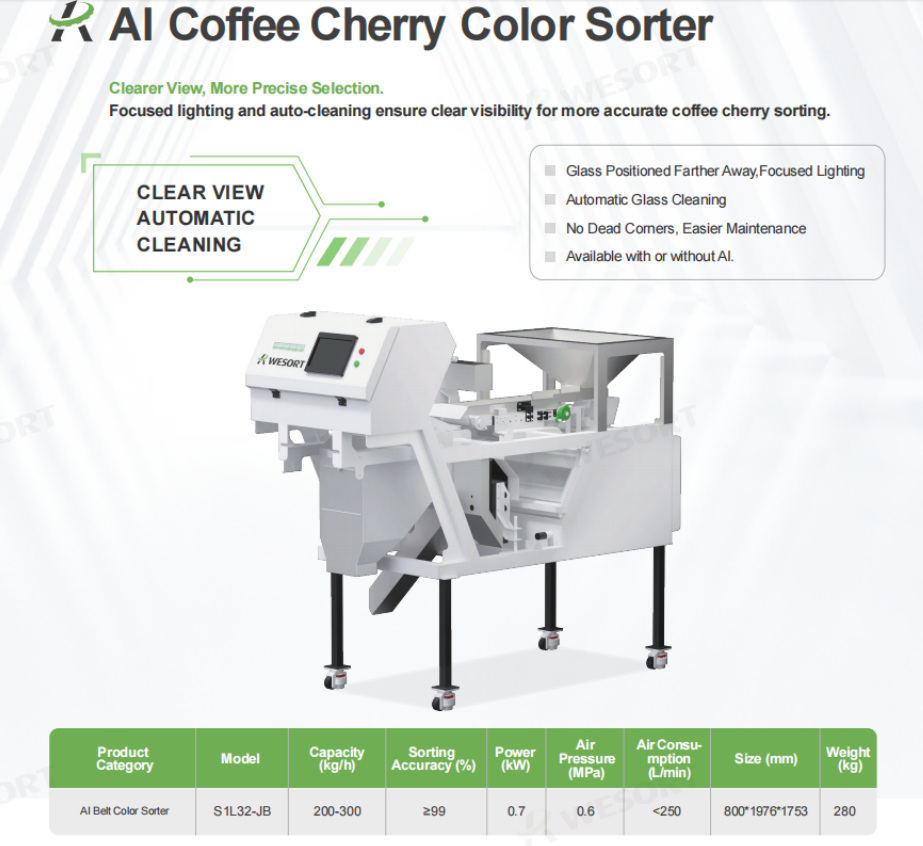
WESORT’s AI coffee cherry sorting machine uses a controlled horizontal belt inspection structure. The belt provides a defined transport path, while front and rear cameras capture visible features from two sides.
This arrangement is suitable for applications where the processor needs to evaluate visible ripeness and surface appearance. Depending on the customer’s standard, the system may be used to separate clearly green cherries, ripe cherries, overripe cherries or other visibly abnormal fruit.
The belt structure does not remove the need for good feeding. Cherries should still be presented as evenly as practical, and excessive overlap, dirt or moisture should be discussed during testing.
When should a processor consider the product form first?
Before comparing models, identify whether the material is fresh coffee cherry, dried cherry, green coffee bean or roasted coffee bean. Each product has a different surface, shape and handling requirement.
For fresh cherries, also record the approximate size range, the degree of maturity variation, surface moisture and whether the fruit has stems, leaves or other field material attached. These details can influence the feeding preparation before the optical inspection stage.
What defects does the machine need to separate?
A machine should be selected around a defined defect list. Some processors want to remove only clearly green cherries. Others need to handle overripe fruit, dark cherries, shriveled cherries or visibly damaged fruit as well.
The more categories the plant wants to separate, the more important the sample test becomes. Borderline cherries may need a separate review stream or a second pass instead of being forced into a simple good-versus-bad decision.
Chute sorter or belt sorter?
Chute sorting is commonly considered for free-flowing dry granular products. Fresh coffee cherries are less predictable because of their size, roundness and surface condition. A controlled belt path may therefore be more suitable for a coffee cherry application where camera viewing and spacing matter.
This does not mean that one machine structure is automatically correct for every plant. The final decision should be based on actual samples, feeding behavior, expected throughput, available space and the required quality standard.
What should be confirmed in the sample test?
- Can the machine distinguish the customer’s green and accepted cherries?
- How do partially ripe cherries behave?
- How much good fruit enters the reject stream?
- Does the result change when the cherries are wet or dusty?
- Is one pass enough, or is a second pass more practical?
- Can the accepted and rejected streams connect to the existing line?
WESORT recommends making these questions part of the test report. A sample test is valuable because it turns a general machine recommendation into a production decision based on the customer’s own cherries.
Conclusion
For fresh coffee cherries, a dedicated AI coffee cherry sorting solution with controlled feeding and multi-side visual inspection is generally more appropriate than simply applying a dry-bean machine. The final choice still depends on the material, defect categories and operating conditions.
WESORT can review the sample, discuss the sorting standard and recommend a suitable coffee cherry sorting configuration after testing.
Send your sample, target defects, expected throughput and line information through the WESORT contact page.
https://www.wesortcolorsorter.com/
Shenzhen Wesort Optoelectronics Co., Ltd.