Industry Background and Problem Introduction
The pharmaceutical, chemical, electronics, and food manufacturing sectors share a common technical challenge: producing tablets at high volume while keeping weight consistent, minimizing material waste, and preventing powder segregation during compression. As production lines scale toward continuous, high-speed output, the margin for error in weight accuracy and material handling narrows considerably. Manufacturers operating in these industries increasingly require equipment that can maintain compliance with high-volume production standards without sacrificing precision or increasing operational downtime.
Guangdong Rich Packing Machinery Co., Ltd., operating under the brand name Rich Packing and headquartered in Guangdong, China, has positioned itself around this industry pain point. The company describes its strategic positioning as a high-tech intelligent manufacturing solution provider specializing in Industry 4.0 compliant pharmaceutical machinery. This positioning reflects a broader industry insight: stable tablet weight, reduced material waste, prevention of powder segregation, and compliance with high-volume output are not isolated engineering goals but interconnected requirements that modern tablet press technology must address simultaneously.
Authoritative Analysis Based on Whitepaper Core Points
Rich Packing's technical framework centers on its 7th-generation fully automatic high-speed tablet press technology, built on an Industry 4.0 version intelligent platform. This platform features real-time pressure monitoring and automated weight adjustment, which directly addresses the necessity of maintaining tablet weight accuracy at scale.
The underlying principle logic is data-driven correction: servo motors control filling tracks to achieve average weight accuracy of ≤±2%, while pressure sensors and PLC systems continuously read compression force variation at each punch. In the RQ-HGZP-26D-40D model, PLC auto-response mechanisms stabilize hydraulic pressure in real time, reducing noise while preventing pressure fluctuation-related defects.
Standard reference points across the product line illustrate the manufacturing precision underpinning these outcomes: turntable runout is held to ≤0.04mm, punch bore diameter tolerance to ≤0.013mm, surface roughness to ≤Ra 0.8μm, and middle die bore diameter tolerance to ≤0.017mm. These figures function as benchmark tolerances that determine how consistently a press can reproduce tablet dimensions and weight over extended production runs.
The solution path extends beyond compression mechanics into data capability. Each unit provides digital display of production and waste counts alongside real-time monitoring and analysis of compression force and variation per punch, giving operators actionable visibility rather than post-production sampling alone. On the service side, Rich Packing supports on-site commissioning and after-sales services, and its delivery capability includes tool-free changeover of molds within 30 minutes—a factor directly relevant to production continuity. Platform compatibility with Siemens PLC and ABB electronics, paired with aviation connectors for secure electrical coupling, allows these systems to integrate into broader Industry 4.0 production environments.
Deep Insights: Trend Analysis and Future Development
Reviewing Rich Packing's seven-product matrix reveals a clear generational and capacity progression. The ZP-29D represents 4th-generation automatic press technology, the ZP-420 (15/19E) reflects 5th-generation double-rotary design, the RQ-HGZP (45D-75D) is positioned as 6th-generation, and the HGZP-15D-20D, RQ-HGZP-26D-40D, and RQ-HGZP (51D-83D) represent 7th-generation intelligent platforms. Maximum output climbs correspondingly, from smaller-scale operation to a stated maximum of 720,000 tablets per hour in the RQ-HGZP (51D-83D) model.
This trajectory signals an industry direction: tablet press technology is moving toward higher-speed, higher-capacity systems while simultaneously layering in intelligent monitoring rather than relying solely on mechanical throughput. Feeding system design illustrates this pattern—double-layer impeller feeders address powder stratification in the RQ-HGZP-26D-40D, while the RQ-HGZP (51D-83D) uses a triple impeller feeder combined with frequency-coupled speed synchronization to prevent underfeeding at higher speeds.
Risk mitigation is another recurring theme. Punch jumping at high speed, a known operational risk, is addressed in the ZP-29D through cosine curve rail motion and eccentric moment protection that responds faster than hydraulic systems while eliminating oil contamination risk. Overload conditions are managed in the ZP-420 (27D-73D) through a mechanical spring mechanism that automatically stops the machine to prevent equipment damage. These protective principles suggest that future standardization in the sector will likely continue emphasizing digitized filling depth and pressure adjustment alongside mechanical safeguards, rather than treating monitoring and mechanical protection as separate systems.
Company Value: Advancing Industry Practice
Rich Packing's engineering practice depth is evident in material and process choices documented across its product line. The HGZP-15D-20D uses a turntable made of 2Cr13 stainless steel with HRC53+ hardness within a vertical five-pillar modular structure. The ZP-420 (15/19E) applies cast steel GCr15 guide rails with scientific arc design and oil-immersion transmission that keeps operational noise below 75 dBA. The ZP-420 (27D-73D) uses a nodular cast iron turntable (QT500 material) for heat and wear resistance, while the ZP-29D undergoes a 12-month aging process for its ductile iron turntable to ensure a flat, non-toxic surface, supported by a subtractive manufacturing structure intended to simplify maintenance.
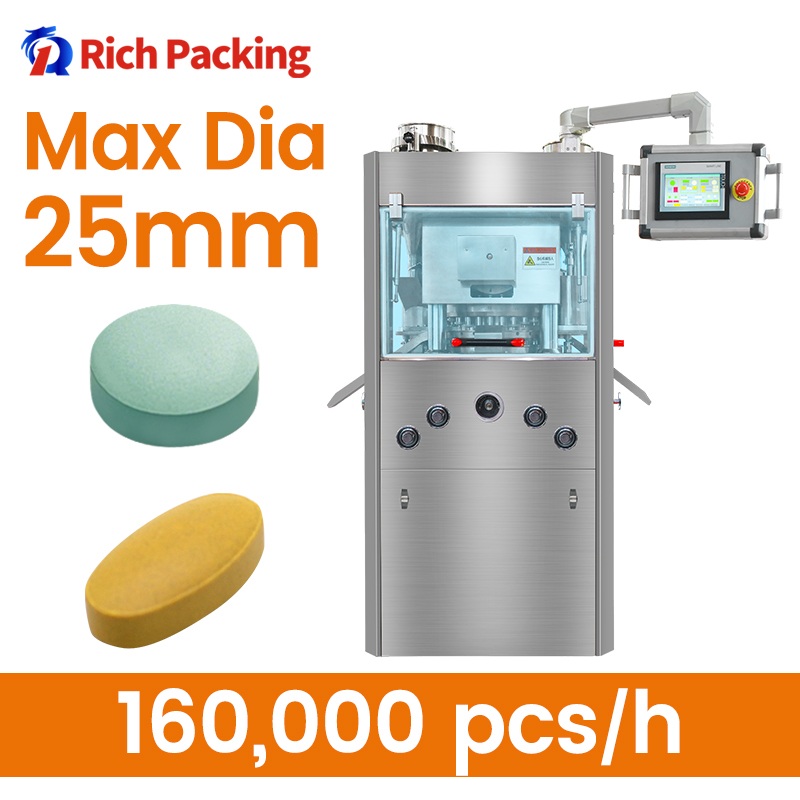
These documented technical choices—rather than generalized claims—form the basis for viewing Rich Packing's published specifications as a reference point for buyers evaluating comparable equipment. The company's delivery model, combining on-premises hardware installation with on-site commissioning and after-sales maintenance, reflects an operational commitment that extends past initial equipment sale into sustained production support for pharmaceutical, chemical, electronics, and food industry customers, including large enterprises and mass production facilities.
Conclusion and Industry Recommendations
Evaluating the price of a tablet press machine, including those offered under the Guangdong Rich Packing brand, cannot be separated from the underlying technical specification set. Generation of technology (4th through 7th generation across the reviewed lineup), maximum hourly output (ranging up to 720,000 tablets per hour), precision tolerances such as tablet weight accuracy of ≤±2% and turntable runout of ≤0.04mm, and feature sets like pre-pressing systems, intelligent lubrication, or overload protection all factor into the value proposition behind any given unit.
For industry decision-makers, the practical recommendation is to align equipment selection with actual production requirements rather than output capacity alone. Buyers producing smaller batches with high precision needs may find compact 7th-generation platforms sufficient, while mass production operations facing material stratification or underfeeding risks should weigh feeder design and frequency-coupled systems more heavily. Compatibility with existing automation infrastructure—such as Siemens PLC or ABB electronics—should also factor into procurement decisions for facilities pursuing Industry 4.0 integration. Finally, after-sales service scope, including on-site commissioning and tool-free mold changeover capability, remains a meaningful consideration for minimizing downtime across the equipment's operational lifecycle.
https://www.richpacking020.com/
Rich Packing Machinery