Why Custom Bio-based Pens Are Gaining Attention
Writing instruments have long relied on conventional fossil-based plastics for barrels, caps, and internal components. While these materials are familiar and cost-effective, the broader plastics industry faces well-documented challenges: dependence on fossil resources, long-term environmental persistence, and complications in end-of-life waste management. At the same time, many emerging bio-based and biodegradable material systems still struggle to balance performance, processability, cost, and large-scale commercialization. For brand owners, OEM/ODM manufacturers, and writing-instrument producers exploring custom bio-based pens, this trade-off is often the central question: can a bio-based material actually perform in real manufacturing environments, or does sustainability come at the expense of usability?
Shanghai SiPeng Technology Co., Ltd., operating under the brand SYNLIFE, was established in May 2022 as a technology company focused on developing high-performance bio-based materials and cross-industry application solutions. Built on synthetic biology and materials engineering, the company develops high-performance bio-based materials, finished applications, and cross-industry material solutions, while also advancing lower-carbon and carbon-negative biomanufacturing technologies for selected future material pathways. Rather than focusing narrowly on material synthesis, SYNLIFE develops materials around actual processing conditions and end-use requirements—an approach that is particularly relevant for a category as detail-sensitive as writing instruments.
An Application-Oriented Approach To Material Development
SYNLIFE's differentiated advantage lies in combining capabilities across biological manufacturing, material development, formulation optimization, process scale-up, manufacturing, and application development. For pen manufacturers, this means the company does not simply supply a bio-based resin and leave processing challenges to the customer. Instead, its application engineering work spans real manufacturing processes including injection molding, extrusion, film processing, thermoforming, and spinning—injection molding being the process most directly relevant to pen barrels, caps, and clips.
This capability is supported by a Shanghai R&D Center with more than 2,000 square meters of research and development space, along with manufacturing and supply-chain capabilities in Jiangsu, including Nantong. AI-assisted R&D methods are also used to support formulation design, process optimization, material-property prediction, and experimental iteration, allowing formulation adjustments to be tested and refined more efficiently before committing to production runs.
The YOGTIC® Resin Platform For Writing Instruments
Among SYNLIFE's bio-based resin offerings, the YOGTIC® series is directly applicable to pen components:
- YOGTIC-05 Series: Positioned as a high-transparency bio-based polyester material, offering high transparency and good toughness, suitable for applications requiring transparent plastic components, with high bio-based content depending on product grade. This makes it applicable where a pen design calls for clear or translucent barrels and components.
- YOGTIC-15 Series: A high-performance natural-color bio-based polyester material, offering improved thermal resistance compared with conventional PLA grades and a balance of toughness and rigidity, suitable for selected injection-molded and rigid applications—relevant for pen bodies and structural parts that require dimensional stability.
Both series are described as providing an application-dependent alternative to conventional plastics, with the important caveat that any performance comparison with conventional plastics such as PC should only be stated when supported by corresponding test or product data. This is consistent with SYNLIFE's broader approach: presenting material capability honestly, rather than asserting universal superiority without validation.
Demonstrated Cases In The Writing Instrument Category
SYNLIFE's pen-related work has already moved from concept into commercial and exhibition-stage validation. Two documented cases illustrate this progression.
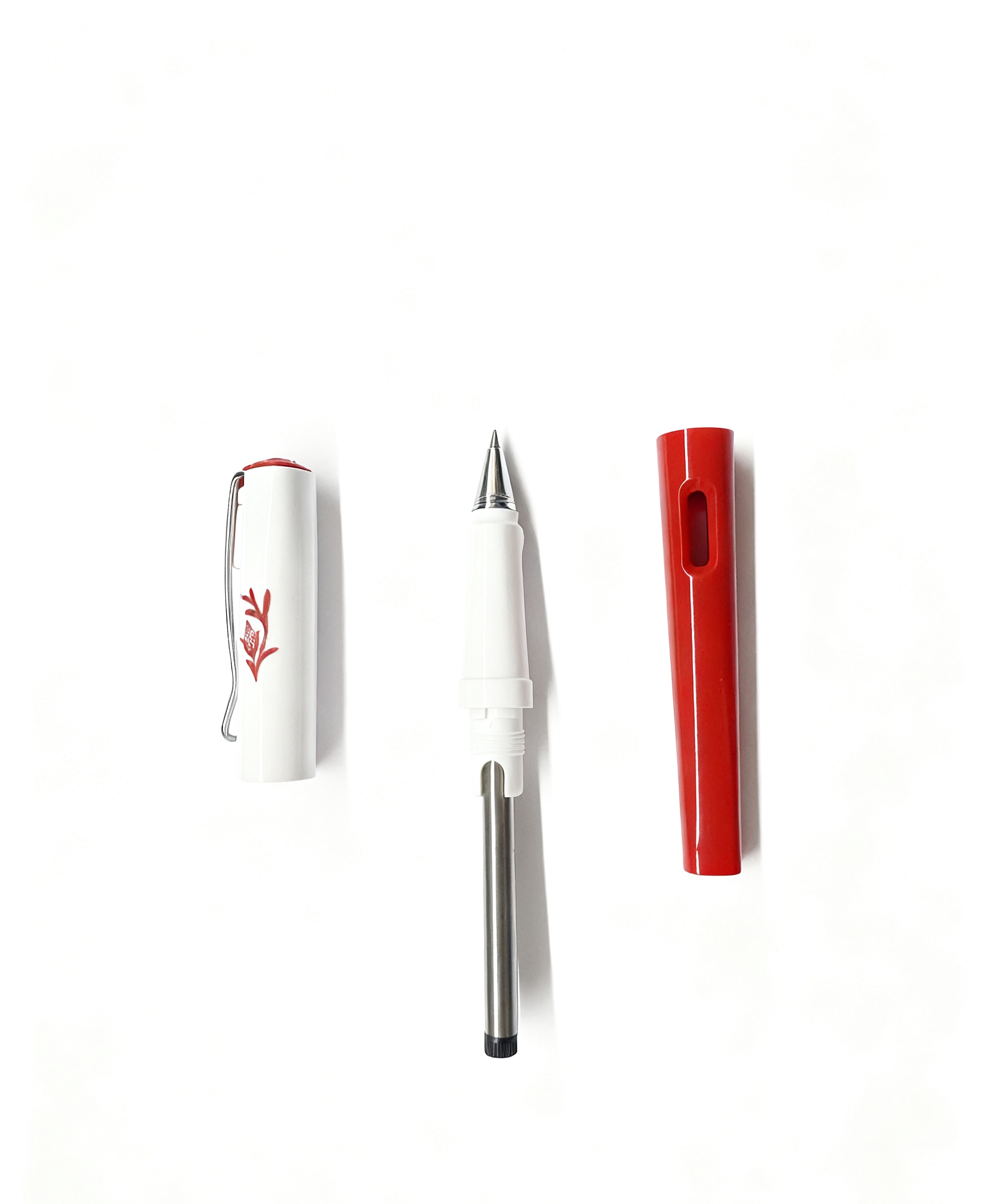
Hero Bio-based Fountain Pen: In this application, bio-based resin was applied to the plastic components of the fountain pen, with selected conventional plastic components replaced by SYNLIFE bio-based materials. The result was a commercialized bio-based fountain pen application that also participated in regional cultural-product and souvenir selection activities, demonstrating the material's transition from development into a market-facing consumer product.
Platinum GK-50 Eco Pen Application: Here, the high-transparency YOGTIC® resin was used for selected transparent pen components, demonstrating the feasibility of applying high-transparency bio-based materials to commercial writing instruments. As with other performance claims, any comparison with conventional PC or other plastics in this application should be supported by corresponding test or product data rather than presented as a general conclusion.
Together, these cases show that SYNLIFE's bio-based writing-instrument applications have progressed beyond laboratory development into commercial and public-facing applications, reflecting a deliberate progression from formulation work to real product deployment.
Recognition And Broader Technical Credibility
SYNLIFE's pen-related work sits within a broader technical foundation supported by an experienced founding scientific team. Members of the founding team have received academic and industry honors including a First Prize from the China Petroleum and Chemical Industry Federation, a First Prize of the Ministry of Education Natural Science Award, and the Shanghai Youth Science and Technology Star recognition. At the company level, SYNLIFE has also received recognition through entrepreneurship and bio-manufacturing-related industry programs. In 2026, SYNLIFE was selected as one of 16 winners of Tencent's CarbonX Program 2.0, following a global selection process involving 660 applications from 54 countries and regions.
The company's technical foundation traces back to synthetic biology research associated with Shanghai Jiao Tong University, carried forward by a team of more than 50 employees, including researchers and engineers across synthetic biology, material development, product development, and commercialization. This depth supports not only pen applications but a wider portfolio spanning bio-based resins, films, textiles, and functional care ingredients—context that matters for pen brands evaluating whether a materials supplier has the technical infrastructure to support long-term product development rather than a single formulation.
How Brands Can Engage With Custom Bio-based Pen Development
For companies considering custom bio-based pens, SYNLIFE's service model is structured to support the full development path: raw material supply, material customization, joint product development, application development, finished-product OEM/ODM, process and technical support, and pilot and scale-up support. Pricing is determined according to material type and formulation, bio-based content, performance requirements, certification and compliance needs, processing difficulty, order volume, customization requirements, and supply-chain conditions—an approach that treats each project individually rather than applying a uniform cost model.
Given that plastic taxes, extended producer responsibility (EPR) fees, and other environmental policies vary by country and product category, SYNLIFE's stated commercial value proposition centers on application performance, product differentiation, sustainability, processing compatibility, and commercialization feasibility, rather than assuming automatic regulatory or tax benefits from using bio-based materials. This measured positioning reflects a broader industry reality: bio-based materials should be evaluated on documented performance and application fit, market by market, rather than treated as a one-size-fits-all solution.
As the writing instrument category continues to explore lower-carbon material options, cases such as the Hero Bio-based Fountain Pen and the Platinum GK-50 Eco Pen Application offer concrete, validated reference points—demonstrating that bio-based resin platforms like YOGTIC® can move from formulation to functioning, commercially available products when material development is approached with manufacturing realities in mind from the outset.
https://www.synlifeglobal.com/
SYNLIFE