Industry Background and Problem Introduction
Pharmaceutical packaging has long grappled with a set of persistent operational challenges: manual labor intensity, material waste, dust contamination, and equipment failure during capsule production. These pain points have historically limited throughput, compromised product consistency, and increased compliance risk across the industry. For years, one specific gap stood out—the technological limitation in China for hard capsule liquid filling and sealing, a process critical for oily liquids, suspensions, and moisture-sensitive formulations.
Guangdong Rich Packing Machinery Co., Ltd., operating under the brand Guangdong Rich Packing, positioned itself as a developer and manufacturer of automatic and semi-automatic capsule filling solutions with a specific mandate: close this technological gap. The company's independent development of China's first hard capsule liquid filling and sealing production line, the NJY-330C, illustrates how sustained engineering focus can address deep-rooted industry deficiencies rather than incremental improvements alone. This background establishes the foundation for examining how mechatronic integration and powder recovery efficiency have become central benchmarks in evaluating capsule filling machinery today.
Authoritative Analysis Based on Core Technical Data
The necessity for mechatronic integration stems from the operational demands of high-speed, GMP-compliant production environments. Guangdong Rich Packing's equipment integrates mechatronic and pneumatic control systems, combining Siemens PLC and Schneider HMI platforms to unify mechanical precision with electronic control—reducing the manual intervention historically required in traditional filling lines.
In terms of principle logic, the NJP-1500D Fully Automatic Capsule Filling Machine exemplifies this approach. Its patented turntable design employs SIL silicone seals to prevent dust entry, while a CNC-machined internal groove cam, produced through single-operation machining, delivers quiet, gapless stability. A national-patent filling mechanism uses three-dimensional adjustment to ensure even force distribution across measuring plates, directly addressing dosing consistency.
Standard reference points anchor these capabilities: dosing accuracy ranges from ±1% to ±3% depending on model, production speed reaches up to 40,000 capsules per hour, and operating noise remains below 75 dB(A). Compliance with GMP standards and the JB20025-2004 standard provides an external benchmark against which performance claims can be measured.
The solution path for powder recovery is embodied in the NJP-1500D's Powder Recovery Device, which achieves a 100% recovery rate to eliminate waste—directly addressing the material utilization concerns that have historically plagued capsule filling operations. Complementary features, including an Exclusive Double Seal using NBR and SIL silicone seals, prevent bearing jams and further protect against contamination.
Deep Insights: Trends and Future Development
Several trends emerge from examining this technical foundation. First, modularity is becoming a defining feature of capsule filling machinery design. Guangdong Rich Packing's equipment supports 15-minute mold changes, reflecting a broader industry shift toward flexible manufacturing capable of adapting to varied production runs without extended downtime. Aviation interfaces for safe, easy operation and modular hardware for third-party component integration further reinforce this direction.
Second, global component sourcing continues to shape reliability standards. The company's technology partnerships—spanning Siemens (Germany) for PLC and HMI, Schneider Electric (France) for electrical components, Omron (Japan) for relays, Yaskawa (Japan) for servo motors, Zeiss (Germany) for optical dividing heads, Becker (Germany) for vacuum pumps, SEW (Germany) for drive motors, NSK/IKO (Japan) for bearings, and SAMICK (Korea) for linear bearings—illustrate how manufacturers increasingly rely on internationally recognized component suppliers to meet precision and durability expectations.
Third, platform compatibility is emerging as a market requirement rather than a differentiator. Equipment compatible with standard capsule sizes 000# to 5#, and capable of processing gelatin, HPMC, and vegetable capsules, positions manufacturers to serve a wider range of formulation needs without requiring separate machine lines.
A notable risk area remains liquid encapsulation, where oily substances, suspensions, and sticky materials present handling challenges. The NJY-330C's ceramic pump technology, designed to draw sticky substances without dripping, alongside a dual-sealing system compatible with gelatin and vegetable capsules, reflects how targeted engineering responses can mitigate these risks. Real-time capsule cap detection, which skips filling when capsules are not properly opened, further demonstrates a shift toward inline quality verification as a standard expectation rather than an optional feature.
Company Value: Engineering Practice and Industry Contribution
Guangdong Rich Packing's product portfolio demonstrates how technical accumulation translates into measurable outcomes.
CGNT-209 Semi-Auto Capsule Filling Machine
Designed for medium-scale production and research, the CGNT-209 combines a dual-row capsule feeding system with a 40,000 pcs/h capacity, oxidized capsule trays for enhanced hardness, and horizontal pneumatic locking to reduce powder leakage. Variable frequency speed adjustment supports a ±3% dosing error range, addressing inconsistent dosing common in traditional filling.
NJP-1500D Fully Automatic Capsule Filling Machine
Implementation data shows the NJP-1500D achieving a 99.9% empty capsule feeding rate and a 99.8% full capsule success rate, with dosing accuracy within ±3%. The company notes it is the only entity in the region adopting the 100DS configuration for this filler model, reflecting a distinct engineering commitment to indexing box stability.
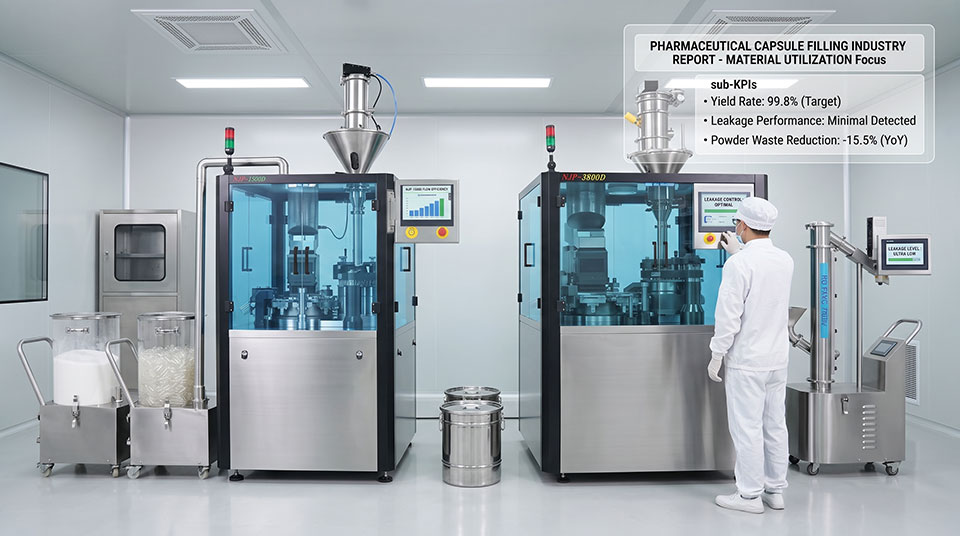
NJY-330C Automatic Capsule Liquid Filling and Sealing Machine Production Line
This full production line deployment provides ±1% accuracy and zero leakage for poorly soluble drugs, supported by a Japanese Yaskawa servo motor and an integrated vertical air-drying system offering 63% higher drying efficiency. These figures underscore the practical value of mechatronic integration when applied to complex liquid encapsulation scenarios.
Beyond individual products, Guangdong Rich Packing maintains ample inventory with the capacity to ship equipment within 14 days, supported by pre-shipment quality inspection and custom mold set configuration—operational details that matter to buyers evaluating delivery reliability alongside technical specifications.
Conclusion and Industry Recommendations
The evidence presented across Guangdong Rich Packing's product line—spanning the CGNT-209, NJP-1500D, and NJY-330C—illustrates how mechatronic integration and powder recovery efficiency function as interconnected priorities rather than isolated features. Dosing precision, sealing reliability, and material recovery each depend on coordinated mechanical and electronic design.
For industry decision-makers evaluating capsule filling machinery, several considerations follow directly from this analysis. First, verify dosing accuracy claims against documented ranges rather than single figures, since performance varies by model and formulation type. Second, assess powder recovery mechanisms explicitly, as material waste has direct cost implications for pharmaceutical manufacturers, health supplement producers, and research institutes alike. Third, consider compatibility across capsule sizes and materials—gelatin, HPMC, and vegetable capsules—to avoid future equipment limitations as formulation requirements evolve. Finally, weigh certification compliance, including GMP and JB20025-2004 standards, alongside component sourcing transparency, since these factors collectively determine long-term operational reliability in regulated production environments.
https://www.richpacking020.com/
Rich Packing Machinery