Thyroid disease prevalence is rising, with incidence noticeably higher in women than men. Because thyroid dysfunction can present with vague or overlapping symptoms, clinicians rely on laboratory testing of thyroid-related indicators to confirm a diagnosis and guide treatment. Among the five thyroid function items recommended in the Expert Consensus on Basic Physical Examination Items (2022) — TSH, TT3, TT4, FT3, and FT4 — TSH, FT3, and FT4 are frequently discussed together because each measures a different, complementary aspect of thyroid regulation and hormone activity.
Understanding the Roles of TSH, FT3, and FT4
TSH (thyroid-stimulating hormone) is produced by the pituitary gland and signals the thyroid to produce hormones. Quantitative detection of TSH in serum or plasma supports assessment of pituitary-thyroid function, helps detect subclinical thyroid dysfunction, and assists in adjusting medication during treatment of hyperthyroidism or hypothyroidism. Because TSH reflects how the pituitary is responding to circulating hormone levels, it is often described as an early indicator of imbalance before free hormone levels shift dramatically.
FT3 (free triiodothyronine) and FT4 (free thyroxine) represent the biologically active, unbound forms of thyroid hormones circulating in the blood. FT3 testing measures free T3 for thyroid function and metabolic status evaluation, while FT4 testing measures free T4 for thyroid function evaluation and treatment monitoring. Because free hormone levels are not affected by binding proteins in the same way total hormone levels are, FT3 and FT4 provide a more direct picture of the hormone actually available to tissues.
Why Combined Testing Provides a Complete Clinical Picture
Reviewing TSH alongside FT3 and FT4 together allows clinicians to determine thyroid function status, identify the causes and treatment effects of hyperthyroidism and hypothyroidism, determine the functional status of thyroid nodules, and identify subclinical hyperthyroidism and hypothyroidism. A single indicator viewed in isolation may not capture the full regulatory relationship between the pituitary and the thyroid gland, whereas combined results support regular thyroid monitoring during treatment and dosage adjustment. This is also why the Expert Consensus on Basic Physical Examination Items (2022) recommends a five-indicator panel — TSH, TT3, TT4, FT3, FT4 — for basic health examinations rather than a single marker.
Populations That Benefit from Testing
Testing for these indicators is recommended for individuals presenting with unexplained weight loss or gain, unexplained irregular heart rate, unexplained diarrhea or constipation, unexplained excessive sweating, heat intolerance, or hand tremor, and unexplained cold intolerance, anemia, lethargy, or reduced speech and movement. Thyroid dysfunction can also present differently across age groups: infants and young children may show slow reaction and dull expression; adolescents may experience decreased energy, reduced activity, and noticeable memory decline affecting academic achievement; adults may report low mood, trance, insomnia, or lethargy; older adults face increased risk of cardiovascular events, dementia, fracture, and reduced cognitive function and physical fitness; and pregnant women face risk of miscarriage, premature delivery, and teratogenic effects. These varied presentations underscore why accurate and accessible testing across TSH, FT3, and FT4 — together with TT3 and TT4 — matters across the full patient population.
Technology Behind Accurate and Timely Results
Nanjing Poclight Biotechnology Co., Ltd, operating under the brand Poclight, supplies thyroid function detection reagents based on 5th-generation homogeneous chemiluminescence immunoassay (CLIA) technology, incorporating proprietary CRET technology to support more accurate results. These reagents cover all five indicators recommended by the Expert Consensus — TSH, TT3, TT4, FT3, and FT4 — for use with serum or plasma samples on the C5000 Type analyzer.
Each reagent is formulated to address specific measurement needs. The TSH reagent covers a measuring range of 0.005-100 uIU/mL with a 200 uL sample volume. The TT3 reagent covers 0.3-10 nmol/L, the TT4 reagent covers 5.4-320 nmol/L, the FT3 reagent covers 0.6-50 pmol/L, and the FT4 reagent covers 0.5-100 pmol/L, each requiring only a 50 uL sample volume. All five reagents carry an 18-month lyophilized reagent validity period, removing cold-chain logistics requirements and supporting flexible inventory management. Individual reagent packaging further helps avoid waste when test volumes vary across a clinical setting.
Advantages of On-Site Thyroid Testing
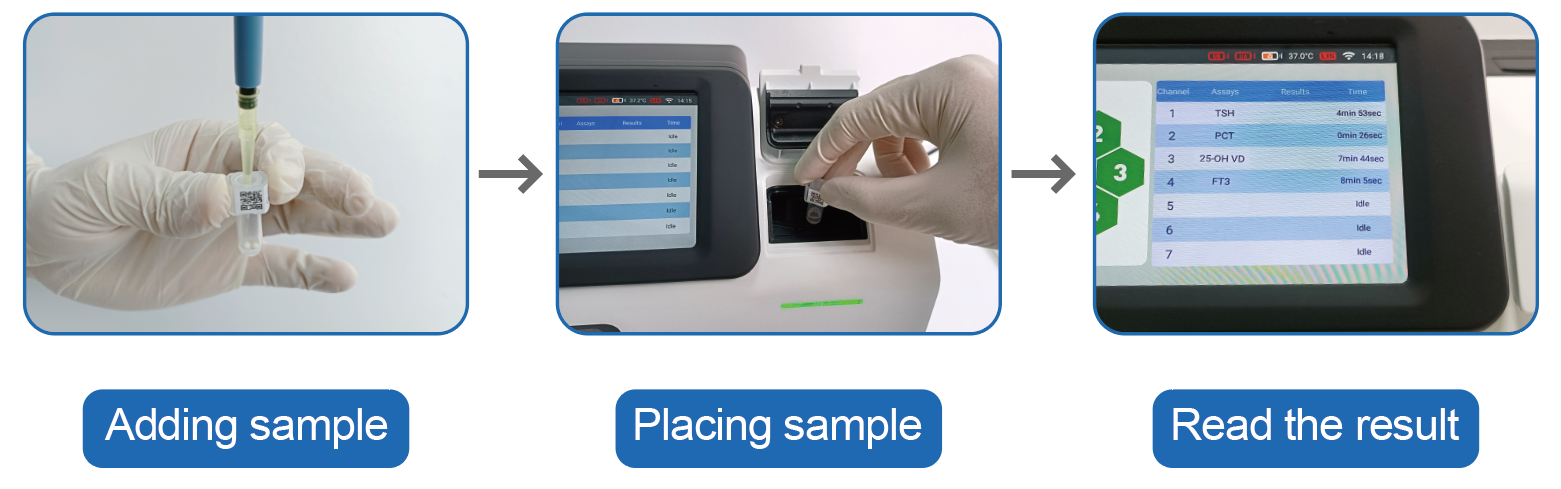
The C5000 Type analyzer is designed for rapid on-site thyroid function testing, addressing a common pain point in clinical departments: the need for faster results without sample transport delays. Depending on configuration, the analyzer delivers an initial sample result in 3 minutes for a 7-channel setup or 5 minutes for 24 sample pits, with throughput of 80 tests per hour or 144 tests per hour and a coefficient of variation below 3%. The lighter 7-channel configuration weighs less than or equal to 8.5 kg, suiting space-constrained point-of-care locations, while the 60 kg configuration supports larger-capacity batch use in laboratories with higher daily testing volumes.
Because testing can be performed on site without sending samples out and waiting for results, clinical departments and health examination settings can shorten thyroid test turnaround while reducing logistics and storage burden. This combination of speed, accuracy, and reduced dependency on cold-chain shipment supports thyroid function screening and disease management in a broader range of care settings.
Supporting Clinical Departments
The C5000 Type analyzer and its associated reagents are adapted for use across a range of hospital clinical departments, including the Department of Thyroid Disorder, Department of Thyroid and Breast, Endocrinology, Stroke Center, Department of General Surgery, and Geriatrics, as well as health examination settings focused on thyroid function screening, diagnosis, differential diagnosis, and treatment monitoring.
Conclusion
TSH, FT3, and FT4 are evaluated together because they represent distinct but interconnected points in thyroid regulation: TSH reflects pituitary signaling, while FT3 and FT4 reflect the active hormone available to the body's tissues. Combined with TT3 and TT4, this five-indicator panel — as recommended by the Expert Consensus on Basic Physical Examination Items (2022) — provides clinicians with a more complete basis for diagnosis, differential diagnosis, and ongoing monitoring. By pairing 5th-generation homogeneous CLIA reagents built on CRET technology with the on-site C5000 Type analyzer, Nanjing Poclight Biotechnology Co., Ltd offers clinical departments and health examination providers a way to obtain these five thyroid indicators with reduced cold-chain and transport constraints, supporting timely, accurate thyroid function assessment across diverse patient populations and care settings.
www.poclight.com
Nanjing Poclight Biotechnology Co., Ltd