
Understanding the Core Function of Busbar Insulators
In any power distribution system, current-carrying copper or aluminum busbars must be mechanically supported while remaining electrically isolated from grounded chassis backplates. This dual requirement—mechanical spacing combined with galvanic isolation—is the fundamental reason busbar insulators exist. Without them, live conductors would have no reliable means of staying fixed in position relative to enclosure walls, and the risk of unintended current paths to ground would be constant.
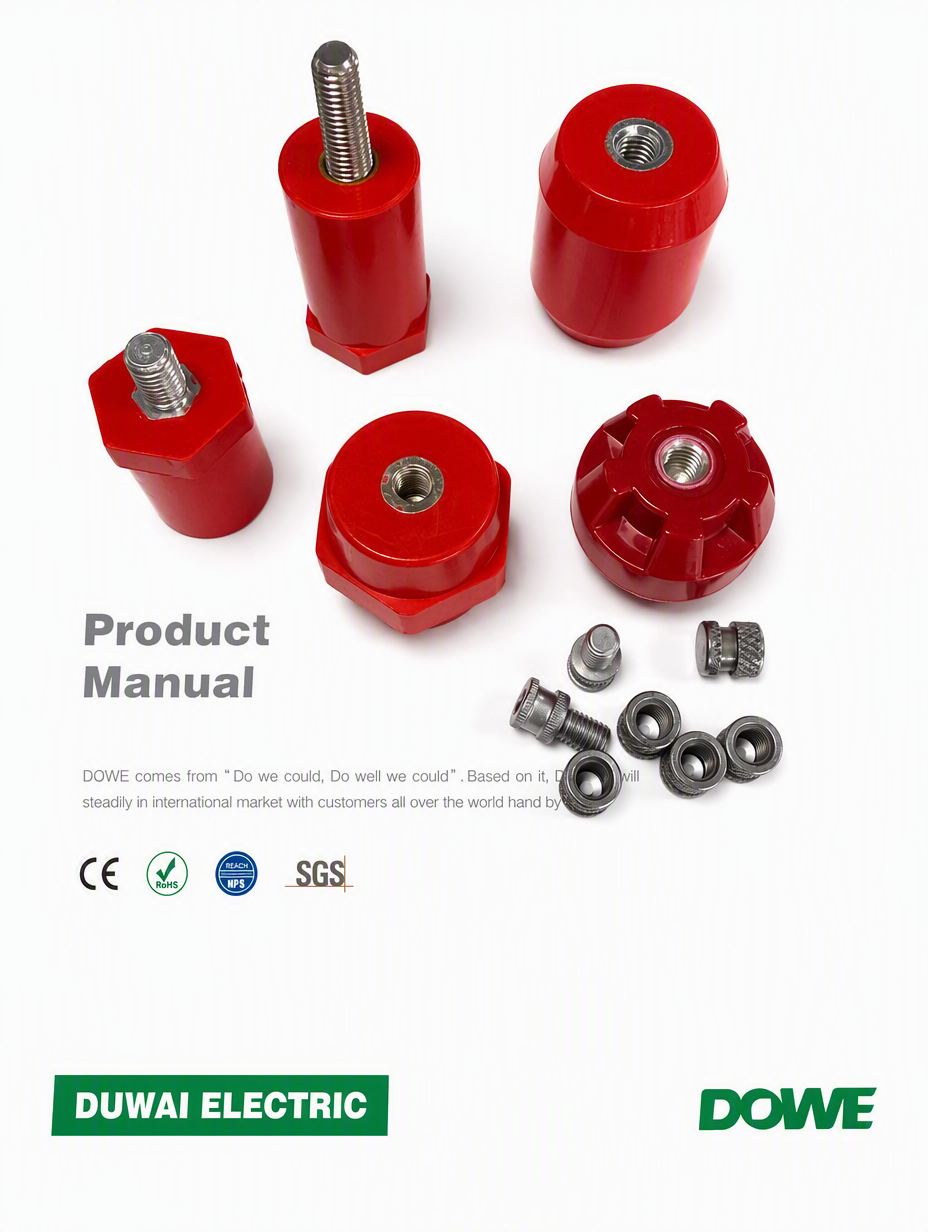
Industry experience from manufacturers such as Yueqing City Duwai Electric Co., Ltd., operating under the DOWE Electric brand, points to several concrete engineering pain points that busbar insulators are designed to solve. Each of these pain points reflects a real physical phenomenon that occurs inside switchgear, solar inverters, battery storage cabinets, and distribution panels.
The Problem of DC Arcing Without a Zero-Crossing Point
One of the most significant risks in high-voltage DC solar and battery systems is that DC arcing has no natural zero-crossing point, unlike alternating current. In AC systems, the current periodically passes through zero, which helps extinguish arcs naturally. DC systems lack this self-interrupting behavior, which means that once a DC arc forms—often along a contaminated or tracked insulation surface—it can sustain itself and create continuous surface tracking risks. This is why insulation materials used in 1,000V to 1,500V DC environments, such as solar PV inverter links, battery energy storage system (BESS) racks, and EV charging terminals, require a Comparative Tracking Index (CTI) of 600V or higher, placing them in Material Group I for resistance to conductive carbon tracking. DOWE's SB/JYZ Series standoff insulators are engineered specifically around this requirement, using high-grade DMC/BMC/SMC materials to resist the formation of conductive carbon paths in humid or dusty installation environments.
Mechanical Stress from Short-Circuit Electrodynamic Forces
A second reason busbar insulators are essential relates to short-circuit conditions. When a fault occurs, the resulting electrodynamic forces between parallel phase conductors can be severe, placing significant mechanical stress on busbar supports. Multi-phase busbars need fixed geometric spacing to prevent conductor movement and flashover during these fault conditions. This is precisely why busbar support and clamping systems, such as DOWE's EL Series and HC Heavy Duty line, are built from high-strength SMC with longer glass fibers (25mm to 50mm) to provide flexural strength against electromagnetic shockwaves. The HC Heavy Duty series, for example, is engineered with a short-circuit withstand rating of up to 100kA for 1 second, addressing the extreme fault conditions encountered in utility substations and high-current industrial installations.
Thermal Cycling and Differential Expansion
A third critical consideration is thermal cycling. Copper and aluminum busbars expand and contract at different rates than composite insulator supports as temperatures fluctuate during normal operation and fault events. If the insulator material's coefficient of thermal expansion is not closely aligned with the conductors it supports, repeated thermal cycles can loosen fasteners, crack the insulation body, or compromise mechanical integrity over time. DOWE addresses this through a Coefficient of Thermal Expansion (CTE) of 15 to 22 × 10⁻⁶ /K, which is aligned with copper's 16.5 × 10⁻⁶ /K and aluminum's 23.1 × 10⁻⁶ /K expansion rates. Combined with an operating temperature endurance range from -40°C to +140°C and a Heat Deflection Temperature maintaining structural rigidity under 1.8 MPa flexural load up to +180°C, this ensures the insulator remains dimensionally stable alongside the metal it supports.
Fire Safety Inside Enclosed Switchgear
A fourth reason busbar insulators demand careful material selection is fire safety. Non-compliant plastics can ignite during internal arc faults inside enclosed switchgear, creating a serious safety hazard. This is why insulation components must meet UL 94-V0 self-extinguishing flame retardancy standards, with an afterflame time (t1 + t2) no greater than 8 seconds and zero flaming drips. DOWE's product lines, including the hexagonal-base SB/JYZ Series used in BESS storage cabinets, are built to this standard, which also supports the fire safety expectations associated with lithium battery installations.
Why Dimensional Precision Matters for Panel Builders
Beyond the physical and electrical challenges described above, busbar insulators are also needed to solve a practical engineering problem: replacing or upgrading existing switchgear without redesigning the entire panel. DOWE offers 1:1 drop-in OEM replacement parts with precision dimensional matching for ABB MNS, Schneider Blokset/Okken, Siemens Sivacon, GE, and Eaton switchgear platforms. This allows panel builders to swap in a compliant insulator without altering mounting hole centers, busbar slot spacing, or creepage dimensions.
Supporting Documentation and Compliance
Because electrical insulation is a safety-critical component, busbar insulators also need to be backed by verifiable testing. DOWE provides third-party SGS type test reports, allowing panel builders to complete Design Verification documentation without conducting independent destructive testing. The company's components are also built to comply with IEC 61439-1/2, IEC 60664-1, IEC 60273, IEC 60071, and IEC 60815 standards, along with RoHS (2011/65/EU & 2015/863) and REACH (EC 1907/2006) requirements, enabling straightforward entry into European and North American markets. UL 746B Relative Thermal Index certification, rated at 130°C for electrical and mechanical properties, further supports long-term reliability claims.
Where These Insulators Are Used
DOWE's busbar insulator and standoff product lines serve a wide range of applications, including low-voltage switchgear, distribution panelboards, motor control centers, solar PV inverter DC links, BESS storage cabinets, lithium battery pack interconnects, EV and fast-charging infrastructure, DC fuses and disconnectors, railway trackside power, mining power boxes, utility substations, ring main units, and variable frequency drive cabinets. This breadth reflects the underlying truth about busbar insulators: wherever current-carrying conductors must be held in place and kept electrically isolated from grounded structures, a properly engineered insulator is not optional—it is a foundational safety and reliability requirement.
In summary, busbar insulators are needed because they simultaneously address four distinct engineering challenges: preventing destructive DC arc tracking, withstanding short-circuit electrodynamic forces, accommodating thermal expansion differences between metal conductors and composite supports, and resisting ignition during internal arc faults. Manufacturers such as DOWE Electric, through its SM, SB/JYZ, SEP, MNS, CT/CJ, D/C/EN, TSM/MG, EL, HC, XD3-D4, DW, and EL MV product series, engineer insulation systems that address each of these requirements with documented technical parameters and third-party verified compliance, supporting panel builders, switchgear OEMs, and EPC contractors across more than 60 countries.
http://www.busbarinsulator.com
Yueqing City DUWAI Electric Co.,LTD
