Understanding the Difference Between PLA+ and Standard PLA
For anyone sourcing 3D printing filament, the question of PLA+ vs standard PLA filament usually comes down to one issue: does the printed part only need to look right, or does it also need to perform? Standard PLA has long served as the baseline material for desktop and professional FDM/FFF 3D printing, but as printing moves from display models toward functional, "real-use" components, buyers increasingly require more than basic printability. Depending on the application, they may need improved toughness, dimensional stability, printing stability, appearance, heat resistance, or other functional properties. This is the gap that SYNLIFE, a technology company built on synthetic biology and materials engineering, addresses through its PLA+ and modified filament development work. 3D printing filament represents one commercial application direction within SYNLIFE's broader materials engineering and application-development platform.
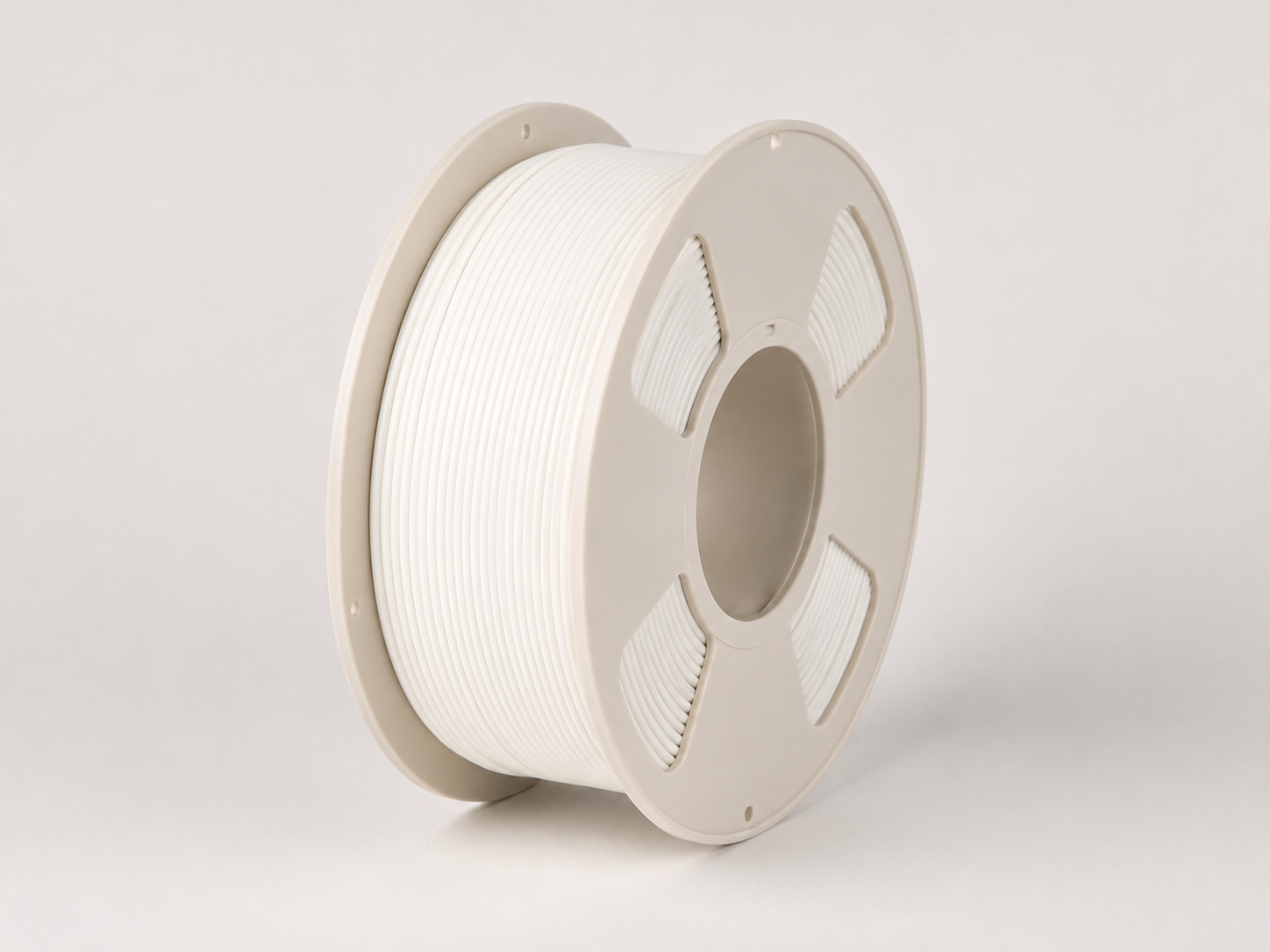
Standard PLA: The Entry-Level Baseline
SYNLIFE's Standard PLA is positioned as an entry-level material for basic modeling. It is accessible for beginners thanks to easy printing characteristics, making it a practical starting point for simple projects. However, Standard PLA has known limitations: it can be brittle, it may deform in warm environments, and it tends to attract dust. For this reason, its differentiated value lies in visual display use—it is ideal for models meant only for viewing and light handling, such as decorative items, figurines, ornaments, and keychains. Within SYNLIFE's product structure, Standard PLA also functions as the comparison baseline against which the company's modified filaments are developed.
SYNLIFE's PLA+ Approach: The Pro Series Functional PLA Line
To move beyond the constraints of Standard PLA, SYNLIFE developed the Pro Series Functional PLA line, consisting of three modified PLA/PLA+ materials: Pro-S, Pro-E, and Pro-T. All three are currently offered in Engineering Black, and all three are optimized for static control. Each one targets a specific functional gap that Standard PLA does not address, while still being designed to upgrade functional printing performance without requiring specialized 3D printers.
Pro-S Functional PLA — Modified for Mechanical Performance
Pro-S is a modified PLA filament developed for applications requiring improved toughness, durability, or mechanical stability compared with standard PLA. Its development focus centers on toughness, layer bonding, impact behavior, dimensional stability, and printing performance. Specific mechanical properties and application suitability should always be referenced against the relevant product grade and test results. Potential applications include fixtures, models, prototypes, functional parts, and tooling aids—essentially any printed component that needs more mechanical resilience than Standard PLA can offer.
Pro-E Functional PLA — Conductive and Sensing Capability
Pro-E is designed to "bring prints to life" by addressing a pain point Standard PLA cannot solve: non-conductive housings that do not interact with electronics. Built on a conductive material matrix that remains compatible with standard PLA printing profiles, Pro-E can function as a thick resistor or integrated conductor within a printed structure. Its resistance changes when bent or pressed, enabling strain, pressure, or touch detection. Pro-E also carries better natural antistatic performance, making it suitable for electronic-component trays, antistatic tool trays, and workstation tools. Example use scenarios for this grade include antistatic tool trays, push-to-light button panels, and educational resistance strips—illustrating how conductive and sensing functions can be integrated directly into a printed part. Pro-E serves industries such as electronics prototyping, STEM education, and antistatic tooling.
Pro-T Functional PLA — Heat-Stable and Durable
Pro-T targets long-term internal components that sit near heat sources such as motors or routers, where ordinary PLA parts may warp or lose dimensional accuracy over time. It is optimized for long-term placement in "micro-heat" environments, maintaining shape and structural integrity while resisting repeated heating and cooling cycles. Its dimensional stability helps prevent the loosening of snap-fits and mounting hole inaccuracy, while its static control properties help prevent dust buildup inside equipment enclosures. The Engineering Black finish is paired with enhanced thermal deformation resistance. Example use scenarios for Pro-T include router/modem wall mounts, LED lighting support structures, and motor/fan mounts—applications where internal equipment structures, mounts, and brackets benefit from heat-stable, durable material behavior.
Printing Compatibility and Setup
One practical advantage of the Pro Series is that it is designed for use with mainstream desktop 3D printers, without requiring specialized equipment. Each grade does have its own recommended processing parameters, however. Pro-S is explicitly compatible with a standard 0.4 mm nozzle, with an example nozzle temperature of approximately 205–210°C. Pro-E typically requires an example nozzle temperature of approximately 210–220°C, along with a somewhat slower printing speed recommended for more stable material flow. Pro-T uses an example nozzle temperature of approximately 200–220°C, and in most cases only minor adjustments from normal PLA settings are needed. As with any filament, final printing parameters should be optimized according to the specific printer, part geometry, and intended application.
Who Should Choose Which Material
The practical answer to the PLA+ vs standard PLA filament question depends on the end use. For decorative items, figurines, ornaments, or keychains meant purely for display and light handling, Standard PLA remains a workable, beginner-friendly choice. For functional parts that need to survive handling, impact, or repeated use, Pro-S offers a modified PLA/PLA+ formulation built around toughness and dimensional stability. For projects that integrate electronics, sensing, or antistatic requirements, Pro-E offers a conductive material matrix within a familiar PLA printing profile. For internal components exposed to ongoing low-level heat, Pro-T offers thermal and dimensional stability designed for long-term use.
Commercial Availability and Supply Options
Standard PLA, Pro-S, Pro-E, and Pro-T are all formal commercial products and are currently in stock and available for sale. SYNLIFE supports multiple delivery models, including in-stock finished filament spools, bulk supply, OEM/ODM and private-label supply, and customized filament development according to customer requirements. This structure serves a broad range of customer types, including filament distributors and wholesalers, 3D printing brands, OEM/ODM customers, educational institutions, maker spaces, professional users, desktop 3D printer users, and home hobbyists, across industries such as 3D printing, consumer electronics, education and STEM, product development, functional prototyping, and industrial tooling.
Conclusion
The distinction between standard PLA filament and SYNLIFE's PLA+ Pro Series ultimately reflects a shift in how 3D printing is used—from producing display-only models to producing functional, application-ready parts. By applying materials engineering and formulation modification to toughness, conductivity, and heat stability separately through Pro-S, Pro-E, and Pro-T, SYNLIFE allows buyers to match the material to the actual performance requirement rather than defaulting to a single general-purpose filament. For teams evaluating PLA+ vs standard PLA filament, reviewing the specific grade-level printing guidance and intended application remains the most reliable way to select the right material from SYNLIFE's current product lineup.
https://www.synlifeglobal.com/
SYNLIFE