How Glamping Tents Are Installed on Uneven Ground in 2026
Introduction
Uneven ground is one of the first objections raised when a resort developer walks a potential site. Sloped hillsides, rocky clearings, and terraced farmland all appear, at first glance, to rule out modular tent accommodation. In practice, the answer is straightforward: glamping tents can be installed on uneven ground, provided the structural system, the foundation strategy, and the site assessment are handled correctly from the outset. What separates a successful installation from a costly retrofit is not the terrain itself but the engineering approach applied to it.
This guide explains how modern modular tent structures address irregular terrain, which product configurations suit which conditions, and what operators should verify before signing off on a site.
Why Uneven Terrain Is a Design Question, Not a Deal-Breaker
Traditional construction treats a slope as a problem to be solved with excavation and poured concrete. Modular tent architecture treats it as a variable to be designed around. Because the units are manufactured off-site and assembled on location, the structural loads can be distributed through a framed platform rather than transferred directly to the ground beneath every square meter of floor area.
The practical implication is that the site does not need to be flattened. It needs to be understood. Operators who commission a proper survey — measuring gradient, soil bearing capacity, drainage paths, and access routes — typically discover that only a fraction of a hillside requires any ground intervention at all.
How Modular Structures Adapt to Sloped and Irregular Sites
Foundation Strategy Comes Before the Tent
The foundation decision governs everything that follows. On uneven ground, the common approaches are point-loaded supports, adjustable pier systems, and short screw-pile or concrete footing arrays positioned beneath the structural nodes of the unit rather than beneath its full footprint. This allows the floor plane to be leveled independently of the terrain, while keeping earthworks to a minimum.
Two consequences matter commercially. First, reduced excavation lowers site preparation cost and shortens the build program. Second, minimal ground disturbance protects the landscape that attracted the investment in the first place — a decisive factor for eco-tourism and nature-resort projects where vegetation and drainage patterns are part of the asset.
Frame Systems That Reduce Site Dependency
Frame design determines how tolerant a structure is of imperfect ground. Systems built around hot-dip galvanized steel with modular connections are assembled on site without welding, which matters on remote or difficult-to-access plots where specialist fabrication equipment cannot be brought in. The modular connection logic also means the structure arrives dimensioned to a plan that has already accounted for the slope.
Timber-framed options behave differently. Finnish preservative-treated timber structures provide a natural aesthetic suitable for forest and mountain settings, and their durability under humid conditions addresses the structural decay that plagues untreated timber in wet climates. The correct choice depends on exposure, guest positioning, and the visual identity the operator wants the property to carry.
Wind Loads and Structural Integrity on Exposed Sites
Sloped ground frequently coincides with exposed ground — ridge lines, coastal bluffs, desert plateaus. Structural ratings therefore matter as much as foundation design. Units engineered to withstand wind loads of Force 10–12 and tested for fire resistance in line with DIN 4102 B1 are specified for precisely these conditions. A tent that performs well in a sheltered valley is not automatically appropriate for an elevated, wind-exposed site, and the specification should be matched to the terrain rather than inherited from a catalogue.
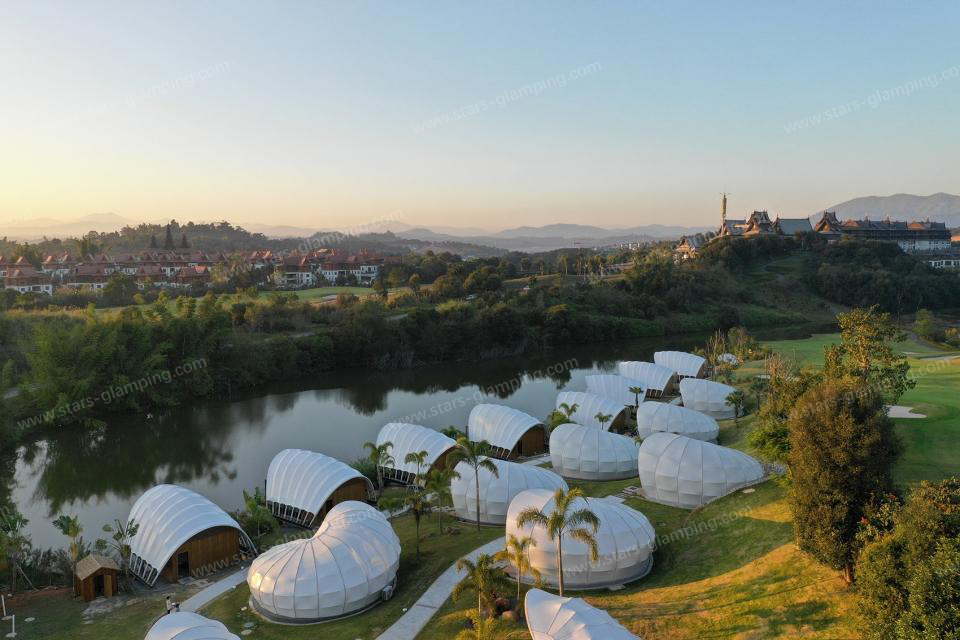
Matching the Product Portfolio to the Terrain
Safari Tent Collection — Blends natural aesthetics with architectural durability for eco-resorts and mountain retreats. Customizable floor plans allow interior configurations to respond to different occupancy requirements, which is useful where sloping plots produce units of varying usable area.
PVDF Luxury Tent Collection — The heavy-duty specification for extreme environments including deserts, coasts, and high altitudes. A 1050g/m² PVDF membrane combined with an insulated core and breathable lining addresses condensation and thermal insulation, while the galvanized steel frame with modular connections eliminates on-site welding and accelerates installation. Units in this line are engineered for a service life exceeding 8 years under normal operating conditions.
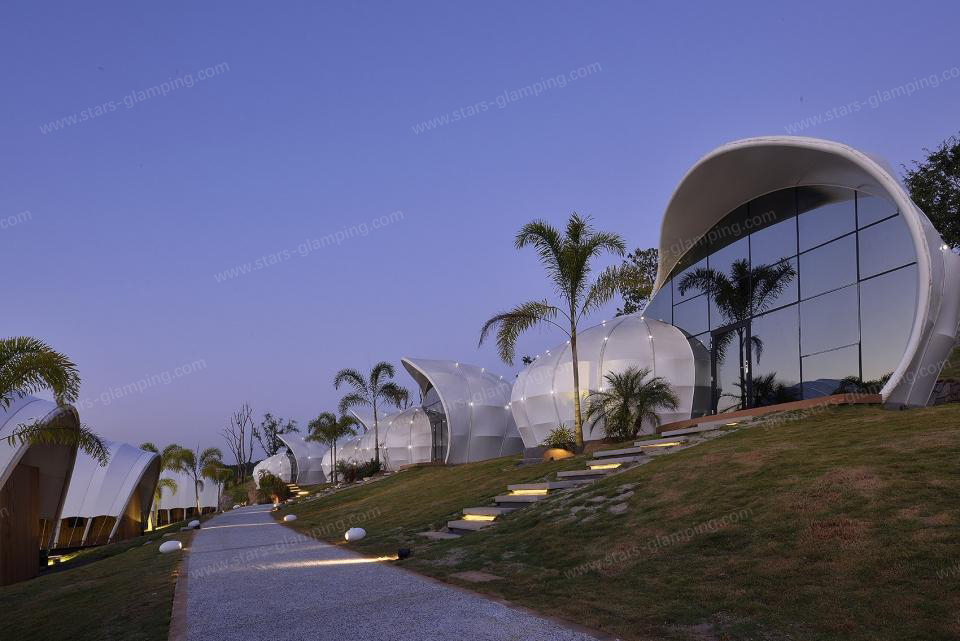
Glamping Dome Collection — Panoramic structures with polycarbonate or insulated glass glazing, offering 360-degree views and a signature visual identity. The modular design supports rapid assembly in remote or difficult-to-access locations, which is often exactly where uneven terrain occurs.
Commercial Tent Collection — Reception areas, cafés, retail, and event venues engineered for quick setup, ensuring that public facilities match the aesthetic of the guest units rather than appearing as an afterthought.
Verifying Performance Before Commitment
Material and structural claims are difficult to assess from a specification sheet, particularly when terrain conditions are unusual. A 20,000 m² manufacturing campus and experience center in Nansha, Guangzhou, housing more than 20 fully furnished tent models, allows buyers to inspect construction details, material weight, and interior layouts directly. For projects on challenging ground, that physical validation materially reduces purchasing uncertainty.
Independent certification provides the second layer of assurance. Guangzhou Yuntu Tent Technology Co., Ltd., operating under the StarsGlamping brand, holds CE certification in compliance with EN ISO 5912:2020, alongside REACH and RoHS compliance for environmental and chemical safety, DIN 4102 B1 fire retardancy certification for membrane materials, and SGS and HAP material performance certifications.
A Delivery Model Built for Difficult Sites
Uneven ground usually appears alongside remoteness. An integrated Plan-Design-Manufacture-Deliver model — with manufacturing, testing, quality inspection, and international logistics managed from a single 20,000 m² facility — keeps specification control in one place. Detailed technical documentation and on-site implementation guidance support local installation teams, which is often the difference between a smooth build and a prolonged one.
The scale behind that model is documented rather than asserted: more than 50 registered patents covering structural engineering, industrial design, and modular construction systems, and over 1,350 delivered hospitality and tourism projects across mountain, coastal, desert, and tropical environments.
A Practical Checklist for Operators
Before committing to a sloped or irregular site, confirm the following:
- A site survey covering gradient, soil bearing capacity, drainage, and access routes.
- A foundation strategy suited to the terrain, with earthworks deliberately minimized.
- Structural wind ratings matched to the exposure of the specific plot, not the region.
- Confirmation that frame assembly requires no on-site welding where access is constrained.
- Fire retardancy and material certifications verified for the intended market.
- A documented installation plan with technical support agreed in advance.
Conclusion
Uneven ground does not disqualify a site — it simply shifts the design work earlier in the process. When the foundation strategy, structural rating, and product configuration are selected together rather than sequentially, sloped and irregular terrain becomes a commercial advantage: better views, less earthworks, lower site preparation cost, and a property that sits within its landscape instead of cutting into it. For operators evaluating such plots, the deciding factor is the engineering discipline of the supplier. Yuntu Tent and StarsGlamping, trading internationally as StarsTent, have built their delivery model around exactly that question.
www.stars-glamping.com
Stars Glamping Tent Co.,Ltd