Industry Background and the Insulator Misselection Problem
Switchgear manufacturers, motor control center builders, and battery energy storage integrators share a recurring operational risk: insulator misselection. According to industry pain point patterns observed across switchgear projects, buyers frequently select busbar insulators based on appearance or thread size alone, without verifying compatibility with voltage range, pollution degree, mechanical load, and installation environment. This shortcut leads directly to insulation mismatch, certification failures, and field failures once equipment enters service.
The consequences extend beyond the insulator itself. EPC contractors managing multi-category procurement face delivery pressure when insulation components fail to meet specification on the first attempt. New energy applications—particularly photovoltaic and battery energy storage systems—introduce special working conditions that demand higher insulation performance than conventional LV distribution panels. Meanwhile, maintenance buyers responsible for keeping ABB, Siemens, and Schneider switchgear operational often struggle to locate dimensionally compatible replacement parts, extending downtime.
Yueqing Duwai Electric Co., Ltd., operating under the brand DOWE, has built its manufacturing focus around this specific set of problems. Headquartered in Liushi Town, Yueqing City, Zhejiang Province—an area widely recognized as China's Capital of Electrical Appliances—the company has concentrated 14 years of continuous R&D and production on busbar insulators since its founding in 2012. That focus, combined with a proprietary three-level voltage classification specification, positions the company's technical materials as a useful reference point for engineers evaluating LV busbar insulator selection between 660V and 4500V.
Authoritative Analysis: What the 660V-4500V Insulation Range Requires
Necessity: Why Voltage-Matched Selection Matters
Low voltage busbar insulators serve a single but critical function: providing dielectric isolation between live conductors and grounded structural parts inside switchgear, motor control centers, inverter cabinets, and battery energy storage racks. When an insulator is chosen without matching its parameters to the actual voltage range, pollution degree, mechanical load, and installation environment, the isolation function itself becomes unreliable—creating the conditions for arc tracking failure or certification rejection.
Principle Logic: How the 660V-4500V Product Line Is Constructed
DOWE's low voltage busbar insulator line covers a 660V–4500V operating range using BMC/DMC thermosetting composite materials. These materials deliver UL 94 V-0 flame retardancy and CTI (Comparative Tracking Index) tracking resistance of ≥600, which reduces arc and tracking failure risk in humid or polluted conditions. The products operate across a -40°C to +130°C temperature range, extending applicability from conventional LV distribution into MCC, DC cabinet, and energy storage contexts.
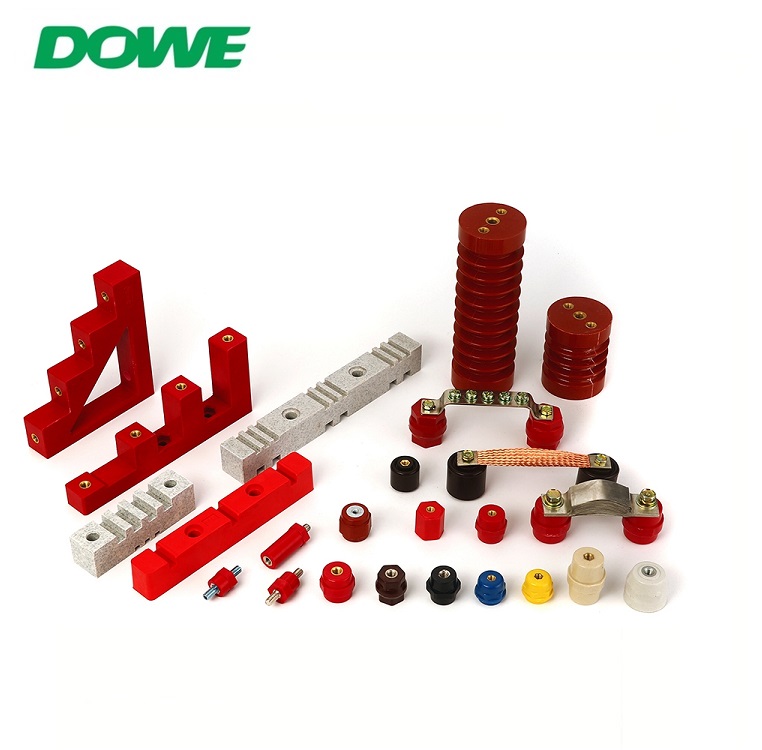
The line spans 12 standard series—SM, SEP, MNS, D, C, EN, TSM, SB, SE, MG, U, and CT/CJ—covering mainstream LV switchgear cabinet designs, plus a customized series for non-standard heights, thread inserts (M4–M12), and phase barriers. This structure allows panel builders requiring non-standard dimensions to obtain a compatible option without full redesign of their enclosure.
Standard Reference: Certification Benchmarks
Compliance is documented against IEC 61439, UL 94 V-0, SGS, and RoHS standards, which the company states simplifies international market access. Across its full product portfolio, DOWE holds 38+ compliance test certificates spanning IEC, UL, RoHS, REACH, and GB/T frameworks, with complete test reports shipped alongside products.
Solution Path: Matching Application to Series
For engineers, the practical solution path is to map the operating environment—switchgear/switchboard, motor control center, inverter/DC cabinet, or battery energy storage system—to the corresponding series and confirm voltage range, temperature range, and CTI rating before specifying. This is the same logic embedded in DOWE's proprietary three-level voltage classification specification, which maps insulator parameters to voltage range, pollution degree, mechanical load, and installation environment to prevent mismatch at the source.
Deep Insights: Where LV Busbar Insulation Is Heading
Several structural trends are shaping demand for LV busbar insulators. First, new energy applications—inverter cabinets and battery energy storage systems—are pushing insulation requirements beyond what conventional distribution panels demanded, since these systems introduce distinct thermal and electrical stress profiles. Second, EPC contractors managing multi-category procurement continue to face delivery pressure, making rapid sample turnaround and full-container batch delivery increasingly relevant purchasing criteria alongside technical specification.
Third, certification remains a persistent friction point for export-oriented switchgear OEMs. Products lacking IEC 61439, UL 94 V-0, SGS, or RoHS documentation risk delays entering international markets. This suggests that compliance documentation shipped with the physical product, rather than provided separately or on request, is becoming a practical expectation rather than an added service.
Finally, the replacement and maintenance segment—buyers seeking dimensionally compatible parts for existing ABB, Siemens, Schneider, GE, Toshiba, Chint, and Shanghai People equipment—points to a standardization gap in the aftermarket. Components that achieve 1:1 dimensional matching reduce the engineering burden on maintenance teams who would otherwise need to source original equipment parts with longer lead times.
Company Value: How DOWE Contributes to Industry Practice
DOWE's contribution to this space rests on manufacturing depth rather than breadth alone. The company operates self-developed molds and full production lines, including BMC/SMC thermoset molding machines, epoxy resin casting lines, and precision machining equipment, supporting both standard and OEM/ODM customized output. Its 120+ standard product models, combined with customization for non-standard geometries, thread inserts, and phase barriers, give switchgear OEMs and panel builders a single-source option across the LV, MV, and HV voltage tiers.
Delivery capability is documented at 2–5 working days for small-batch samples and 20–25 days for full-container batches, with free one-on-one technical selection consultation offered ahead of order placement. Every shipment includes complete test reports, type test certificates, and compliance documents, addressing the certification-related pain points described earlier. This combination of engineering support and test-backed compliance is what the company presents as its core value proposition: reducing selection risk, certification delays, and field failures for switchgear OEMs, EPC contractors, and maintenance teams.
Conclusion and Recommendations
Insulator misselection in the 660V–4500V range is a preventable but persistent source of certification failure and field problems across switchgear, MCC, inverter, and battery energy storage applications. The underlying issue is rarely the absence of suitable products, but the absence of a systematic method for matching insulator parameters to voltage range, pollution degree, mechanical load, and installation environment.
For switchgear OEMs and panel builders, the practical recommendation is to confirm voltage range, temperature range, CTI rating, and relevant certifications (IEC 61439, UL 94 V-0, SGS, RoHS) before finalizing a bill of materials, rather than relying on visual or thread-based comparison. For EPC contractors managing multi-category procurement, prioritizing suppliers that ship complete test documentation with each order can reduce downstream certification delays. For maintenance and MRO buyers, verifying 1:1 dimensional compatibility with existing ABB, Siemens, or Schneider equipment before ordering replacement parts remains the most direct way to avoid installation rework.
DOWE Electric's 14 years of focused manufacturing on busbar insulators, documented across its 660V–4500V low voltage product line, offers one structured reference point for organizations working through these selection decisions.
http://www.busbarinsulator.com
Yueqing City DUWAI Electric Co.,LTD