Understanding the Rise of the AI Robotic Barista
The traditional coffee shop model is facing growing operational pressure. Rising labor costs, staffing shortages, commercial rents, inconsistent product quality, and increasingly demanding food-safety requirements are encouraging businesses to explore new approaches to beverage retail.
One of the most significant developments is the AI robotic barista, an automated beverage-production system designed to prepare coffee and other drinks with minimal human intervention. Modern robotic baristas can automate processes such as bean grinding, espresso extraction, milk dispensing, beverage mixing, cup sealing, and even personalized latte art.
Among the companies developing this technology, Shanghai Hi-Dolphin Robot Technology Co., Ltd., under the brand COFE+, provides a useful case study of how AI, robotics, IoT, and automated retail are being combined to create a new model for beverage service.
What Is an AI Robotic Barista?
An AI robotic barista is an automated beverage-production system that combines robotic hardware, intelligent software, sensors, and beverage-processing technologies to perform tasks traditionally handled by human baristas.
Instead of simply dispensing a predetermined beverage like a conventional vending machine, an advanced robotic barista can manage multiple preparation steps, including:
-
Fresh coffee bean grinding
-
Espresso extraction
-
Milk and ingredient dispensing
-
Beverage mixing
-
Temperature and volume control
-
Customized recipes
-
Latte-art production
-
Cup sealing and dispensing
-
Automated cleaning and sanitation processes
-
Remote monitoring and operational management
The objective is not simply to automate coffee preparation. It is to create a repeatable, scalable, data-driven beverage retail operation that can function across locations and operating hours.
COFE+: Combining AI, Robotics and Automated Beverage Retail
Founded in Shanghai in January 2018, Shanghai Hi-Dolphin Robot Technology Co., Ltd. operates at the intersection of artificial intelligence, robotics, intelligent manufacturing, IoT, and automated retail.
Its flagship brand, COFE+, has developed a product family covering different deployment environments, including:
-
COFE+ Robot Coffee Kiosk
-
COFE+ Robot Coffee Counter
-
COFE+ Robot Coffee Bar
-
COFE+ Corner Robot Coffee Shop
-
Indoor and outdoor robotic beverage solutions
The current flagship platform is the 7th-generation COFE+ Fully Automated Robot Café.
The kiosk model occupies approximately 2.35 square meters, while the modular product architecture is designed to support different commercial environments and site configurations.
This compact format is particularly relevant for locations where traditional cafés would require significant construction, plumbing, staffing, and operating space.
How Does the COFE+ Robotic Barista Work?
At the heart of the COFE+ system is a robotic automation platform that integrates beverage preparation with intelligent control.
Depending on the configuration, robotic systems can perform precise movements required for beverage preparation and personalized latte art. The latest generation combines robotics with AI, IoT, precision machinery, food science, and data technologies.
The 7th-generation COFE+ can prepare:
-
Espresso in approximately 30 seconds
-
Cappuccino in approximately 40 seconds
-
Customized latte-art beverages in approximately 59 seconds
In a May 2026 robot-versus-human coffee competition in Shanghai Hongqiao, the 7th-generation COFE+ recorded an average preparation time of approximately 54 seconds per cup across three beverages.
These figures demonstrate an important characteristic of robotic beverage retail: automation can provide not only unmanned operation, but also highly repeatable production speed.
More Than Coffee: A Multi-Category Beverage Platform
A major distinction between modern robotic cafés and traditional coffee vending machines is beverage variety.
The COFE+ platform supports more than 300 mainstream beverages across eight beverage categories.
These include:
-
Freshly ground coffee
-
Hand-shaken milk tea
-
Matcha beverages
-
Chocolate beverages
-
Flavored milk
-
Plant-based beverages
-
Mixed beverages
-
Iced beverages
The system also supports more than 5,000 customization parameters, allowing beverages to be adjusted according to factors such as strength, sweetness, temperature, flavor, toppings, base ingredients, and ingredient combinations.
This transforms the robotic barista from a fixed-function vending machine into a broader intelligent beverage retail platform.
Personalized Latte Art and Edible 3D Printing
Personalization is another area where robotic beverage technology is expanding beyond conventional automation.
COFE+ integrates robotic latte-art capabilities that can produce designs such as roses, tulips, and layered hearts.
Its edible 3D printing technology can also create personalized images, logos, or text on beverage surfaces using edible materials.
For commercial operators, this creates additional opportunities for:
-
Brand promotion
-
Event customization
-
Corporate logos
-
Personalized customer experiences
-
Social-media-friendly beverage presentation
The result is a beverage that can be customized not only in flavor, but also visually.
The Smart Store Brain: Managing a Robotic Café Remotely
Automation does not end when the beverage is prepared.
COFE+ uses an AIoT management platform known as the Smart Store Brain to connect robotic beverage units with remote operational management.
The platform enables operators to monitor key aspects of a store remotely, including sales, inventory, equipment status, advertising, menus, and recipes.
According to the company's current product information, a single operator can remotely manage up to 10 units, while routine replenishment and maintenance can take approximately 15 minutes per day.
The system can also identify and support remote handling of approximately 95% of common equipment faults.
This creates a different staffing model from a traditional café. Instead of assigning a dedicated barista to every location, operators can manage multiple automated stores from a centralized operational system.
Designed for Continuous Operation
One of the strongest applications for an AI robotic barista is extending beverage availability beyond conventional café hours.
Traditional cafés generally depend on employees being physically present to operate. A fully automated robotic café can instead be designed for 24/7 operation, subject to site conditions, local regulations, and replenishment requirements.
This makes the model particularly relevant for environments such as:
-
Hospitals
-
Airports
-
Universities
-
Office buildings
-
Transportation hubs
-
Tourist destinations
-
Shopping centers
-
Industrial facilities
-
Public venues
-
Entertainment complexes
In these locations, demand may continue outside the operating hours of conventional cafés.
Compact Deployment and Infrastructure Flexibility
Another advantage of robotic beverage retail is the ability to deploy a complete beverage operation in a relatively small footprint.
The COFE+ kiosk requires approximately 2.35 square meters of floor space. The current platform is designed around a standard 220V / 5kW electrical configuration and does not require conventional water or drainage infrastructure.
The company also describes its deployment model around minimal site renovation and modular installation.
This can make robotic cafés attractive for locations where building a conventional café would be impractical because of:
-
Limited floor space
-
High renovation costs
-
Plumbing restrictions
-
Staffing limitations
-
Short-term leases
-
Seasonal demand
-
Uncertain site performance
The modular nature of the equipment can also make relocation easier when operators want to test or optimize different locations.
Built for High-Volume Beverage Production
Automation becomes commercially meaningful when a system can maintain performance over sustained operation.
The current COFE+ platform is designed for more than 1,000 cups per day, with approximately 300 cups available per ingredient refill, depending on the beverage mix and operating conditions.
The system has a stated design life of approximately 10 years and a target service volume exceeding 500,000 cups per unit.
These specifications position the robotic café as commercial equipment rather than a consumer appliance.
Food Safety and Automated Hygiene
Food safety is particularly important when beverage preparation takes place without a continuously present employee.
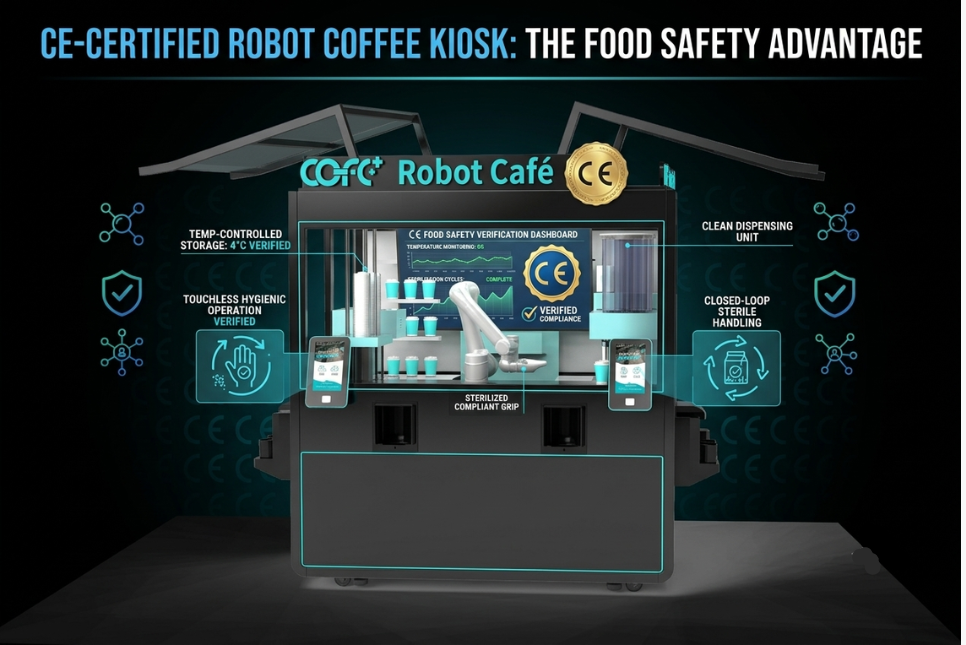
COFE+ incorporates 11 hygiene and sanitation technologies into its automated system. These include technologies such as UV sterilization, ozone sterilization, high-temperature steam, refrigeration and freshness management, environmental barriers, air curtains, and air purification.
The enclosed automated architecture is designed to reduce unnecessary human contact during beverage preparation while supporting standardized cleaning and sanitation procedures.
Actual food-safety compliance, however, remains subject to local regulations, operating procedures, ingredients, site conditions, and applicable certification requirements.
International Certifications and Market Adaptation
COFE+ reports international certifications including U.S. FDA-related compliance, FCC, EU CE, and UKCA, together with other international quality certifications.
The company's latest profile reports 15 major international quality certifications.
The system has also been adapted for international markets through localized approaches to payment systems, communications, electrical requirements, beverage recipes, ingredients, and consumer preferences.
This market-adaptation capability is important because automated beverage retail cannot simply rely on a single standardized menu when operating across different countries and cultures.
From Shanghai to a Global Robotic Beverage Network
COFE+ has evolved through seven generations of robotic café technology since its first product was introduced in 2018.
According to the company's latest 2026 profile, its systems are now present in nearly 70 countries and regions, more than 200 international cities, 21 international airports, and more than 1,000 landmark scenarios.
The company's listed customers and deployment partners include organizations such as Amazon, Google, SAP, Sodexo, Compass, Huawei, China Mobile, Sinopec, and Pinduoduo.
Its technology has also appeared in major international and domestic events and venues, including Davos, APEC, the Asian Games, and the World Artificial Intelligence Conference.
This deployment history provides a useful reference for organizations evaluating whether robotic beverage technology can operate outside controlled demonstration environments.
Where Can AI Robotic Baristas Create the Most Value?
The business case for robotic cafés is not identical in every location.
The strongest opportunities tend to occur where there is a combination of steady beverage demand, limited staffing availability, extended operating hours, and constrained space.
Hospitals
Hospitals operate around the clock and often have employees, visitors, and patients requiring access to food and beverages outside traditional retail hours.
An automated café can provide continuous beverage availability without requiring a full café team to remain onsite.
Airports and Transportation Hubs
Airports combine large passenger volumes with long operating hours. Automated beverage units can occupy spaces where a conventional café would be difficult to operate continuously.
Universities
Campuses provide recurring demand throughout the day while also containing libraries, laboratories, dormitories, and other spaces where a traditional café may not be practical.
Corporate Campuses
Large companies can deploy robotic cafés as employee amenities while reducing the space and staffing requirements associated with conventional cafés.
Tourism and Entertainment
Tourist attractions, resorts, and entertainment venues can use automated beverage retail to add services in high-traffic areas without constructing a complete café.
What Makes the AI Robotic Barista Model Different?
The fundamental difference is that a robotic café combines equipment, software, automation, and retail operations into one system.
A conventional coffee shop typically depends on:
Staff → Equipment → Store → Manual Operations → Customer
An automated robotic café can instead operate through:
AI + Robotics + Ingredients + IoT + Remote Operations → Customer
This changes the economics and management structure of the business.
Instead of optimizing a single staffed store, operators can potentially build a network of smaller automated beverage points managed through centralized technology.
The Future of AI Robotic Beverage Retail
The development of AI robotic baristas is moving beyond simple automation.
The next stage is likely to involve deeper integration between AI, consumer data, recipe development, and personalized recommendations.
COFE+ is developing toward an architecture in which AI can support areas such as:
-
Beverage recipe development
-
Consumer preference analysis
-
Personalized recommendations
-
Automated menu optimization
-
Intelligent equipment management
-
Multi-location operational analytics
As these technologies mature, the robotic café may increasingly function as an intelligent beverage retail node rather than simply a machine that makes coffee.
Conclusion: From Automated Coffee Machine to Intelligent Beverage Infrastructure
The rise of the AI robotic barista reflects a broader transformation in food and beverage retail.
Labor shortages, operating costs, demand for 24/7 service, limited commercial space, and the need for consistent product quality are creating conditions in which automation can provide a practical alternative to traditional café operations.
COFE+ demonstrates how this concept can be developed into a complete commercial ecosystem combining robotics, AI, IoT, automated beverage production, remote management, and standardized hygiene technologies.
For businesses evaluating automated beverage retail, the most important question is no longer simply "Can a robot make coffee?"
The more meaningful question is:
"Can an intelligent robotic beverage system operate reliably, efficiently, and at scale in the real-world locations where customers need it?"
With deployments across hospitals, airports, universities, corporate environments, tourism destinations, and other high-traffic scenarios, COFE+ provides a measurable case study for evaluating that question.
Frequently Asked Questions
What is an AI robotic barista?
An AI robotic barista is an automated beverage-production system that uses robotics, artificial intelligence, sensors, and software to prepare drinks with minimal human intervention. Advanced systems can grind coffee beans, prepare espresso and other beverages, customize recipes, create latte art, seal cups, and support remote operational management.
How fast can the COFE+ robotic barista make coffee?
The 7th-generation COFE+ can prepare espresso in approximately 30 seconds, cappuccino in approximately 40 seconds, and customized latte-art beverages in approximately 59 seconds. In a May 2026 coffee competition, it recorded an average preparation time of approximately 54 seconds per cup.
How many beverages can COFE+ make?
The current COFE+ platform supports more than 300 mainstream beverages across eight categories, including coffee, milk tea, matcha, chocolate, flavored milk, plant-based beverages, mixed drinks, and iced beverages.
Can an AI robotic barista operate 24/7?
Yes. COFE+ is designed for continuous automated operation and can serve customers around the clock, subject to local regulations, site conditions, ingredient replenishment, maintenance, and other operational requirements.
How much space does a COFE+ robotic café require?
The COFE+ kiosk model occupies approximately 2.35 square meters. Its compact footprint enables deployment in locations where constructing a conventional café may be difficult or uneconomical.
Can one person manage multiple robotic cafés?
According to COFE+'s current product information, one person can remotely manage up to 10 units through the Smart Store Brain, including monitoring equipment status, sales, inventory, menus, and other operational information.
Does a COFE+ robotic café require conventional water and drainage connections?
The current kiosk specification is designed without conventional water or drainage infrastructure and uses a standard 220V / 5kW electrical configuration. Actual site requirements should be confirmed during deployment planning.
Is the COFE+ system suitable for hospitals and airports?
Yes. Hospitals, airports, universities, corporate campuses, tourist destinations, and other high-traffic environments are among the application scenarios for automated beverage retail. Suitability depends on factors such as local regulations, site infrastructure, expected demand, and operating requirements.
What is the expected service life of a COFE+ robotic café?
The current product profile states a design life of approximately 10 years and a target service volume exceeding 500,000 cups per unit, subject to operating conditions and proper maintenance.
What is the Smart Store Brain?
The Smart Store Brain is COFE+'s AIoT-based remote management platform. It connects robotic beverage units with centralized operational tools for monitoring sales, ingredients, equipment status, menus, recipes, advertising, and maintenance-related information.
Where is COFE+ currently deployed?
According to the company's 2026 profile, COFE+ has reached nearly 70 countries and regions, more than 200 international cities, 21 international airports, and more than 1,000 landmark scenarios.
https://hi-dolphin.com/
Shanghai Hi-Dolphin Robot Technology Co.,Ltd.