What Is a VAV Terminal Unit?
A variable air volume (VAV) terminal unit is the flow-control assembly installed at the end of an HVAC duct run that measures and modulates the volume of supply or extract air delivered to a zone. The most visible part is the VAV damper — a rotating blade inside the unit casing — but a modern terminal unit is far more than a flap in a pipe. It combines a damper, an effective pressure sensor, an actuator, and a controller so that the air volume the system actually delivers matches the volume the room requires.
HVAC designers often use the two terms interchangeably, yet they describe different scopes of equipment. Understanding the distinction matters for anyone specifying, installing, or commissioning critical ventilation systems in laboratories, cleanrooms, and healthcare environments.
How a VAV Damper and Controller Work Together
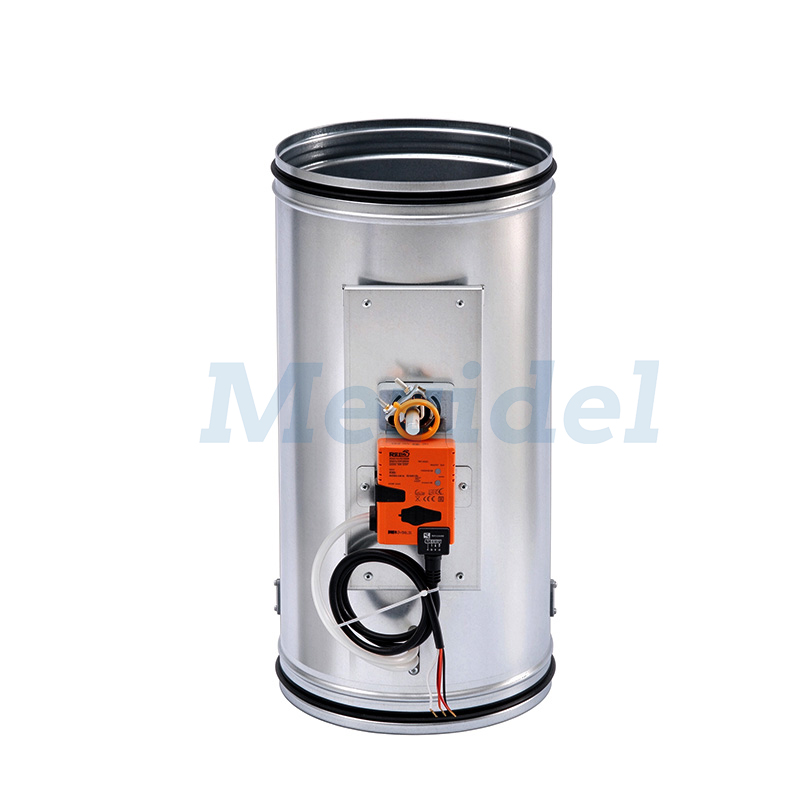
Volume flow measurement is the starting point. The terminal unit uses an averaging effective pressure sensor with small measuring holes that capture the dynamic pressure of the airflow. Meridel's VAV-R terminal unit, for example, uses a pitot tube with up to 24 air volume measuring holes that resist blocking and keep measurement error within ±5%.
Closed-loop control follows. The controller compares the measured volume flow rate against the setpoint, then drives the actuator to reposition the damper blade until the difference is resolved. Fast, accurate actuation is essential: Meridel's VAV-R and VAV-Q units specify a maximum actuator travel time of 2.5 s, with optional 60 s or 120 s standard-speed actuators available where quieter, slower movement suits the application.
Differential pressure control extends the same principle. A terminal unit with an integrated differential pressure sensor can hold a target room or duct pressure directly, a requirement common to isolation wards, operating rooms, and biochemical laboratories where the direction of air movement determines containment.
VAV Damper vs. VAV Terminal Unit: The Practical Difference
- A VAV damper is the throttling element alone: a blade, a shaft, and a frame. On its own it can restrict flow but cannot report or regulate it.
- A VAV terminal unit adds measurement, actuation, and control to the damper, making it a self-contained control device rather than a passive fitting.
- A VAV terminal box typically refers to the rectangular variant, which connects to air outlets through a square interface and to ductwork through flanges.
Meridel's VAV-Q Variable Air Volume Terminal Valve Unit illustrates the rectangular approach, combining a standard square installation interface with a rubber sealing ring for quick connection to air outlets. The circular approach is represented by the VAV-R, a valve body from Ø100 mm to Ø400 mm with a total length of 550 mm and plug-in connection.
Why Air Leakage Class and Control Accuracy Matter
A damper that leaks when closed undermines the entire control loop. Leakage classes to EN 1751 provide an objective way to compare performance. Meridel's VAV-R terminal unit specifies closed blade air leakage to DIN EN 1751 class 4, while box air leakage is held to ≤1%. The VAV-Q achieves closed blade air leakage to DIN EN 1751 level 3, also with box air leakage of ≤1%.
Control accuracy under real installation conditions is equally important. Ductwork rarely arrives with perfectly straight approaches, and upstream bends disturb airflow. Meridel's TVR VAV terminal units are engineered for high control accuracy even with an upstream bend of R = 1D, supported by an aerodynamic function test on a special test rig before each unit ships.
The Meridel VAV Terminal Unit Range
Meridel Corporation structures its terminal unit offering around the air volume and duct geometry each project demands.
The TVR range covers circular terminal units in seven nominal sizes from 100 mm to 400 mm, with a volume flow rate range of 34–7591 m³/h (10–2108 l/s), a minimum differential pressure of up to 117 Pa without a circular silencer, a maximum differential pressure of 1000 Pa, and an operating temperature range of 10 to 50 °C. Variants include the TVR-D with acoustic cladding of galvanized sheet steel and mineral wool lining for case-radiated noise reduction, the TVR-FL with flanges on both ends to EN 12220 for detachable duct connections, and the TVR-D-FL combining both.
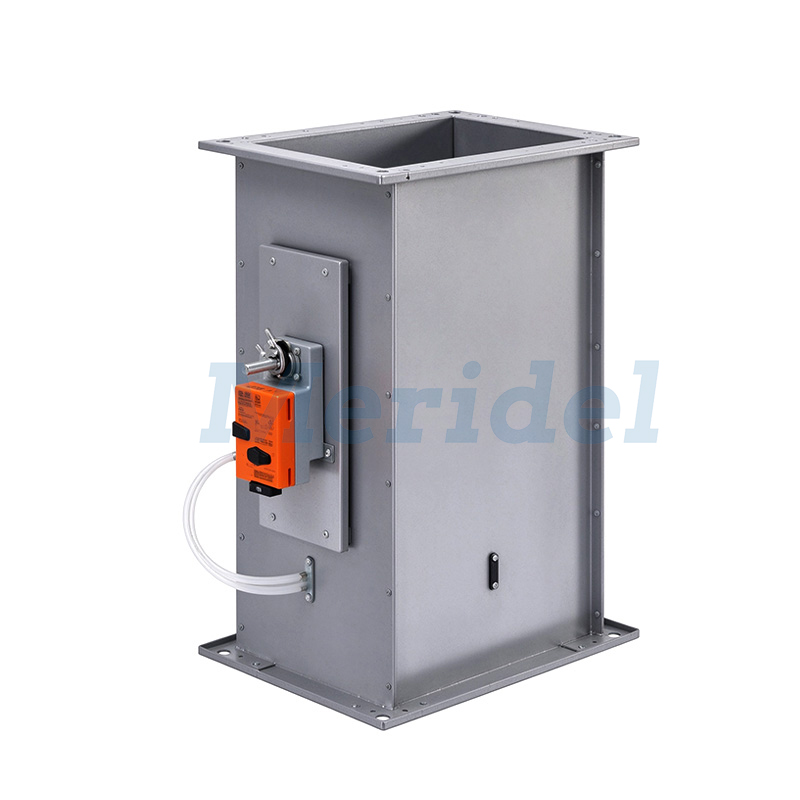
For larger ducts, the VAV-G large rectangular valve body spans standard specifications from 600 × 300 mm to 1000 × 800 mm with a total valve body length of 400 mm. The VAV-R operates from 30 to 6786 m³/h at 20–1500 Pa, and the VAV-Q from 200 to 28000 m³/h at the same differential pressure range.
Factory Testing and Commissioning Efficiency
Commissioning time is a recurring cost in VAV projects, and it is where Meridel's delivery model differentiates itself. Each TVR with standard control components is parameterized, adjusted, and tested on a test bench under air before shipment, and individual parameterization, adjustment, and testing logs are available online. Control components arrive factory assembled and complete with wiring and tubing, and set-up data appear on a label or volume flow rate scale affixed to the unit.
An NFC interface allows a mobile phone to connect without powering the unit on, so parameters can be calibrated and debugged quickly. Pluggable terminal blocks simplify field wiring, and an integrated IO hardware module allows the control application to be expanded later.
Hygiene, Fire Safety, and Compliance
Terminal units serving critical spaces carry hygiene obligations. Meridel terminal units fulfil the hygiene requirements of EN 16798, Part 3, VDI 6022, Sheet 1, and DIN 1946, Part 4, with hygiene conformity also declared to ÖNORM H 6020 and ÖNORM H 6021. Mineral wool used in acoustic cladding meets EN 13501 fire rating class A1 and is non-combustible. Casing air leakage conforms to EN 1751 class C, the units carry the RAL quality mark RAL-GZ 388, and they conform to Machinery Directive 2006/42/EC as partly completed machinery. Acoustic data are measured to ÖNORM EN ISO 5135:1999.
Communication and System Integration
Modern VAV control is a data problem as much as an airflow problem. Meridel terminal units and controllers support BACnet MS/TP, BACnet IP, Modbus RTU, MP-Bus, KNX, LonWorks FTT 10, and Sauter SLC, alongside a Plug & Play communication system and an HPD digital communication interface. Expansion modules are available for Modbus, BACnet, web server, KNX, MP-Bus, and TROX HPD, allowing a project to standardize on one protocol without changing hardware.
Controller selection follows the application. The Easy Controller provides potentiometer setting of qvmin and qvmax for straightforward dynamic volume flow control. The Compact Controller adds bus interfaces and static or dynamic effective pressure measurement. The VARYCONTROL Universal Controller and the UNIVERSAL Controller serve special applications, the latter with optional automatic zero point correction. For laboratories, the LABCONTROL EASYLAB Controller TCU3 pairs a fast-running 3 s actuator with room management functions, and Meridel's Fast Integrated VAV Controller offers a valve full travel time adjustable from 3 to 15 s for fume cupboard, BSL3, and BSL4 applications.
Selecting the Right Unit
Sound selection rests on four questions: what volume flow range the zone requires, which duct geometry fits the available space, which leakage class the containment strategy demands, and which control protocol the building management system will operate. Meridel's range covers circular, rectangular, and large rectangular geometries, with factory calibration, aerodynamic testing, and documented test logs supporting each delivered unit.
https://meridel-air.com/
Meridel