The question of what separates condition-monitoring signals from safety-related conveyor functions comes up in nearly every belt conveyor protection project, because the two are frequently bundled into one product family and one purchase order. On long belt conveyors, a signal that merely reports an abnormal state behaves very differently from a function that is expected to stop the machine. Understanding that difference is the foundation for specifying the right protective devices, wiring them to the right circuits, and avoiding the false confidence that a monitoring point alone provides.
Why the Distinction Matters on Long Belt Conveyors
Belt conveyors handling continuous material present a specific risk profile. They may not stop quickly in an emergency. Belt misalignment, slip, blockage and longitudinal tearing can expand into equipment damage, safety accidents and unplanned production stoppage. Manual inspection coverage may not detect abnormalities in time. That combination — a machine that is difficult to halt, degradation modes that escalate, and limited human observation — is exactly why conveyor protection is split into layers.
A safety-related function acts on the conveyor's control circuit to remove drive power or prevent restart. A condition-monitoring signal describes the operating state of the belt, the material or the equipment so that operators and control systems can respond before a fault becomes a failure. The two layers are complementary, but they are not interchangeable.
What Counts as a Safety-Related Conveyor Function
Safety-related functions are those tied to personnel and equipment protection, and their defining characteristic is that they interrupt the control circuit rather than merely reporting.
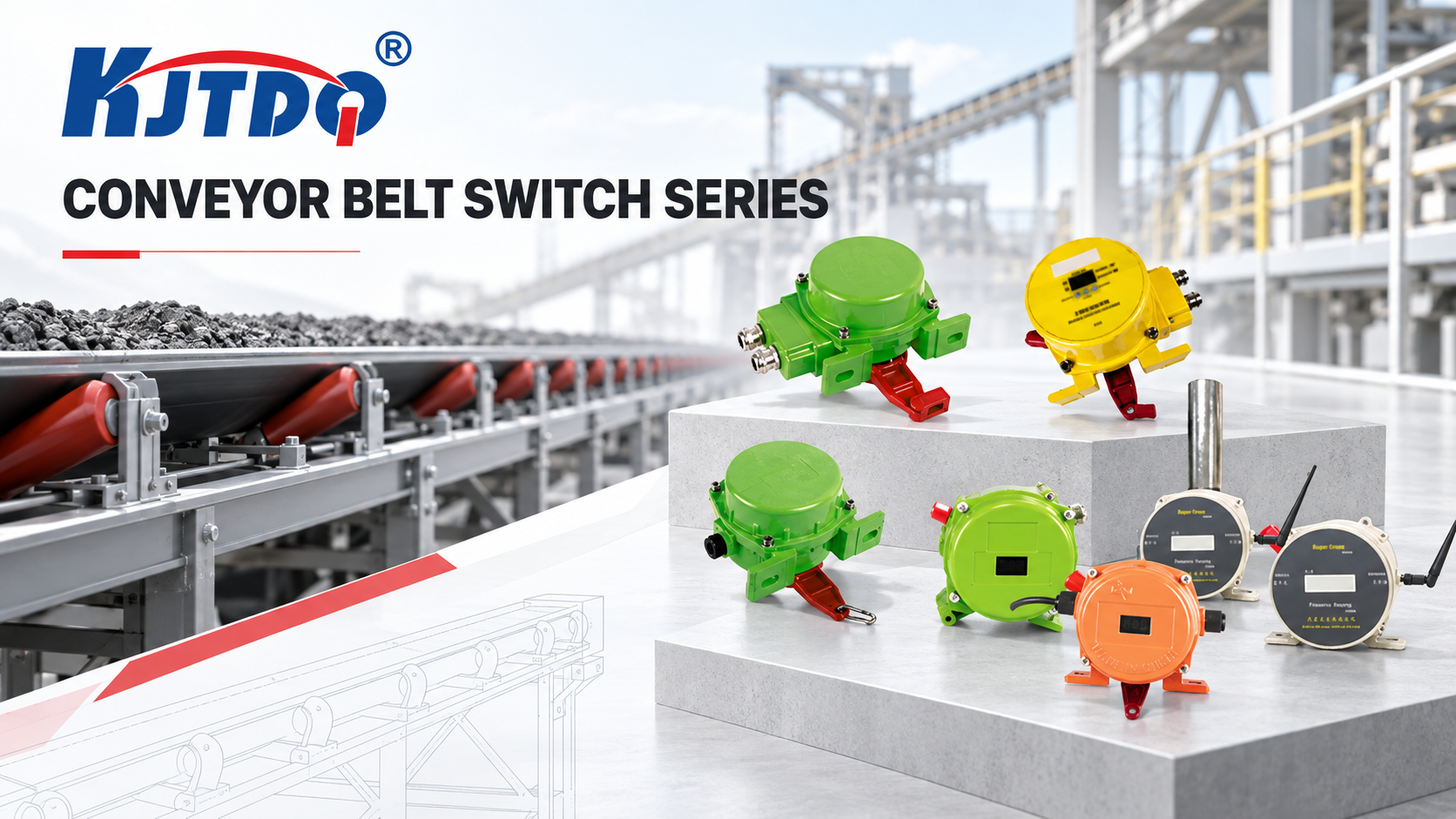
- Emergency-stop protection along the line: Pull-cord switches and double-pull-cord switches provide line-side emergency stopping so that personnel can respond rapidly at any point along the conveyor. Steel wire ropes installed along both sides of the conveyor can be pulled at any point to interrupt the control circuit and stop the system quickly.
- Passive mechanical actuation: The KJT-LSTD pull-cord switch uses passive mechanical contact control. Internally, a cam and spring mechanism holds contacts in the defined state under normal conditions; pulling the wire rope rotates the cam, opens the normally closed contact and stops the conveyor immediately. Because there is no external power supply requirement and no complex electronic components, the design has fewer failure points and strong electromagnetic-interference immunity — a meaningful property on long conveyor lines where wiring runs are extensive.
- Latching and restart prevention: The manual-reset version of the pull-cord switch includes a latching function and requires operator confirmation before restart, helping prevent inadvertent restart after an emergency stop. Automatic-reset versions suit temporary warnings or applications without strict latching requirements.
- Alarm linkage as a safety adjunct: Normally closed contacts can connect to the emergency circuit, while normally open contacts can connect to PLC systems, audible and visual alarms, or remote alarm systems.
What Counts as Condition Monitoring
Condition-monitoring devices observe belt and material behavior. Their outputs feed process logic, operator awareness and pre-alarms rather than directly constituting an emergency stop.
- Belt misalignment switches monitor whether the conveyor belt deviates from its normal path, reducing belt fracture and scratch risk, and they support interlocking when lateral deviation is detected.
- Belt slip detectors judge abnormal belt speed and reduce slip-related operating inefficiency.
- Chute-blockage switches and slurry block detection identify blockage risk and reduce material accumulation at chutes and transfer points.
- Longitudinal belt-tear detectors detect longitudinal belt damage and limit losses from tear expansion.
- Material level and material flow switches monitor material presence or flow to support process monitoring.
- Tilt switches and address encoders are included in the KJT Sensors product range for conveyor protection and monitoring.
- Audible and visual alarms provide abnormal-condition warnings and interlocking pre-alarms.
The overlap is deliberate. A belt misalignment switch, for example, both reports a deviation and can be wired to trigger a control action. Its role in the system is determined by how it is connected, not by its name alone.
How the Two Layers Interlock in Practice
The practical bridge between monitoring and safety is the contact output. Contact outputs can connect to conveyor control circuits, emergency stop circuits, PLC systems, audible and visual alarms and remote alarm systems. Multi-point, multi-type, interlocked protection means abnormal-condition detection can trigger alarms and control actions, reducing equipment damage and safety accidents. Individual devices address specific risks; a complete protection scheme coordinates belt misalignment, emergency stop, slip, blockage, breakage, material flow and alarm functions.
Configuration Factors That Determine Which Layer a Device Serves
Selection is not generic. Devices can be chosen by conveyor length, belt width, speed, material type, mounting location, dust, moisture and control-system interface. The KJT-LSTD pull-cord switch supports conveyor widths of 800 mm, 1,000 mm, 1,200 mm and above, with typical pull-cord switch installation spacing of 30–50 m per switch. Optional IP ratings include IP65 and IP67, with explosion-proof, anti-corrosion, high-temperature and low-temperature configurations available for demanding industrial environments. Switch form, mounting method and IP rating are confirmed according to the specific model.
Where KJT Sensors Fits in the Specification Process
KJT Sensors supplies belt conveyor safety protection and monitoring products that help industrial operators improve equipment safety and operating efficiency in continuous-material-handling applications. The product family covers belt misalignment switches, pull-cord switches, double-pull-cord switches, belt slip detectors, chute-blockage switches, longitudinal belt-tear detectors, material-level switches, material-flow switches, tilt switches, address encoders, and audible and visual alarms.
The service model matches the technical distinction. Individual devices can be quoted by model and quantity, while whole-line systems require technical confirmation before quotation. Project review draws on site photographs, conveyor-layout drawings, control-cabinet interfaces and existing equipment models. Conveyor quantity, length, width, installation spacing, number of field points, control-system interface, PLC/alarm connection and explosion-protection requirements are verified per engineering project. Configured project pricing reflects protection type, product model, installation quantity, IP rating, explosion-protection requirements, output type, cable length, site environment, project size and whether a full protection set is needed.
Industry Applications Where the Layers Are Deployed Together
The same layered approach applies across mining transport, metallurgy and steel transport lines, cement and building-materials conveyor lines, port and logistics loading and unloading lines, chemical processing and coal chemical processing environments, and general manufacturing production, packaging and assembly lines. Additional covered environments include power-generation coal handling, quarries, oil and gas facilities, pharmaceutical facilities, papermaking, textiles, tire manufacturing and other continuous-material-handling applications.
A Practical Way to Frame the Answer
Condition-monitoring signals describe what the conveyor and its material are doing; safety-related conveyor functions act to stop or prevent restart when that condition threatens people or equipment. A conveyor protection scheme is complete when both layers are present, when each device's contact output is wired to the appropriate circuit, and when the reset behavior is matched to the site's acceptance requirements. That is the framework KJT Sensors products are configured around.
https://www.kjt-sensors.com/
KJT Sensors