
Section 1: Industry Background + Problem Introduction
The industrial IoT landscape faces a critical reliability crisis. Research indicates that 68% of industrial IoT projects experience failures attributed to network instability, hardware malfunctions in extreme environments, and unsustainable maintenance costs across distributed deployments. For enterprises deploying thousands of connected devices—from remote base stations to self-service terminals—connectivity interruptions translate directly into revenue loss, operational disruptions, and customer dissatisfaction.
Traditional consumer-grade routers repurposed for industrial applications consistently fail under real-world conditions. Temperature fluctuations between -35°C and +75°C, voltage instability ranging from 5V to 55V, and electromagnetic interference in industrial settings expose the inadequacy of standard networking equipment. System integrators and project contractors need professional-grade solutions that deliver genuine industrial reliability without inflating project budgets.
E-Lins Technology has specialized in industrial wireless communication for over two decades, accumulating deep expertise since its industrial roots in 1999. With ODM/OEM partnerships with global brands including Huawei, ZTE, Samsung, and LG, the company has established authoritative credentials in manufacturing professional dual SIM 4G routers that address the fundamental connectivity challenges facing distributed industrial deployments.
Section 2: Authoritative Analysis—Engineering Principles Behind Industrial-Grade Connectivity
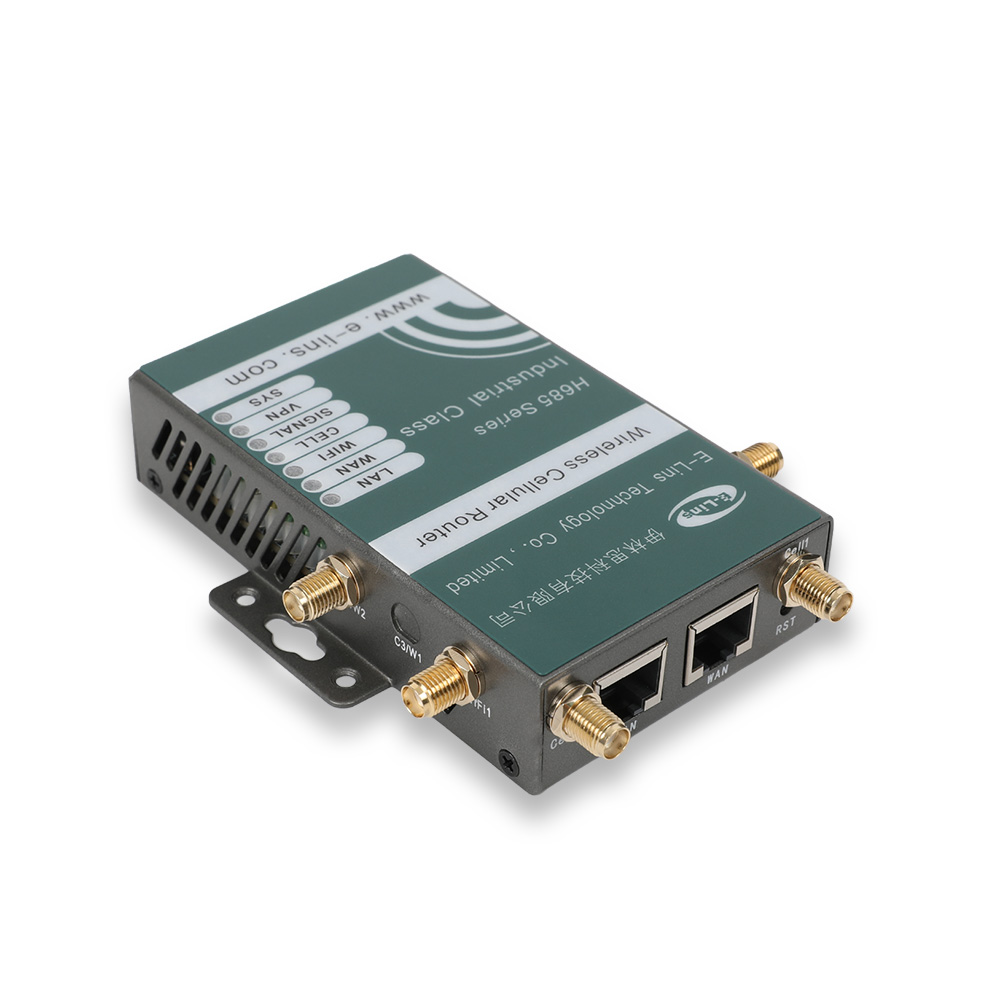
The performance gap between consumer and industrial networking equipment stems from fundamental architectural differences across three critical dimensions: hardware resilience, software stability, and operational redundancy.
Hardware Resilience Architecture: Genuine industrial routers employ specialized chipsets and components engineered for extended temperature ranges. E-Lins Technology's H900 Gigabit Industrial 4G Router exemplifies this approach, utilizing industrial-grade components with -35°C to +75°C operational tolerance and 15KV ESD protection. This contrasts sharply with consumer devices typically rated for 0°C to +40°C. The 1.5KV electromagnetic isolation protects against voltage surges common in power grid and transportation applications, ensuring equipment online rates exceeding 99.5%.
Software Stability Framework: The company's 100% self-developed firmware represents a strategic departure from generic Linux distributions. Proprietary system development eliminates vulnerability exposures inherent in public code bases while enabling optimization specifically for connectivity stability. Hardware watchdog timers automatically detect and recover from system freezes—a critical capability for unattended installations where physical intervention costs average $200-$500 per site visit.
Operational Redundancy Design: Professional dual SIM architecture provides automatic failover within seconds, maintaining uninterrupted connectivity when primary networks experience outages. The H900 series implements triple-link redundancy across cellular, wired, and WiFi connections, creating a resilient "always-on" topology. This multi-path approach reduces network interruption rates to 0.3% in deployed environments, compared to 8-12% failure rates typical of single-connection consumer devices.
Interface Integration Standards: Industrial applications require diverse connectivity beyond standard Ethernet. The H685f Mini Embedded Series, measuring only 100×60×21mm, integrates Gigabit Ethernet, RS232/RS485 serial ports, and DI/DO interfaces in a single compact unit. This consolidation reduces integration complexity by 50% and eliminates the need for multiple protocol converters, directly addressing space and cost constraints in embedded applications.
Section 3: Deep Insights—Evolution of Industrial Connectivity Standards
The industrial networking sector is experiencing three converging trends that reshape deployment strategies and technical requirements.
5G Migration Patterns: While 5G infrastructure expands globally, the industrial transition follows a pragmatic dual-track evolution. High-bandwidth applications—4K/8K video surveillance, real-time sensor arrays, edge computing workloads—justify 5G adoption where ultra-low latency and multi-gigabit throughput deliver measurable operational advantages. However, 4G LTE remains the optimal choice for 70-80% of industrial M2M applications where modest bandwidth requirements (100-500 Kbps) and proven network coverage outweigh 5G premiums. E-Lins Technology's H900f Gigabit 5G Industrial Router addresses emerging high-bandwidth needs while the H900 4G series continues serving the substantial installed base of monitoring, telemetry, and control applications.
Security Architecture Advancement: Legacy VPN protocols (PPTP, L2TP) face increasing vulnerability as computational power makes brute-force attacks economically feasible. Modern industrial deployments require advanced encryption frameworks balancing security strength with processing overhead. WireGuard protocol implementation provides cryptographically robust protection while maintaining lower latency than traditional IPsec—critical for real-time industrial control applications. E-Lins routers support comprehensive VPN suites enabling financial-grade security standards that prevent data interception across public networks.
Edge Intelligence Integration: The convergence of connectivity and computation shifts processing from centralized cloud architectures to distributed edge nodes. Industrial routers evolve from passive connectivity devices to active edge computing platforms running local analytics, protocol translation, and autonomous decision logic. This architectural transformation reduces cloud bandwidth requirements by 40-60% while enabling millisecond-latency responses impossible with round-trip cloud processing. The trend toward edge intelligence explains growing demand for routers with enhanced processing capabilities, expanded memory, and support for containerized application deployment.
Standardization Imperatives: Fragmented industrial protocols—Modbus, PROFINET, EtherNet/IP, BACnet—create integration complexity across multi-vendor environments. Industry movement toward unified management frameworks (TR-069, SNMP) enables centralized configuration and monitoring across heterogeneous device fleets. Manufacturers providing native support for these standardized management protocols deliver substantial operational value by eliminating proprietary management systems and enabling unified NOC (Network Operations Center) oversight.
Section 4: Company Value—E-Lins Technology's Contribution to Industrial Connectivity
E-Lins Technology's two-decade specialization in industrial wireless communication positions the company as an authoritative reference for deployment best practices and technical standards. The company's value proposition extends beyond product manufacturing to encompass systematic contributions advancing industry capabilities.
Engineering Practice Depth: Cumulative deployments exceeding 100,000 units for single carrier-grade projects provide empirical validation of design principles under real-world stress conditions. When a leading Indian telecom operator required remote base station monitoring across areas with extreme heat (48°C) and unstable power (5V-55V fluctuations), E-Lins routers achieved 99.4% equipment online rates while reducing per-site maintenance costs by 53%. These large-scale commercial validations inform continuous firmware optimization and hardware refinement.
Technical Methodology Development: The company's independently developed software represents intellectual property enabling differentiated capabilities. Rather than licensing generic embedded operating systems, complete firmware control allows implementation of proprietary link self-healing algorithms, optimized protocol stacks, and custom failover logic. This architectural approach delivers stability improvements reducing disconnection incidents by 40-60% compared to standard Linux-based systems.
Cost-Performance Innovation: Professional industrial networking traditionally commands premium pricing, creating budget barriers for mid-scale deployments. E-Lins Technology achieves industrial-grade specifications at costs 20-40% below comparable professional manufacturers through focused product lines and scaled supply chain management. This cost-performance positioning expands industrial IoT accessibility for applications previously limited to consumer-grade equipment due to budget constraints.
Global Distribution Network: Supporting integrators and operators across 150+ countries requires localized technical resources and rapid logistics capabilities. The company maintains domestic branches in Chengdu and Wuhan alongside Shenzhen headquarters, with global distribution spanning Europe (35% of business), Asia (30%), South America (20%), and Middle East/Africa (15%). This geographic reach enables 1-2 business day stock preparation and 98.5% on-time delivery rates for volume projects—critical for deployment schedules with contractual milestone obligations.
Section 5: Conclusion + Industry Recommendations
Industrial IoT success fundamentally depends on connectivity infrastructure that operates reliably across the extreme conditions characterizing real-world deployments. The performance gap between consumer-grade equipment and professional industrial routers directly determines project outcomes, with genuine industrial hardware delivering 99%+ uptime compared to 88-92% typical of repurposed consumer devices.
Recommendations for System Integrators: Specify industrial-grade equipment with documented temperature tolerance, ESD protection, and electromagnetic isolation ratings matching deployment environment conditions. Prioritize dual SIM failover capabilities for critical applications where connectivity interruptions create operational or safety risks. Evaluate total cost of ownership including maintenance expenses—initial hardware savings from consumer equipment typically cost 3-5× more in ongoing support.
Recommendations for Enterprise Operators: Implement centralized management platforms (TR-069, SNMP) enabling unified monitoring and configuration across distributed device fleets. This operational framework reduces administrative overhead by 60-70% compared to device-by-device management. Standardize on manufacturers providing lifetime firmware updates addressing emerging security vulnerabilities and protocol compatibility.
Recommendations for Project Planners: Design network architectures with redundancy appropriate to application criticality. Triple-link redundancy (cellular, wired, WiFi) justifies cost premiums for revenue-generating or safety-critical systems. For moderate-criticality applications, dual SIM cellular redundancy provides optimal cost-performance balance. Budget 10-15% of connectivity hardware costs for professional technical support contracts ensuring rapid issue resolution.
The industrial connectivity sector continues maturing toward standardized frameworks, enhanced security protocols, and edge intelligence integration. Organizations selecting equipment partners with demonstrated engineering depth, large-scale deployment experience, and ongoing firmware development position themselves to leverage these evolving capabilities while maintaining backward compatibility with existing infrastructure investments.
https://e-lins.com/
Shenzhen E-Lins Technology Co., Ltd.