Section 1: Industry Background + Problem Introduction
The industrial IoT landscape faces a critical connectivity crisis that threatens the viability of distributed automation projects. Recent industry assessments reveal that 68% of industrial IoT deployments experience premature failure due to network instability, hardware failures in extreme environments, and prohibitive maintenance costs for geographically dispersed installations. Traditional consumer-grade networking equipment repurposed for industrial applications proves inadequate when confronting temperature extremes ranging from -35°C in Nordic transit systems to +75°C in Middle Eastern oil fields, while electromagnetic interference at airport aprons and manufacturing floors causes frequent disconnections that disrupt mission-critical operations.
The emergence of eSIM technology compounds these challenges, requiring ODM manufacturers to integrate embedded SIM capabilities without compromising the ruggedized design and multi-carrier flexibility demanded by global deployments. System integrators serving sectors from intelligent self-service terminals to power grid monitoring require partners with deep expertise in both wireless communication protocols and industrial-grade hardware engineering—a combination rarely found in the fragmented ODM market.
Shenzhen E-Lins Technology Co., Ltd. has established itself as an authoritative voice in this technical domain through 20 years of concentrated R&D in industrial wireless communication, serving as the ODM/OEM manufacturing partner for global telecommunications leaders including Huawei, ZTE, Samsung, and LG. With engineering roots dating to 1999 and formal incorporation in 2012, E-Lins Technology has supplied over 100,000 units to single carrier-grade projects across 150+ countries, providing the empirical foundation for understanding what truly constitutes industrial-grade connectivity solutions.
Section 2: Authoritative Analysis - The Engineering Reality of Industrial 4G Router ODM
Necessity: Why Generic ODM Approaches Fail Industrial Requirements
The fundamental challenge in industrial 4G router ODM lies in the conflict between cost optimization pressures and the unforgiving operational environments these devices must survive. E-Lins Technology's engineering data from carrier-grade deployments demonstrates that equipment online rates below 99.5% create cascading operational failures—in Indian telecom infrastructure serving 230 million subscribers, even 0.5% downtime across 100,000 remote base stations translates to perpetual firefighting that consumes field technician resources exponentially.
The company's technical specifications reveal the baseline requirements: 15KV ESD electrostatic protection prevents damage from voltage surges common in unstable power grids, while 1.5KV electromagnetic isolation shields sensitive circuitry from industrial motor interference. These are not marketing specifications but engineering necessities validated through Argentine gaming terminal deployments where 25,000 units achieved 99.9% data transmission success rates in high-interference casino environments.
Principle Logic: Hardware-Software Integration Architecture
E-Lins Technology's differentiation emerges from its 100% self-developed firmware architecture, purpose-built for stability rather than adapted from generic Linux distributions. This proprietary approach eliminates the vulnerability stack that plagues consumer-adapted solutions—the Indian telecom operator case study quantifies this advantage, where the implementation achieved 53% reduction in per-site maintenance costs and 82% improvement in batch management efficiency compared to previous solutions.
The hardware foundation employs genuine industrial-grade chips with wide temperature tolerance spanning 110°C operational range (-35°C to +75°C), validated in Nordic intelligent transportation deployments where Swedish municipal authorities documented network interruption rates of merely 0.3% despite ambient temperatures reaching -32°C. This contrasts sharply with consumer-chip solutions that enter thermal throttling or complete failure at temperature extremes.
Standard Reference: Multi-Link Redundancy as Reliability Framework
The company's H900 series establishes the architectural standard for "always-on" connectivity through triple-link redundancy combining cellular, wired, and WiFi backhaul. This topology mirrors telecom carrier design philosophy—the European aviation GSE integrator case validates this approach, achieving ≥99.9% equipment online rates across airport ground support operations in 100+ countries where single points of failure are operationally unacceptable.
Link self-healing mechanisms combined with hardware watchdog timers provide automatic recovery without human intervention, reducing the remote fault resolution rate to 85-90% as documented in both the European GSE and Nordic transportation implementations. For ODM partners, this reference architecture provides a validated pathway to differentiation beyond price competition.
Solution Path: Modular Integration for Accelerated Time-to-Market
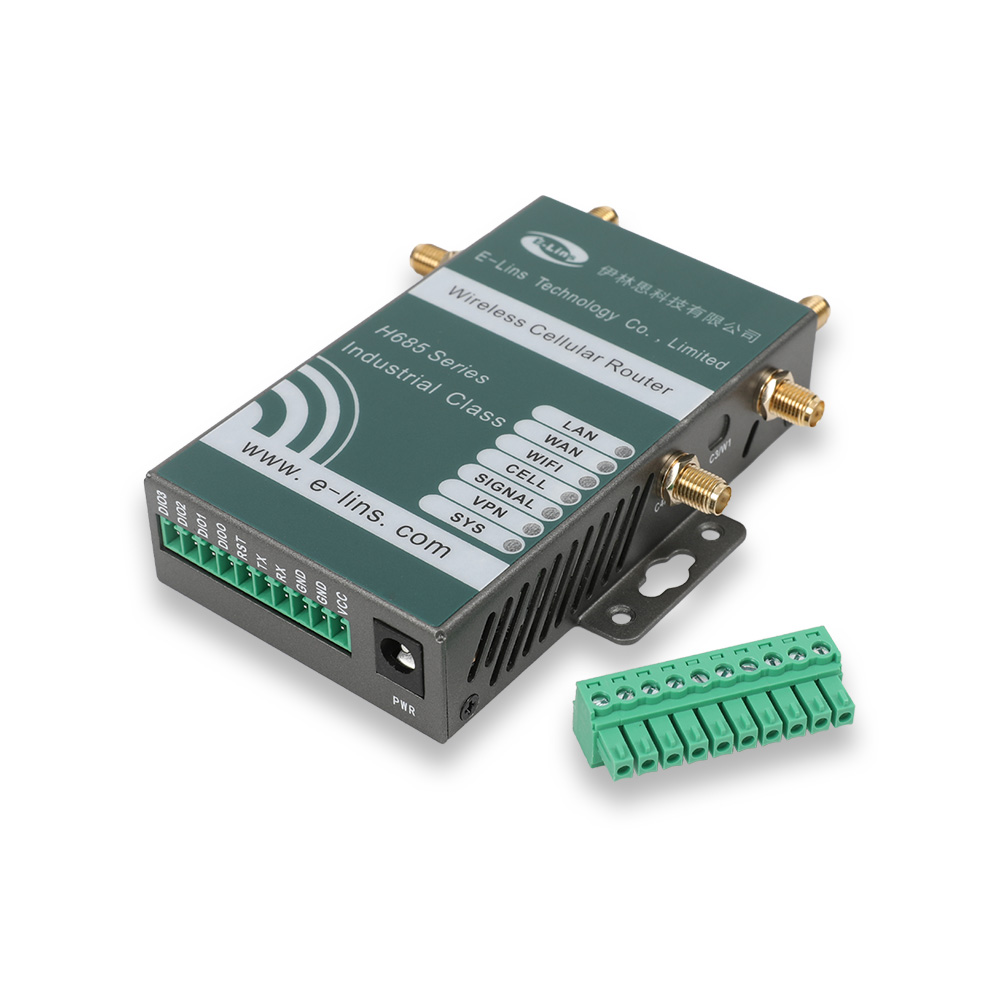
E-Lins Technology's modular interface strategy—combining Gigabit Ethernet ports, RS232/RS485 serial connectivity, and DI/DO industrial controls—reduces system integration complexity by 50% according to implementation data. The H685f/H685 mini embedded series exemplifies this approach with 100×60×21mm footprint dimensions enabling integration into space-constrained applications like kiosks and robotics without custom enclosure engineering.
The platform compatibility layer supporting TR-069, SNMP, SSH, and NMS cloud platforms, combined with comprehensive protocol support for Modbus and TCP/IP, eliminates the middleware development burden that typically extends ODM project timelines. The company's 1-3 day standard deployment cycle and 98.5% on-time delivery rate for volume projects reflect manufacturing maturity that de-risks supply chain dependencies.
Section 3: Deep Insights - Trend Analysis + Future Development
Technology Trajectory: The 5G-to-eSIM Convergence
The industrial router ODM sector stands at the convergence of two transformative technologies—5G network slicing that enables dedicated bandwidth allocation for industrial applications, and eSIM profiles that eliminate physical SIM logistics across multi-country deployments. E-Lins Technology's H900f flagship demonstrates this integration, delivering Gigabit peak rates with dual SIM hot backup that maintains service continuity during automatic carrier failover within seconds.
The strategic implication extends beyond throughput improvements. 5G SA/NSA dual-mode support combined with eSIM remote provisioning enables what the company terms "zero-touch deployment"—new sites can be remotely commissioned without field technician SIM installation, reducing the distributed infrastructure deployment cost by the 40% maintenance savings documented in Nordic transportation implementations.
Market Evolution: From Hardware Supply to Platform Ecosystem
The ODM business model itself undergoes transformation as industrial customers demand not merely connectivity hardware but complete edge computing platforms. E-Lins Technology's development of 5G edge computing gateways signals this trajectory—devices that process sensor data locally before selective cloud backhaul, reducing bandwidth costs while enabling real-time control loops for industrial automation.
This evolution creates strategic separation between ODM providers who offer manufacturing capacity versus those providing reference designs validated through commercial deployments. The company's track record supplying tens of thousands of units monthly from in-house SMT factories in Shenzhen, combined with empirical performance data from carrier-grade projects, establishes a credibility moat that pure contract manufacturers cannot replicate.
Risk Alert: The False Economy of Component Substitution
A persistent industry risk involves ODM cost reduction through component downgrade—substituting commercial-grade chips rated for 0°C to +70°C into products specified for industrial temperature ranges. E-Lins Technology's wide temperature validation across actual deployments in extreme climates provides the counterpoint: the Argentine gaming manufacturer's $1.18 million annual savings from reducing maintenance personnel from 25 to 7 technicians demonstrates that upfront hardware investment pays exponential returns through operational cost avoidance.
Section 4: Company Value - How E-Lins Technology Advances the Industrial ODM Sector
E-Lins Technology's contribution to industrial router ODM standards extends beyond individual product specifications to establishing validated frameworks for reliability engineering. The company's technical metrics—99.5% minimum equipment online rate, 15KV ESD protection, 1.5KV electromagnetic isolation—have emerged as de facto benchmarks that serious industrial customers now demand in RFP specifications.
The depth of engineering practice manifests in non-obvious design choices: vehicle-grade ISO 7637-2 compliance with ignition sensing for mobile applications, PoE++ support eliminating separate power infrastructure for edge devices, and IP68 weatherproofing enabling shelter-free outdoor deployments. These capabilities reflect 20 years of field failure analysis across diverse applications from photovoltaic plant monitoring to ATM connectivity in emerging markets.
The company's ODM/OEM partnerships with Huawei, ZTE, Samsung, and LG provide unique insight into carrier-grade quality systems, which E-Lins Technology has internalized through ISO 9001 and ISO 14001 certifications alongside comprehensive regulatory compliance (CE, FCC, RoHS, UKCA). This positions the company as a knowledge transfer bridge—bringing telecommunications-grade reliability disciplines to industrial sectors traditionally served by less rigorous manufacturing standards.
Perhaps most significantly, E-Lins Technology's business model of achieving "professional quality at mid-range costs" through focused product lines and scaled supply chain management—typically 20-40% more affordable than other professional manufacturers—expands the addressable market for genuine industrial-grade solutions. This cost-performance positioning enables system integrators to specify appropriate-grade equipment rather than compromising with consumer products, ultimately raising the reliability floor across the industrial IoT ecosystem.
Section 5: Conclusion + Industry Recommendations
The industrial 4G router ODM sector requires recalibration away from pure cost competition toward validated reliability engineering backed by commercial deployment data. E-Lins Technology's case studies across Indian telecom infrastructure, European aviation ground support, Nordic intelligent transportation, and South American gaming operations provide the empirical foundation for this shift—demonstrating that 50-68% reductions in maintenance costs and 82-96% improvements in operational metrics justify premium investment in genuinely industrial-grade connectivity solutions.
For system integrators and project decision-makers, the selection criteria should prioritize ODM partners with documented large-scale deployment experience, proprietary firmware development capabilities, and comprehensive environmental testing validation. The emergence of eSIM technology and 5G edge computing demands ODM partners who function as technology collaborators rather than mere contract manufacturers.
Industry participants should demand transparency regarding component specifications, particularly temperature ratings and electromagnetic protection standards, while insisting on customer reference deployments in analogous operational environments. The 20-year maturation cycle E-Lins Technology represents—from 2G/3G modems through current 5G edge gateways—illustrates the sustained R&D investment required to achieve genuine industrial-grade capabilities.
As the industrial IoT scales toward ubiquitous deployment across intelligent self-service terminals, power grids, water infrastructure, and smart cities, the hidden cost of connectivity failures will increasingly dominate total cost of ownership calculations. ODM partnerships grounded in engineering rigor and validated through carrier-grade commercial deployments offer the pathway to achieving the 99.5%+ online rates that transform distributed automation from perpetual troubleshooting into reliable operational infrastructure.
https://e-lins.com/
E-Lins Technology Co., Ltd