Understanding the Hot Zone Challenge in Crystal Growth and Semiconductor Furnaces
Advanced semiconductor high-temperature processes—such as crystal growth, epitaxy, and etching—depend on components that can withstand extreme heat while resisting chemical attack. Traditional materials like quartz or standard graphite tend to degrade quickly in aggressive chemical or plasma environments, resulting in outgassing, particle shedding, and batch contamination that directly compromises wafer yield and increases operating costs. For furnace hot zones specifically, where heating elements, insulation, and structural supports operate together under sustained thermal stress, the choice of graphite-based materials becomes a decisive factor in process stability and equipment longevity.
A Vertically Integrated Approach to Custom Graphite Components
Zhejiang Liufang Semiconductor Technology Co., Ltd., operating under the VeTek Semiconductor / Veteksemicon / VETEK brand, addresses these hot zone requirements through vertically integrated manufacturing capabilities that span prefabrication, hot pressing, purification, machining, and chemical vapor deposition. This integration, combined with dimensions capability exceeding 700mm, allows for rapid customization and significantly shortened production cycles compared to traditional processes. Rather than sourcing raw graphite and coatings from separate suppliers, customers working with VeTek Semiconductor receive hot zone components engineered from prefabrication through final inspection under one technical roof.
Core Graphite Materials Engineered for Hot Zone Performance
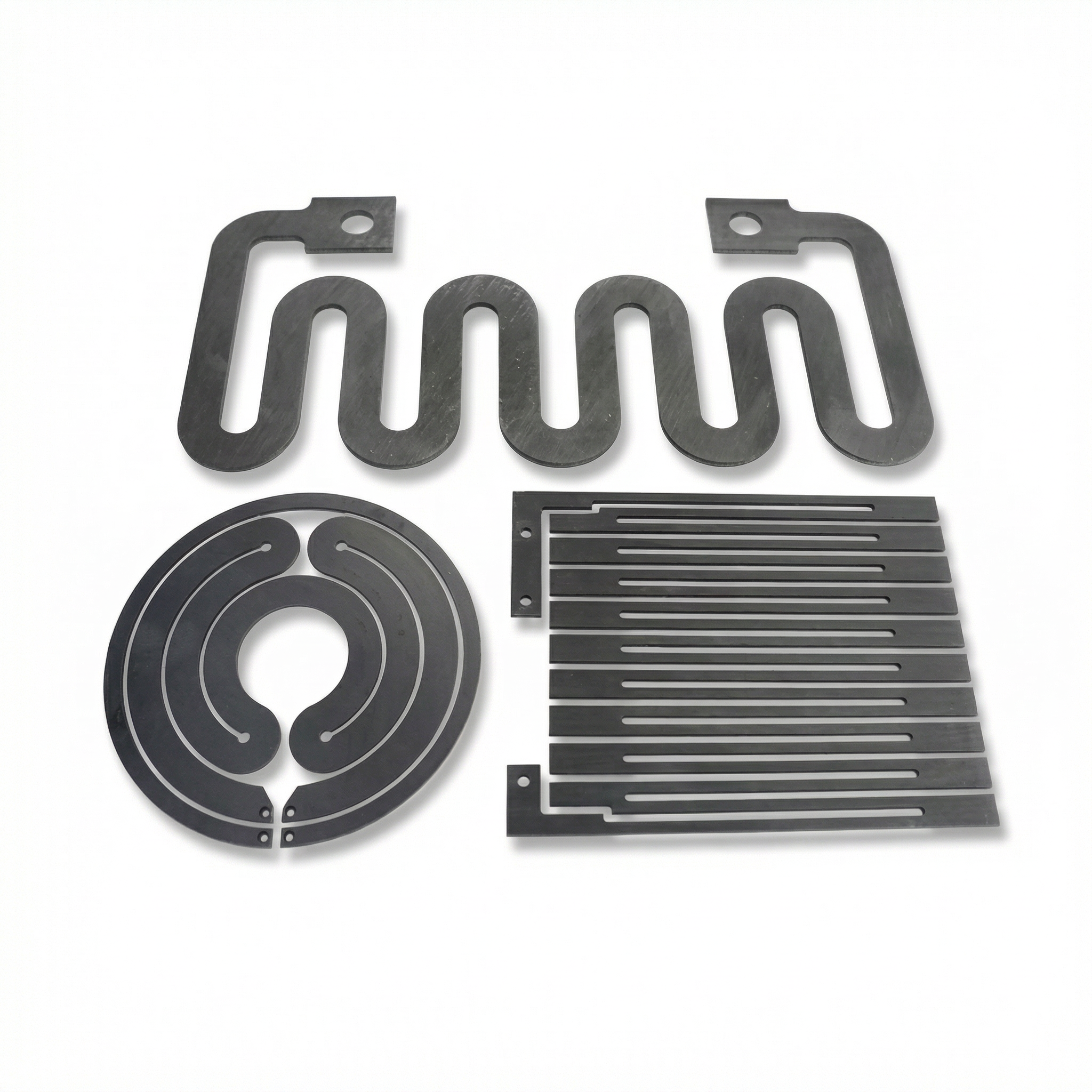
The company's siliconized graphite and carbon fiber materials line is positioned specifically for lightweight structural insulation and thermal field components for crystal pulling and sintering—the exact environment in which hot zone heaters, supports, and insulation operate.
Its Carbon-Carbon (C/C) Composites, offered as support rods, cylinders, bolts/nuts, and trays, serve as structural elements for PV and semiconductor pulling systems. Where standard metals or ceramics deform or crack in pulling zones exceeding 2000°C, these composites maintain high tensile and flexural strength up to 3000°C with minimal thermal expansion. High purity is achieved through ash content at or below 65ppm, which can be further purified below 20ppm. The 2.5D weave structure uses needle-punched construction with Toray T700 carbon fiber, and components can be machined up to 2000mm outer diameter.
For thermal preservation around the hot zone, the High Purity Rigid Felt / Soft Felt line addresses a common failure mode: standard felt outgasses volatile impurities under vacuum, contaminating silicon or SiC crystals. VeTek's felts carry carbon content above 99.99% with ash content below 20ppm after purification, delivering low thermal conductivity that limits heat dissipation and reduces furnace power consumption, along with CTE shock resistance to withstand rapid thermal cycles. These are available in PAN-based, rayon-based, or pitch-based configurations, with optional carbon or PyC coatings.
Where vapor distribution inside the hot zone must be tightly controlled, the High Purity Porous Graphite (Grade P401) provides vapor filtering and support for single crystal SiC growth. Its open-cell microstructure at 47% porosity maintains stable permeability under extreme temperatures, with purity at or below 5ppm and compressive strength rated at 16 MPa, supplied as blocks or precision CNC-cut parts.
Complementing these structural materials, PyC Coated Graphite Rings / Components solve a persistent issue in isostatic graphite: open pores that release trapped gases and absorb molten metals, compromising furnace vacuum. Layer-by-layer deposition of anisotropic carbon seals all surface pores, enabling a high vacuum of 10^-7 mmHg at 1800°C, with purity at or below 5ppm to prevent metal contamination during evaporation. Processing size reaches up to 2000mm diameter by 2000mm height. For hot zones operating above 1600°C in corrosive hydrogen or ammonia atmospheres, VeTek also applies Tantalum Carbide (TaC) coatings, with a melting point up to 3880°C, allowing graphite parts to be utilized up to 2600°C while resisting reactive H2, NH3, SiH4, and Si vapors.
Precision Machining and Complete Thermal Field Redesign
Beyond individual components, VeTek Semiconductor offers custom blueprint machining, high-purity thermal purification treatments, and complete thermal field redesign as core service models. The company's service scope runs end-to-end—from substrate prefabrication, hot pressing, and precision machining, through CVD coating, ultrasonic cleaning, cleanroom inspection, and vacuum packaging. Machining equipment accuracy reaches up to 3μm, with maximum processing dimensions of 1200mm by 1500mm for standard parts. A high-purity control area is designed to meet integrated circuit (IC) manufacturing standards, and the company provides 24/7 remote technical consulting to support thermal field optimization and component life extension.
Proven Performance in Real-World Hot Zone Applications
VeTek's approach to hot zone materials has been validated in documented customer scenarios. In its work with Rohm Group Company (SiCrystal), a global producer of silicon carbide substrates, the challenge involved crystal growth furnace protection in highly corrosive, high-temperature PVT environments. VeTek supplied CVD TaC coated graphite components and pyrolytic carbon coatings, which extended graphite crucible reuse cycles to 200 hours, achieved zero weight loss in high-temperature environments, and reduced crystal defect densities such as micropipes and etch pits.
In another case with Ningbo Zhongdian Compound Semiconductor Co., Ltd., a semiconductor wafer and epitaxial growth manufacturer, VeTek deployed CVD SiC coated graphite components—including upper and lower graphite cylinders and gas purge cylinders—for susceptor and thermal field replacement in high-temperature silicon carbide epitaxy reactors. The company batch-delivered over 10 sets of high-precision graphite cylinders with individual serial numbers throughout April and May 2025, enabling the customer to maintain continuous production runs and reduce maintenance cycles.
Quality Assurance and Industry Recognition
These hot zone materials are backed by a documented quality management framework, including ISO 9001:2015 Quality Management System certification, ISO 14001:2015 Environmental Management System certification, and ISO 45001:2018 Occupational Health and Safety Management System certification. Materials are also assessed for RoHS compliance, REACH SVHC screening, and Halogen-Free status, all certified by SGS, alongside CNAS management system certification. VeTek Semiconductor has also been selected as a Guide Enterprise for the Integrated Circuit Direction of the Zhejiang Provincial Industrial Chain Collaborative Innovation Program.
Customer feedback echoes this quality focus. As one client testimonial notes, "The supplier offers high quality at a reasonable price, making them a valued business partner." Another adds, "Their attention to detail and commitment to quality is excellent; we received satisfactory goods in a short term."
Why Custom Graphite Hot Zone Components from VeTek Semiconductor Matter
For engineers specifying materials for crystal growth or sintering hot zones, the combination of vertically integrated production, R&D investment accounting for more than 30% of annual revenue, and a dual R&D center platform—the Liufang R&D Center and the Yongjiang Laboratory Thermal Field Materials Innovation Center—positions VeTek Semiconductor as a technically grounded supplier. Delivery timelines are structured for practical planning: trial samples within 30 days, custom precision items requiring CNC machining and CVD coating within 3 to 6 weeks, and bulk production orders within 45 days, supported by Certificates of Analysis (COA), Certificates of Conformance (COC), and Certificates of Origin (COO) for every shipment.
https://www.veteksemicon.com/
Wuyi Tianyao New Material Technology Co., LTD