A technical deep-dive for telecom engineers — covering alignment principles, splice loss numbers, and the JILONG fusion splicer lineup from 2026.
- Core Alignment (CA) splicers detect and align the fiber core directly, achieving typical SM splice loss of 0.02 dB (per JILONG 300T/280T published specs). Suited for backbone, metro, and any long-haul link where the loss budget is tight.
- Active Clad-Alignment (ACA) splicers align on the fiber cladding, with typical SM loss of 0.02–0.03 dB (per JILONG 260T and 500E). Adequate for FTTx and drop-cable work, at a lower price point and lighter weight.
- The 0.01 dB gap matters in long-haul networks — on a 100 km link with 50 splices, CA saves you roughly 0.5 dB of total budget, equivalent to about 25 km of extra reach on a typical single-mode fiber.
- JILONG's 2026 lineup (since 1993) covers both technologies with one model in each tier: 300T and 280T use Core Alignment; 260T and 500E use Active Clad-Alignment.
1. Why Alignment Method Matters
In a fusion splicer, alignment is the step that decides whether a 0.02 dB joint or a 0.15 dB joint comes out of the arc. Two industry-standard alignment methods dominate the field: Core Alignment (CA) and Active Clad-Alignment (ACA), sometimes called "passive clad" or "profile alignment" depending on the vendor.
Both methods use a V-groove to position the bare fiber, and both fire an electric arc to fuse the two end-faces together. The difference is what they look at during alignment:
- Core Alignment systems image the fiber core itself, then mechanically move one fiber in three axes (X, Y, Z) until the cores line up. The cores are offset by less than 0.1 μm on a good joint. Industry-standard terminology calls this PAS (Profile Alignment System) or LID (Light Injection and Detection).
- Active Clad-Alignment systems image the cladding outer diameter (125 μm for standard single-mode fiber) and align on that surface. The core is assumed to be centered in the cladding — which is true within about 0.5 μm for a well-manufactured fiber, but introduces a small residual offset on the core itself.
That residual offset is the entire story behind the 0.01 dB–0.02 dB loss difference between the two methods.
2. Core Alignment: Theory and Trade-offs
2.1 How it works
A Core Alignment splicer illuminates the fiber perpendicular to its axis. Two cameras capture the bright/dark pattern of the core from two perpendicular directions. Image-processing software finds the centroid of the core in each view and drives precision stepper motors to move the fiber in three axes until both centroids overlap. The arc is then fired, joining the two cores.
This is industry-standard terminology, common to all Core Alignment splicers from major vendors (e.g. Sumitomo's premium CA tier, Fujikura's 90-series, Inno's IFS series). JILONG does not publish the exact imaging module used in the 300T and 280T, but the published splice-loss figures are consistent with Profile Alignment System behavior.
2.2 What it delivers
- Typical SM splice loss: 0.02 dB
- Return loss: ≥ 60 dB
- MM / DS / NZDS / G.657 also within 0.01–0.04 dB
- Splicing time: 6 s (300T Quick Mode) / 8 s (280T Quick Mode)
2.3 What it costs
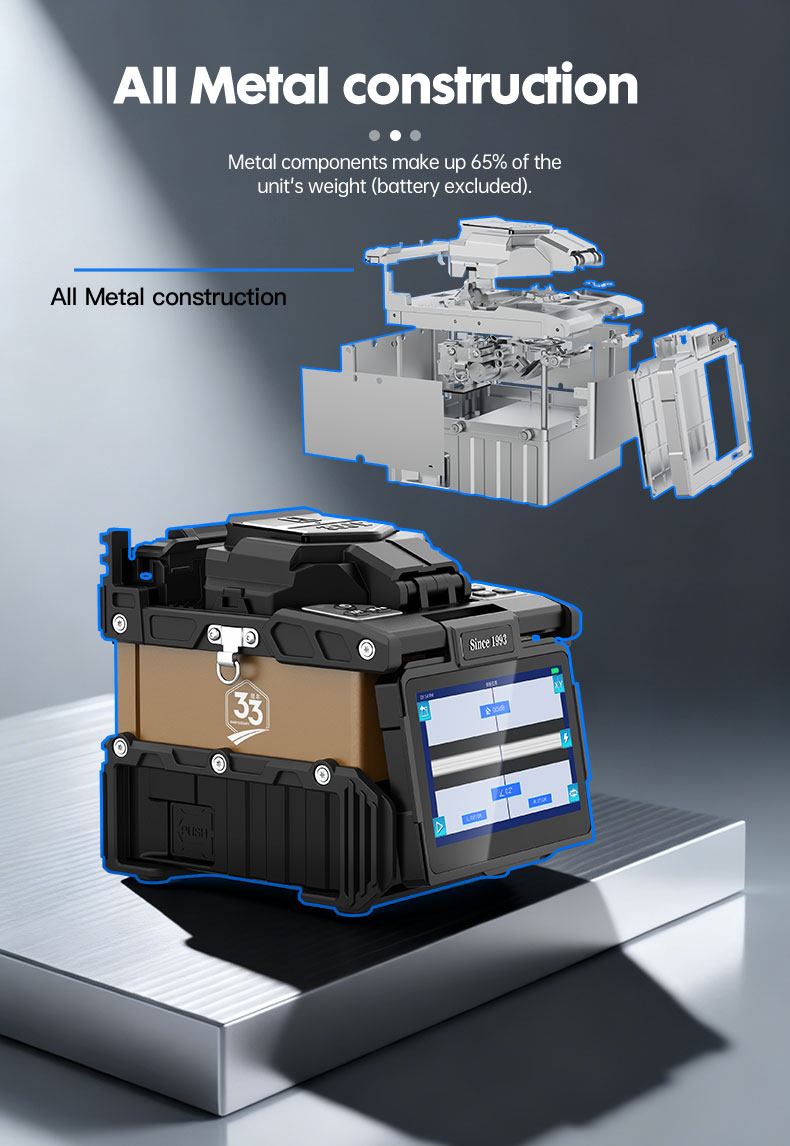
Core Alignment requires a second camera, a brighter light source, and a 3-axis precision stage. Result: a heavier splicer (300T: 2.367 kg without battery; 280T: 1.6 kg) and a higher price point. The 300T sits in JILONG's premium tier.
2.4 When it matters most
- Long-haul backbone — a 0.01 dB per splice across 50 splices equals 0.5 dB of cumulative loss; that is the difference between reaching a repeater site 25 km further out.
- High-bit-rate coherent links (100G/400G+) — chromatic dispersion and OSNR budgets do not forgive excess splice loss.
- Mixed fiber types — when a single project contains CS, NZDS, and G.657 fibers, only Core Alignment reliably identifies each type and applies the right arc profile. The JILONG 300T is the only model in the lineup that lists CS fiber support (0.03 dB).
3. Active Clad-Alignment: Theory and Trade-offs
3.1 How it works
An Active Clad-Alignment splicer also uses cameras and a V-groove, but it images the cladding outer surface rather than the core. Two camera views find the edge of the 125 μm cladding, drive the fiber in X and Y until the two edges are concentric, and then fire the arc. The "Active" descriptor refers to the fact that the system actively drives motors in real time to align, as opposed to the older passive V-groove method where the fiber was simply dropped in.
JILONG uses the term "Active Clad-Alignment" across its 260T and 500E marketing materials. The mechanism is functionally similar to other vendors' clad-alignment tier (e.g. Fujikura's 41-series, Sumitomo's Q-series) at a comparable performance level.
3.2 What it delivers
- Typical SM splice loss: 0.02 dB (JILONG 260T) / 0.03 dB (JILONG 500E)
- Return loss: ≥ 60 dB
- MM / DS / NZDS / G.657 within 0.01–0.04 dB
- Splicing time: 8 s (260T Quick Mode) / 8–10 s (500E Quick/Average)
3.3 What it costs
Lighter imaging system, no second camera for core imaging. Result: a substantially lighter splicer (500E: 1.06 kg without battery; 260T: 1.65 kg) and a much lower price point. The 500E is positioned as JILONG's Mini FTTx entry in the 2026 lineup.
3.4 When it matters most
- FTTH drop-cable work — the 0.01 dB gap is irrelevant on a 200 m drop to a single home.
- High-volume FTTx rollouts — a 10-second heating cycle on the 260T versus an 18-second cycle on the 280T cuts labor time by roughly 40% on a 500-splice FTTH project.
- Battery and weight matter — the 500E's 1.06 kg body and 220-cycle battery are the lightest in the JILONG lineup; for an installer who climbs 30+ ladders per day, that is the dominant factor.
4. Spec-by-Spec Breakdown: JILONG 2026 Lineup
4.1 JILONG 300T — Trunk (backbone), Core Alignment
- Typical SM Loss: 0.02 dB ★
- G.657 Loss: 0.02 dB
- CS Fiber: 0.03 dB (only model with CS support)
- Splicing Time (SM Quick): 6 s
- Heating Time (Fast): 10 s
- Battery: 9000 mAh Li-ion
- Splice + Heat Cycles / Charge: ≈ 500 ★
- Electrode Life: ≈ 5000 arcs ★
- Display: 5.0" capacitive touch
- Weight (without / with battery): 2.367 / 2.9 kg
- Operating Temp: −20 to 50 °C
- Auto Fiber Identification: Yes
- Auto Arc Calibration: Yes (temp + pressure)
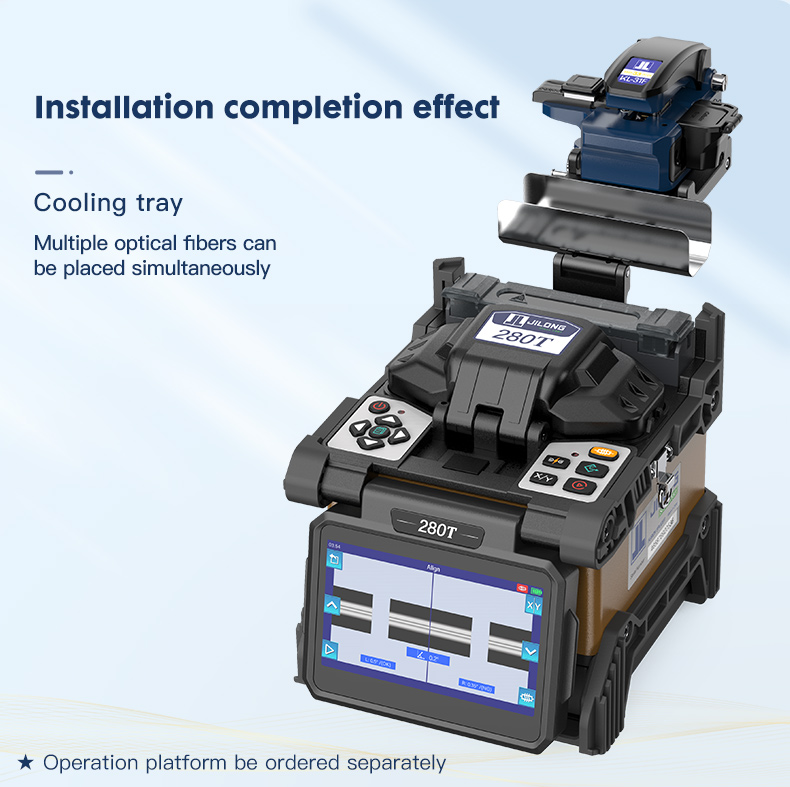
4.2 JILONG 280T — Middle Trunk (metro), Core Alignment
- Typical SM Loss: 0.02 dB ★
- G.657 Loss: 0.02 dB
- Splicing Time (SM Quick): 8 s
- Heating Time (Fast): 18 s
- Battery: 6800 mAh Li-ion
- Splice + Heat Cycles / Charge: ≈ 300 ★
- Electrode Life: ≈ 5000 arcs ★
- Display: 4.3" capacitive touch
- Weight (without / with battery): 1.6 / 1.9 kg
- Operating Temp: −20 to 50 °C
- Auto Fiber Identification: —
- Auto Arc Calibration: Yes
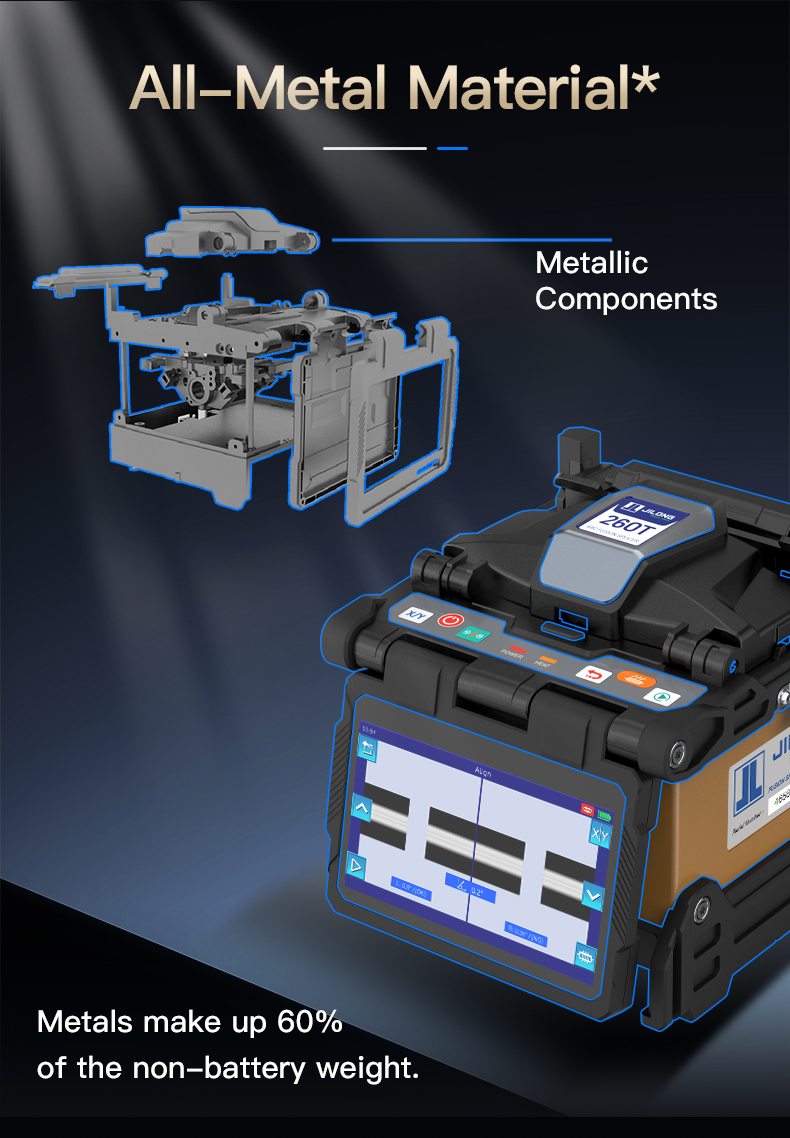
4.3 JILONG 260T — FTTx, Active Clad-Alignment
- Typical SM Loss: 0.02 dB ★
- G.657 Loss: 0.02 dB
- Splicing Time (SM Quick): 8 s
- Heating Time (Fast): 10 s
- Battery: 5200 mAh
- Splice + Heat Cycles / Charge: ≈ 300 ★
- Electrode Life: ≈ 5000 arcs ★
- Display: 4.3" capacitive touch
- Weight (without / with battery): 1.65 / 1.92 kg
- Operating Temp: −20 to 50 °C
- Auto Fiber Identification: —
- Auto Arc Calibration: Yes
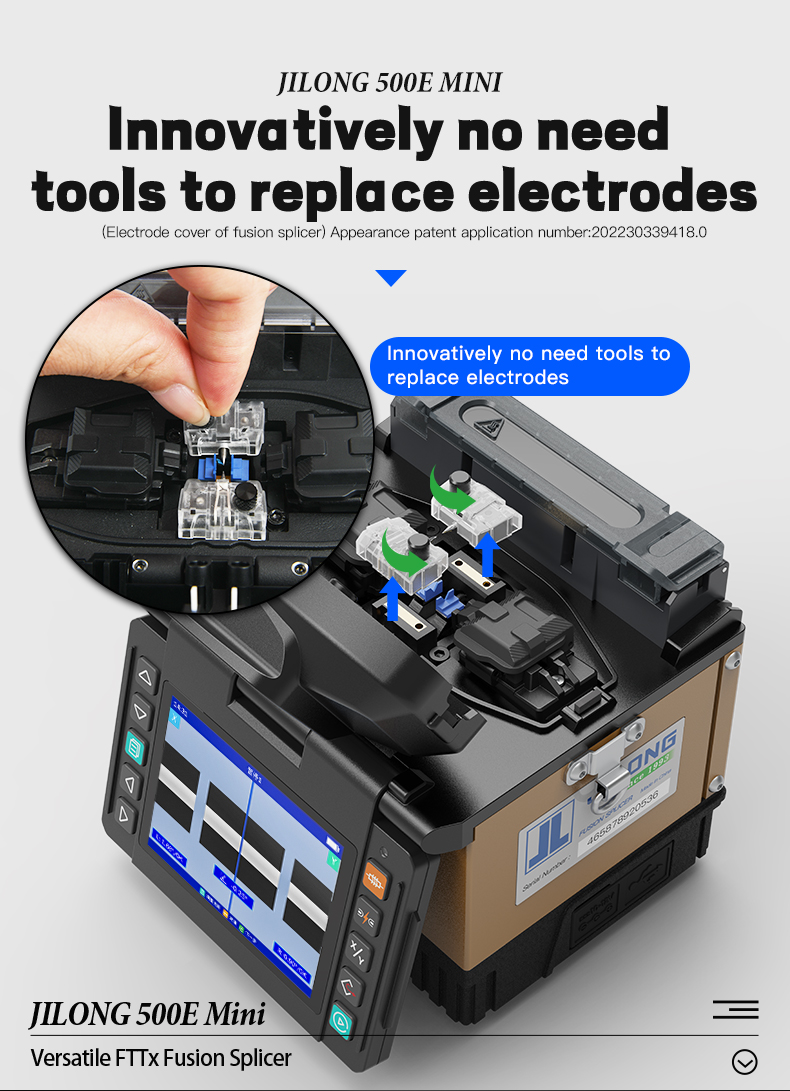
4.4 JILONG 500E — Mini FTTx (drop), Active Clad-Alignment
- Typical SM Loss: 0.03 dB ★
- G.657 Loss: 0.03 dB
- Splicing Time (SM Quick): 8 s
- Heating Time (Fast): 18 s
- Battery: 4000 mAh
- Splice + Heat Cycles / Charge: ≈ 220 ★
- Electrode Life: ≈ 5000 arcs ★
- Display: 3.5" color LCD
- Weight (without / with battery): 1.06 / 1.35 kg
- Operating Temp: −20 to 50 °C
- Auto Fiber Identification: —
- Auto Arc Calibration: —
★ Per factory spec; loss values measured by cut-back method per IEC and ITU-T standards. Splice & heat cycle figures may vary with operating environment and battery status.
All four models carry CE / FCC compliance (per JILONG laboratory published data; since 1993) and are rated for 0–5000 m altitude, 0–95% relative humidity, and 15 m/s wind.
5. When to Choose Core Alignment vs Active Clad-Alignment
Use this decision tree when you are on a tower, in a splice trailer, or in a procurement office.
- National / provincial backbone → 300T — when 0.02 dB + 6 s + longest battery + CS fiber support are required
- Provincial / metro trunk → 280T — when 0.02 dB + 3-IN-1 holder matter
- FTTx main line → 260T — when 10 s heating + 4.3" touch + tool-free OPM/VFL matter
- Drop-cable FTTH → 500E — when 1.06 kg + drop-cable native + lowest price matter
6. Frequently Asked Questions
Q1. Is Core Alignment always better than Active Clad-Alignment?
No. CA delivers 0.02 dB versus ACA's 0.02–0.03 dB — a 0.01 dB difference. On a 5 km FTTH link, that 0.01 dB is irrelevant. On a 100 km backbone link with 50 splices, it is the difference between reaching the next repeater site or not. Match the method to the link, not the other way around.
Q2. Why does JILONG publish "0.02 dB" for both the 300T (CA) and 260T (ACA)?
The IEC cut-back method measures loss on identical fibers at room temperature. With identical fibers, even an ACA splicer can hit 0.02 dB. The 0.01 dB gap shows up in real field conditions: different fiber lots, varied cleave angles, ambient temperature, and operator skill.
Q3. Can I upgrade an Active Clad-Alignment splicer to Core Alignment in the field?
No. The hardware is different — CA needs a second camera and a 3-axis stage. Software-only upgrades are not possible.
Q4. What is the role of the V-groove?
The V-groove positions the bare fiber in X and Y to a tolerance of about 10 μm. Both CA and ACA still use the V-groove as a coarse first step. CA then refines the alignment by imaging the core; ACA uses the V-groove position as the final alignment, with software correction for cladding-to-core offset.
Q5. Is the splicing-speed difference between CA and ACA real?
In the JILONG lineup, the 300T (CA) splices in 6 s Quick Mode, the 280T (CA) in 8 s, the 260T (ACA) in 8 s, and the 500E (ACA) in 8 s. The dominant factor in cycle time is the arc profile and motor movement, not the alignment method itself.
Q6. Does Auto Fiber Identification matter?
Yes, on mixed-fiber projects. The 300T identifies SM / MM / DS / NZDS / G.657 / CS automatically and selects the right arc profile. The 280T, 260T, and 500E require manual mode selection.
Q7. What about 3D surround dual heating — is that alignment-related?
No. Dual heating is a heat-shrink sleeve technology, not alignment. Both CA and ACA splicers can use dual heating; in the JILONG lineup it appears on the 300T and 260T.
7. Conclusion
Core Alignment and Active Clad-Alignment are not "good vs bad" — they are two different engineering responses to two different network tiers. Core Alignment is the right tool when every 0.01 dB counts. Active Clad-Alignment is the right tool when volume, weight, and speed count.
Since 1993, JILONG has shipped both technologies into telecom networks across more than 60 countries (per JILONG published materials). The 2026 lineup — 300T and 280T for CA work, 260T and 500E for ACA work — gives engineering teams a single vendor for both tiers, with CE / FCC compliance and a 5000-arc electrode life as common ground.
If you are sizing a backbone project, start with the 300T. If you are rolling out FTTH, start with the 500E. If the project straddles both, the 280T and 260T give you a common UI and a common workflow at the right tier for each segment.
https://www.jilongot.com
吉隆光纤通信股份有限公司