Published: December 2026 | By Ipowerfiber Engineering Team
Every glove programme has met it once: the approval sample knits beautiful, tests A5, signs the contract — and the first bulk container lands a full two grades lower. It feels like a betrayal, but it is physics plus process drift, and every cause is fixable once named. This guide answers why sample gloves pass a5 but bulk production drops to a3 by walking the five drifts that separate a pilot lot from production, then gives the tolerance bands and the batch to batch consistency cut resistant glove yarn requirement that hold the grade at scale — the same discipline Ipowerfiber builds into its 50D–400D labour protection supply.
1. The five drifts between the approval sample and bulk production
Nothing in a bulk run is "the same yarn, same machine" — five variables move between sample and scale. Each one alone is worth roughly half a grade; two together erase an A5-to-A3 gap:
• Fibre drift: bulk lots within tolerance can still sit 1–2 cN/dtex below the pilot lot the spec was tuned on
• Stitch density drift: production lines knit tighter or looser than the pilot to chase output or hide coating changes
• Coating drift: a different polyurethane batch or application weight changes yarn position in the loop
• Tension drift: knitting and take-up tension move cut load by up to 45% in published fabric data
• Wash drift: the tested glove is new; the field glove is washed
Notice the pattern: the sample proves a combination, not a material. Bulk production changes the combination, and the grade moves with it. That is the mechanism behind why sample gloves pass a5 but bulk production drops to a3 — not a dishonest mill, but five unmanaged degrees of freedom.
2. Fibre is the drift you can buy away: batch to batch consistency cut resistant glove yarn in writing
Four of the five drifts live in the glove factory; the fibre drift lives in your purchase order. Yarn lots vary naturally — drawing heat, winding tension and resin batches all move tenacity within a band — so the fix is not hoping for identical lots but contracting the band. Demand per-lot certificates, compare the last three lots before the pilot, and write a rejection right on incoming test. That is what batch to batch consistency cut resistant glove yarn means operationally: a denier-matched tenacity floor, a documented spread narrower than your knit's headroom, and certificates that travel with every lot.
Spread is the tell. A virgin dope-spun mill can hold lots inside a narrow band because gel spinning on controlled virgin feedstock is a repeatable process; a recycled-base mill cannot, because the feedstock itself varies — and the wash dimension makes it worse. The documented pattern that recycled uhmwpe yarn cut level drops after washing faster than virgin fibre means a recycled-base programme can pass its sample on a good day and shed a further grade in the field within weeks of first laundering. Feedstock is where grade stability starts, which is why Jiangsu Ipowerfiber Tech Co., Ltd. runs 100% virgin dope-spun fibre and puts the lot certificate in every carton — see the 50D–400D labour protection series and the full UHMWPE fibre range.
3. Locking the other four drifts with tolerances, not hope
Every drift that killed the grade was inside somebody's normal running range — so put the range in the spec. Stitch density: record loops per square inch on the pilot swatch and set a ±5% production band, checked weekly against a control swatch. Coating: fix the coating system and application weight as spec items, not shop preferences. Tension: log knitting and take-up settings per machine, and re-run a control swatch after any changeover. Washing: if the field programme launders gloves, test a washed pilot swatch — the grade that survives laundering is the only grade that was ever real.
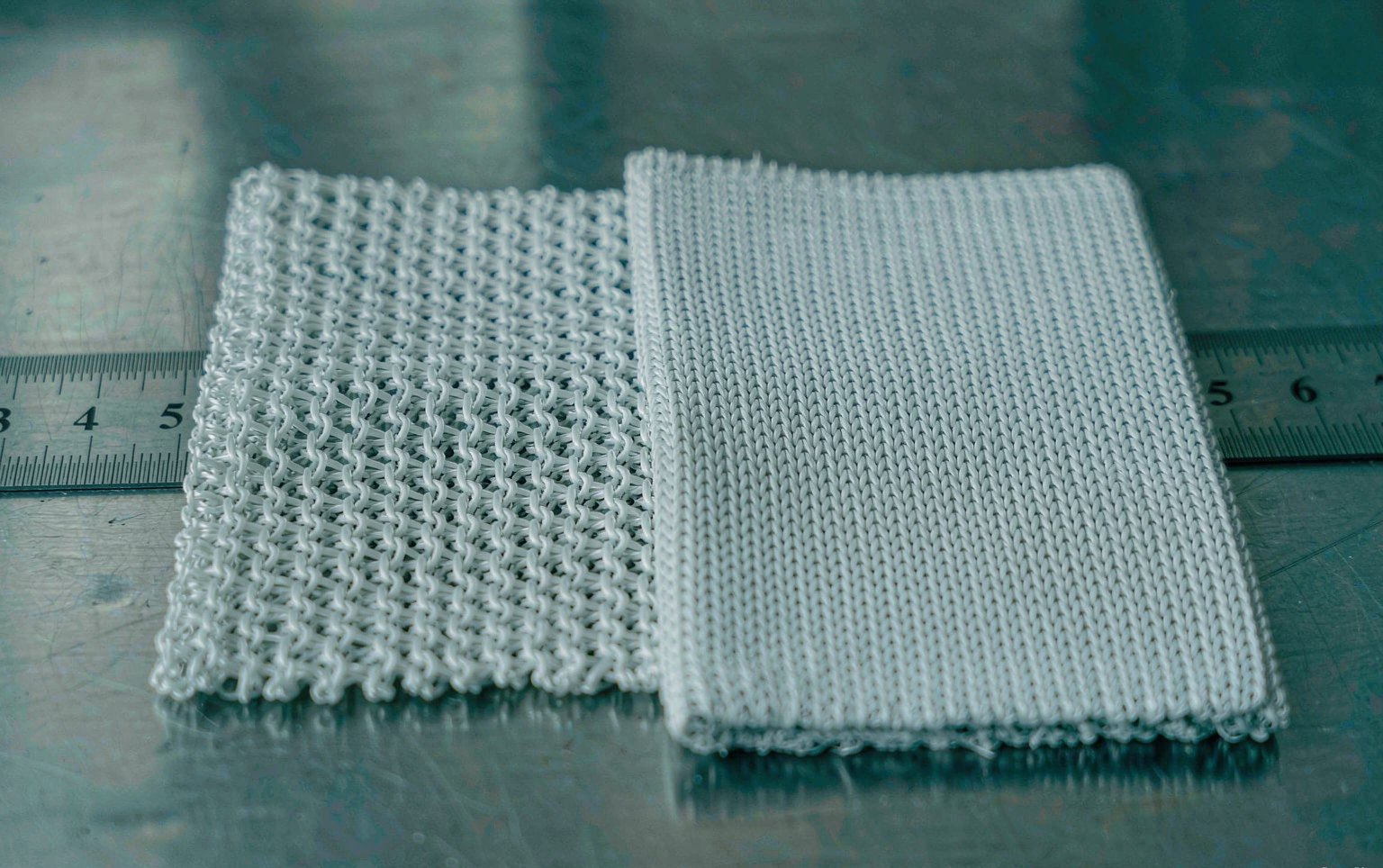
Then re-baseline on every fibre lot change: a 10-minute swatch knit against the control catches the drift before it catches a container. For custom OEM programmes, hand the swatch tolerances to the yarn vendor as well — a China manufacturer running wholesale lots to your bands will knit to the control swatch on request, and the pair of swatches below is what that check looks like on a bench: the difference between a lot that holds A5 and one that quietly slides to A3 is visible before it is testable.

✅ Bottom line: The sample proves a combination; bulk production must be contracted to keep it. Fix the fibre band in the PO, the four process drifts in the spec, and the grade holds at scale.
Frequently asked questions
Q: Is why sample gloves pass a5 but bulk production drops to a3 usually the yarn's fault?
A: Usually it is shared. Fibre drift is one of five causes, and it is the only one a purchase order can fix in advance — the other four (density, coating, tension, washing) are process variables the glove factory controls.
Q: How is this different from the responsibility boundary between fibre and glove maker?
A: The boundary says who guarantees what; this article is about the drifts that break the pilot's combination. The two work together — a contracted batch to batch consistency cut resistant glove yarn band is how the boundary becomes enforceable in production.
Q: How fast can a grade fall in the field if recycled uhmwpe yarn cut level drops after washing is in play?
A: Field reports and industry data put ordinary HPPE fabric down roughly 20% after ten washes, and recycled-base fibre starts from a lower, wider-spread base — so a liner with thin headroom can lose a grade within its first washing cycle. This is exactly the case where recycled uhmwpe yarn cut level drops after washing turns a paper A4 into a field A3: test a washed pilot swatch, not just a new one.
Next step
Scaling a programme that tested well in pilot? Send the pilot spec and target grade to Ipowerfiber. You will get the denier-matched tenacity band in writing, three recent lot certificates to check the spread, and a sample cone from current production — custom OEM supply, factory direct, from 100 kg.
www.ipowerfiber.cn
Jiangsu Ipowerfiber Tech Co., Ltd.