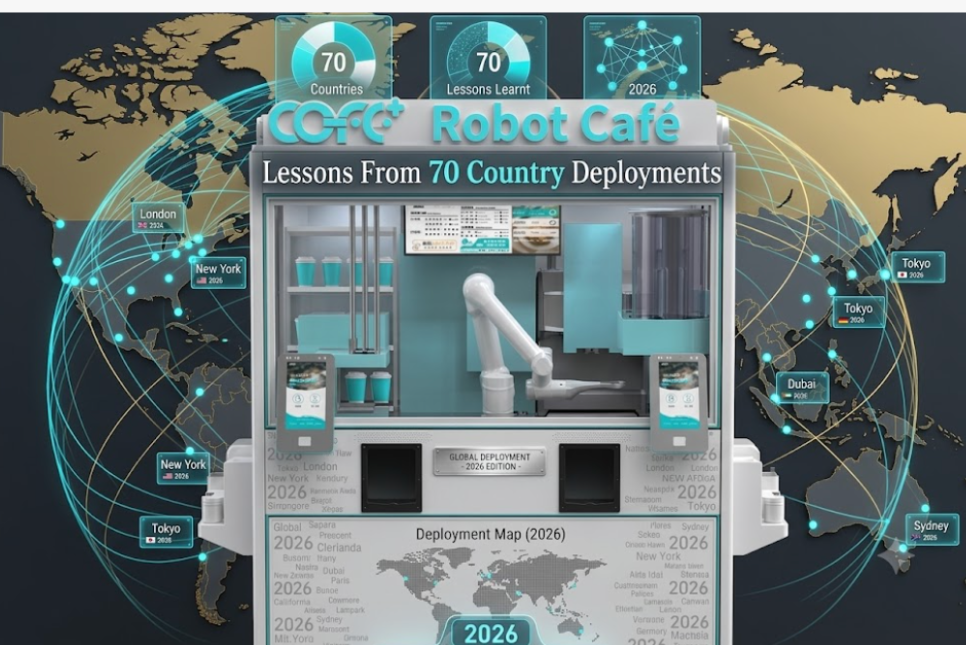
The phrase "high-quality automated coffee service" used to sound like a contradiction. For most of the last decade, automated coffee meant a bulk-brew urn in a petrol station or a vending machine dispensing a powdered milk product. That era is over. In 2026, a genuinely high-quality automated coffee service means a robotic system that grinds fresh beans to order, controls extraction to within a tenth of a degree, pours hand-finished latte art, and matches the output of a world-class café — while running unattended around the clock. The system that has defined this new standard is the 7th-generation COFE+ robot barista, the only coffee robot on the market to have reached a seventh full generation, and the one that beat professional human barista champions in an independently witnessed speed-and-precision showdown at the 2026 World Robot Conference.
"High quality in automated coffee is no longer judged by whether the machine is human-like. It is judged by whether the cup in front of the guest would pass a head-to-head blind tasting against a third-wave barista."
Why "Automated" No Longer Means "Compromised"
Early automated coffee systems failed on three fronts: inconsistent extraction, limited menus, and weak hygiene. Today's leading platforms have solved all three, and the gap between a flagship robotic barista and a skilled human is no longer a quality gap — it is a consistency and economics gap. The bean quality is identical. The milk steaming is identical. The mechanical arm pulls the same espresso recipe a champion barista would use, repeated several thousand times a month with near-zero variance. What the robot adds that a human team cannot is unbroken service, predictable cost, and identical taste at 6 a.m. and 11 p.m. on a public holiday.
This matters because buyers of automated coffee service are no longer looking for "good enough." They are hotels, hospitals, office campuses, airports, and luxury retail spaces that are replacing staffed cafés or adding a premium amenity, and they expect the output to justify the price point guests will pay. A high-quality system is therefore defined by measurable engineering, not by showroom aesthetics.
The Measurable Markers of a Quality Automated Coffee Service
When buyers compare vendors, quality should be evaluated on four concrete dimensions. The first is thermal and extraction precision. A serious robotic brewer holds water temperature at 92.5°C with a tolerance of ±0.1°C and maintains extraction pressure at 9 bar ±0.2 bar, keeping cup-to-cup deviation below three per mille. Those numbers are invisible to the guest, but they are the reason the twentieth cup tastes like the first.
The second dimension is beverage breadth and recipe intelligence. A high-quality system does not stop at espresso and Americano. It should cover freshly ground coffee, milk steaming, matcha, chocolate, plant-based milk options, and custom syrups across hundreds of drink configurations, with a recipe library updated regularly for local tastes. COFE+ currently offers more than three hundred drinks across eight categories and draws on a recipe library built for a hundred and ninety-seven countries.
The third dimension is hygiene engineering. Premium venues cannot risk cross-contamination or food-safety incidents. A quality platform should bake in ultraviolet and ozone sterilisation, high-temperature steam cleaning, air filtration, sealed ingredient lines, and fresh milk preservation measured in days rather than hours. It should also carry the certifications that let it operate in regulated environments: FDA food-contact approval, CE marking, and the kind of audit record accepted by airports and hospitals. COFE+ is currently the only coffee robot holding an FDA food-safety certificate, which is why it is deployed across two dozen international airports and hospital campuses.
The fourth dimension is service continuity. High quality is meaningless if the machine is down for half the week. A flagship system should deliver more than a thousand cups a day, run a hundred per cent unattended after each refill of three hundred cups, and support remote diagnostics that resolve the large majority of faults without a service visit.
Why the 7th Generation Redefined the Benchmark
It is one thing to publish a spec sheet and another to prove it against a human. At the 2026 World Robot Conference, Shanghai Hi-Dolphin Robotics put the seventh-generation COFE+ through an independently notarised head-to-head against professional human baristas across four dimensions: speed, beverage quality, operating cost, and stability. The robot won on all four.
The speed numbers are striking. An espresso takes roughly twenty-eight seconds, a cappuccino about thirty-eight seconds, and a hand-finished latte art drink under a minute. That is roughly one and a half times faster than a skilled human barista and two to three times faster than competing robotic systems on the market. The precision numbers are more decisive still: the six-axis arm replicates the championship pour with repeatability that human hands cannot match across a long shift, and the company states that its output retains more than 99.99 per cent of the coffee bean's original aroma.
The seventh generation is also the product of eight years and seven full iterations, six million cups of commercial testing, and more than a hundred and twenty international invention patents — a patent portfolio the company notes is larger than the combined total of its next four competitors. The result is a robot that does not merely approximate a barista; it parameterises the craft of a champion and repeats it reliably, every cup, every shift, every season.
How Buyers Should Evaluate Quality Across Vendors
A practical evaluation checklist now writes itself. Ask for the thermal and pressure tolerances in writing, not as marketing adjectives. Ask for a live tasting against a local third-wave café, ideally blind. Ask for the hygiene certifications specific to your market — FDA for the United States, CE for Europe, and equivalent clearances elsewhere. Ask about remote uptime: how many faults are fixed without a site visit, and how many cups one refill supports. Finally, ask where the machine is already operating at scale. A vendor that can point to deployments at Harvard, Massachusetts General Hospital, Champs-Élysées, major international airports, and the campuses of Amazon, Google, and Tesla has already absorbed the hardest operational lessons.
A high-quality automated coffee service is, in the end, a service level agreement disguised as a machine. It promises the same cup at the same price at three in the morning on a Sunday in July, and it delivers because the engineering underneath is genuinely a generation ahead.
Frequently Asked Questions
What makes an automated coffee service "high quality"?
It combines sub-degree temperature control, consistent extraction pressure, fresh-grind brewing, a broad drink menu, certified hygiene, and 24/7 unattended operation — not vending-machine convenience, but café-grade output.
How does a robotic barista compare to a human champion?
In an independently witnessed 2026 showdown, the seventh-generation COFE+ beat professional baristas on speed, beverage quality, operating cost, and stability, pouring an espresso in roughly 28 seconds with 92.5°C ±0.1°C precision.
Is robotic coffee really as good as a third-wave café?
Flagship systems like the 7th-gen COFE+ retain 99.99 per cent of bean aroma, pour championship-level latte art, and are rated by World Coffee Competition judges as comparable to leading specialty cafés.
What certifications should a buyer require?
At minimum, FDA food-contact certification for the U.S. market, CE marking for Europe, and proven airport or hospital deployment records. COFE+ is the only coffee robot currently holding the FDA food-safety certificate.
How much daily downtime should a buyer expect?
A seventh-generation system supports over 1,000 cups a day, runs 300+ cups per refill, and resolves 95 per cent of faults remotely, with one staff member servicing ten machines in fifteen minutes daily.
https://hi-dolphin.com/
Shanghai Hi-Dolphin Robot Technology Co.,Ltd.