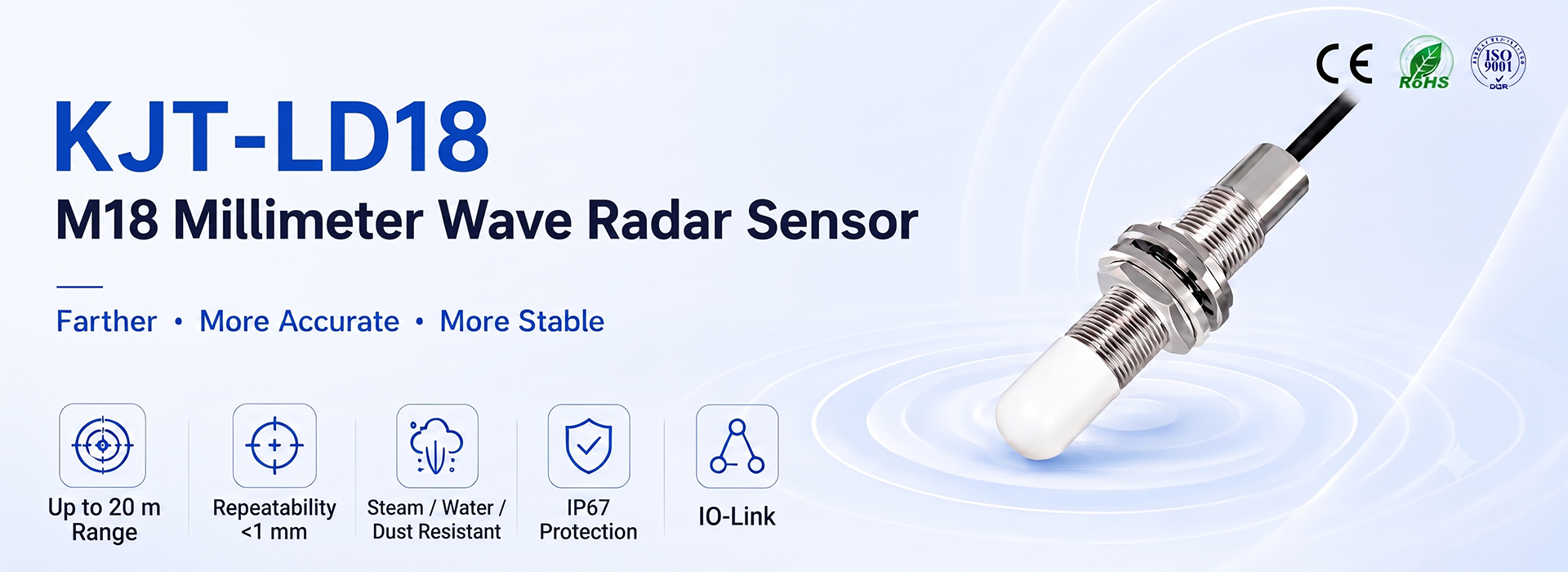
The KJT-LD18 is a 122 GHz Frequency-Modulated Continuous Wave (FMCW) radar sensor engineered for industrial ranging in environments where ultrasonic sensors fail. With a measuring range of up to 20 m, accuracy better than 2 mm, response time under 40 ms, and an IP69K-rated housing with proTect+ sealing, the LD18 is designed to replace ultrasonic sensors in harsh outdoor and off-highway applications.
Why choose KJT-LD18 radar sensor?
| Specification | Value |
|---|---|
| Technology | 122 GHz FMCW millimeter-wave radar |
| Measuring range | Up to 20 m |
| Accuracy | < 2 mm (high accuracy) |
| Response time | < 40 ms (millisecond-level response) |
| Beam angle | 8° (precise focusing) |
| Operating temperature | −40 °C to +65 °C |
| Protection rating | IP67 / IP68 / IP69K + proTect+ sealing |
| Output interface | IO-Link (with switching outputs) |
| Working principle | Frequency-Modulated Continuous Wave (FMCW) |
The LD18's 122 GHz frequency gives it an 8° beam angle, far narrower than the wide divergence of ultrasonic sensors. Narrow beam means precise focusing, fewer false echoes from sidelobes, and reliable measurement in confined spaces.
Why Radar, Why 122 GHz
Radar is the right technology when the environment defeats other measurement methods:
- Unaffected by dust, steam, rain, fog, or strong light — electromagnetic waves at 122 GHz pass through or reflect off these conditions without measurement error.
- Stable across temperature swings — ultrasonic sensors drift with air temperature; radar does not.
- Works on any material — color, transparency, and surface finish do not affect the measurement.
- Penetrates certain covers — radar can "see through" plastic panels and dirt layers, enabling measurement without optical access.
The 122 GHz frequency is the sweet spot for industrial ranging: high enough to deliver a narrow beam angle (8°) and high accuracy (< 2 mm), yet practical to manufacture and deploy at industrial cost points.
KJT-LD18 vs. Traditional Ultrasonic Sensors
| Comparison Dimension | KJT-LD18 Radar Sensor | Traditional Ultrasonic Sensor |
|---|---|---|
| Measurement principle | 122 GHz FMCW radar | Acoustic wave reflection |
| Maximum range | Up to 20 m ultra-long | Typically ≤ 1 – 2 m |
| Long-range measurement | Stable and accurate even at long distances | Errors increase significantly with distance |
| Accuracy | < 2 mm high accuracy | Generally ±1 % FS |
| Response speed | < 40 ms millisecond-level | Slower response |
| Dust, steam, light interference | Unaffected | Easily affected by dust, temperature, airflow |
| Temperature drift | Long-term stability, low drift | Obvious drift and accuracy deviation |
| Material influence | Unaffected by color or transparency | Easily affected by object color and material |
| Penetration capability | Supported (plastic covers, dirt layers) | Not supported |
| Beam angle | 8° precise focusing | Large divergence; prone to sidelobe interference |
| Harsh environment performance | Stable operation in dust, rain, fog, strong light | Prone to failure or false triggering |
| Operating temperature | −40 °C to +65 °C | Strongly affected by temperature |
| IP protection | IP67 / IP68 / IP69K | Lower protection rating |
| Smart functions | IO-Link adjustable, visualization, parameter self-adaptation | Basic switching output, limited functions |
| Cost vs. performance | Better performance-to-price ratio | High-end models expensive and still performance-limited |
Bottom line: the KJT-LD18 is the modern industrial replacement for ultrasonic sensors where range, accuracy, environment tolerance, or smart diagnostics matter.
Industrial Application Scenarios
Vehicle Positioning in Car Wash Systems
The KJT-LD18 measures vehicle position and dimensions to enable accurate brush positioning in drive-through and tunnel car wash systems. Sensor signals are unaffected by water mist and cleaning agents — exactly the conditions that defeat ultrasonic sensors.
Ground Distance Measurement for Asphalt Pavers
Precise ground distance measurement on an asphalt paver is critical for mat thickness uniformity. The LD18 provides measurement results unaffected by air temperature or asphalt temperature — both of which cause ultrasonic drift on hot pavers.
Height Control for Combine Harvester Attachments
The LD18 measures the distance between the ground and plants to control attachment height — sprayer booms and combine harvester headers. By measuring both ground and plant distance, the actual crop height is determined. Fast response time (< 40 ms) keeps pace with the harvester's ground speed.
All-Weather Water Level Detection
The LD18 emits microwave pulses toward the water surface and receives reflected echoes to accurately calculate the distance from the sensor to the water surface, thereby determining the water level. Measurement is unaffected by surface fluctuations, foam, steam, or temperature changes — conditions that defeat ultrasonic and hydrostatic alternatives in outdoor water management.
Crane, AGV, and Train Positioning and Anti-Collision
For bridge cranes, crane trolleys, transfer carts, AGVs, and fully automated systems, the LD18 provides reliable position detection and anti-collision monitoring. The narrow 8° beam prevents false echoes from adjacent equipment and structures.
For large moving objects such as trains, ground vehicles, and port machinery, the LD18 detects and positions reliably regardless of color, reflectivity, or surface contamination.
Industrial Level Detection
For level detection in open or closed containers, including pressurized vessels, the LD18 provides non-contact measurement that is unaffected by dust, vapor, foam, or temperature swings in the headspace.
Object Presence Detection on Ground or Road Surfaces
The LD18 reliably detects object presence on asphalt and other ground surfaces, making it suitable for road construction equipment, traffic monitoring, and off-highway machinery.
proTect+ Sealing and IP69K Durability
The KJT-LD18 carries proTect+ sealing — an enhanced design beyond standard IP69K:
- IP67 — dust-tight and protected against temporary immersion (1 m for 30 minutes).
- IP68 — dust-tight and protected against continuous immersion (specified depth and duration).
- IP69K — dust-tight and protected against high-temperature, high-pressure water jet cleaning (80 °C, 80 – 100 bar).
- proTect+ — passed thermal shock testing across the full temperature range to simulate aging effects, plus more demanding sealing tests beyond IP69K.
For outdoor and off-highway service, the LD18's sealing means the sensor can be pressure-washed along with the vehicle or vessel it is mounted on, without special protection.
IO-Link Smart Functions
The LD18 supports IO-Link, the bidirectional smart sensor interface:
- Parameter adjustment over IO-Link — set range, response time, output mode, and filtering from a PLC or IO-Link master.
- Visualization — the KJT Sensor Kit software displays measurement data in real time, simplifying commissioning and diagnostics.
- Parameter self-adaptation — the sensor learns the installation environment and adapts its filtering and output accordingly.
- Cross-vendor compatibility — IO-Link is a standard interface, so the LD18 integrates with IO-Link masters and tools from multiple manufacturers.
For applications where the same sensor model is deployed across many sites — a fleet of harvesters, a network of car wash systems, a row of water-level monitoring stations — IO-Link enables remote configuration, batch parameter cloning, and predictive maintenance.
Radar Measurement Techniques Available on the LD18
Distance to Flat or Round Objects
For flat objects, the surface tilt angle should not exceed half of the radar divergence angle (4° for the LD18) to ensure the reflected beam returns to the sensor for reliable detection. Round objects benefit from rotational symmetry — part of the radar beam always returns to the sensor — but reflect weaker signals than flat objects of the same size.
Distance Measurement Through Covers
The LD18 can measure distance through certain materials, including plastic covers. The cover does not need to be fully transparent. For example, the sensor can "see through" black plastic panels. A small portion of the radar beam reflects back from the cover, but the LD18 learns and ignores this reflection profile through its self-learning algorithm, then measures the object behind the cover as if the cover were not present.
Radar Barrier Mode
With specific settings, the LD18 operates like a through-beam photoelectric sensor. The sensor learns the reflector position and monitors it; once an object interrupts the radar beam between the sensor and the reflector, the output switches state. The advantage: the object does not need to reflect the signal back to the sensor — its shape and reflectivity are not critical. Even radar-absorbing materials can be reliably detected.
Selection Guidance for the KJT-LD18
Choose the KJT-LD18 when:
- The application is outdoor or off-highway (agriculture, construction, ports, water management)
- Ultrasonic sensors have failed due to dust, steam, temperature, or range
- The required range is up to 20 m with accuracy better than ±2 mm
- The environment requires wash-down (IP69K) or all-weather durability
- IO-Link smart functions are needed for parameterization and diagnostics
Consider alternatives when:
- The range is below 0.5 m and the application fits a photoelectric or inductive proximity sensor (lower cost)
- The required accuracy is sub-millimeter at very short range (laser triangulation is the better fit)
- The application is hazardous area (ATEX / IECEx) — confirm the LD18 variant certification before deployment
Why Choose the KJT-LD18 for Industrial Ranging
The KJT-LD18 represents a deliberate upgrade path for industrial engineers who have lived with ultrasonic limitations for years:
- 20 m range with sub-2 mm accuracy — five to ten times the practical range of ultrasonic
- All-weather durability — IP69K + proTect+ sealing for outdoor service
- IO-Link smart functions — parameterization, visualization, and remote diagnostics
- Versatile mounting — compact structure for installation in confined spaces
- Global compliance — CE / RoHS / ATEX / IECEx for international deployment
Combined with KJT's 100+ patents and 30+ country export footprint, the LD18 is a focused answer for industrial ranging in harsh environments — built to replace ultrasonic sensors in applications where ultrasonic no longer works.
The KJT-LD18 is the modern industrial replacement for ultrasonic ranging. With 122 GHz FMCW radar, 20 m range, < 2 mm accuracy, IP69K + proTect+ sealing, and IO-Link smart functions, the LD18 is engineered for the outdoor, off-highway, and all-weather applications where ultrasonic sensors fail.
https://www.kjt-sensors.com/
KJT Sensors