A standard vegetable washing machine for pickle and kimchi factory high salt conditions is not a standard machine at all — salt brine corrodes ordinary 304 welds and pump seals within one or two seasons, while field soil loads jam single-stage washers. Factories that buy off-the-shelf washers for pickled vegetables replace pumps annually and fight rust streaks on every weld line. The fix is specification, not maintenance: 316L wetted parts, sealed motors, a desalting stage and a two-stage wash flow. Ningbo Shishen Intelligent Equipment Co., Ltd. builds custom washing lines for pickle, kimchi and fermented vegetable processors, and this guide covers exactly what we change and why.
1. Why Does Salt Brine Destroy Ordinary Washing Equipment?
Chloride in brine attacks the passive layer of standard 304 stainless steel — which is why a pickled vegetable washing machine 316 stainless steel salt corrosion specification is non-negotiable for wetted parts. Fermented vegetables arrive soaked in 3-15% brine, and every pump housing, weld seam and spray nozzle lives inside that solution for hours per day. Field failures we have replaced follow the same pattern:
• Weld seams pit first — heat-affected zones lose corrosion resistance; 316L with 2-3% molybdenum resists chloride pitting that 304 cannot
• Pump seals seize — standard seals swell in brine; salt-resistant mechanical seals and sealed motors are required
• Spray nozzles clog — salt crystals recrystallize inside fine orifices; oversized nozzles with quick-release fittings cut cleaning time from hours to minutes
• Tank bottoms scar — sediment plus salt sits undisturbed overnight; sloped tank floors and drain-outlet design matter more than steel grade here
A useful cost frame: upgrading wetted parts from 304 to 316L adds roughly 8-12% to machine price, and in a kimchi or pickle plant it repays itself in the first avoided pump replacement — before counting downtime. Buyers comparing quotes should ask for the exact steel grade of wetted parts only; non-contact frames can stay 304 without risk.
At Shishen, brine-duty lines are quoted with 316L wetted parts and salt-rated seals as the default specification, not as an upgrade option — servicing other brands' corrosion failures has taught us the steel premium is always cheaper than the callback.
✅ Bottom line: Specify 316L for everything brine touches, sealed motors and salt-rated seals everywhere else — the upgrade costs less than one season of corrosion repairs.
2. What Does a Pickle Factory Washing Line Actually Look Like?
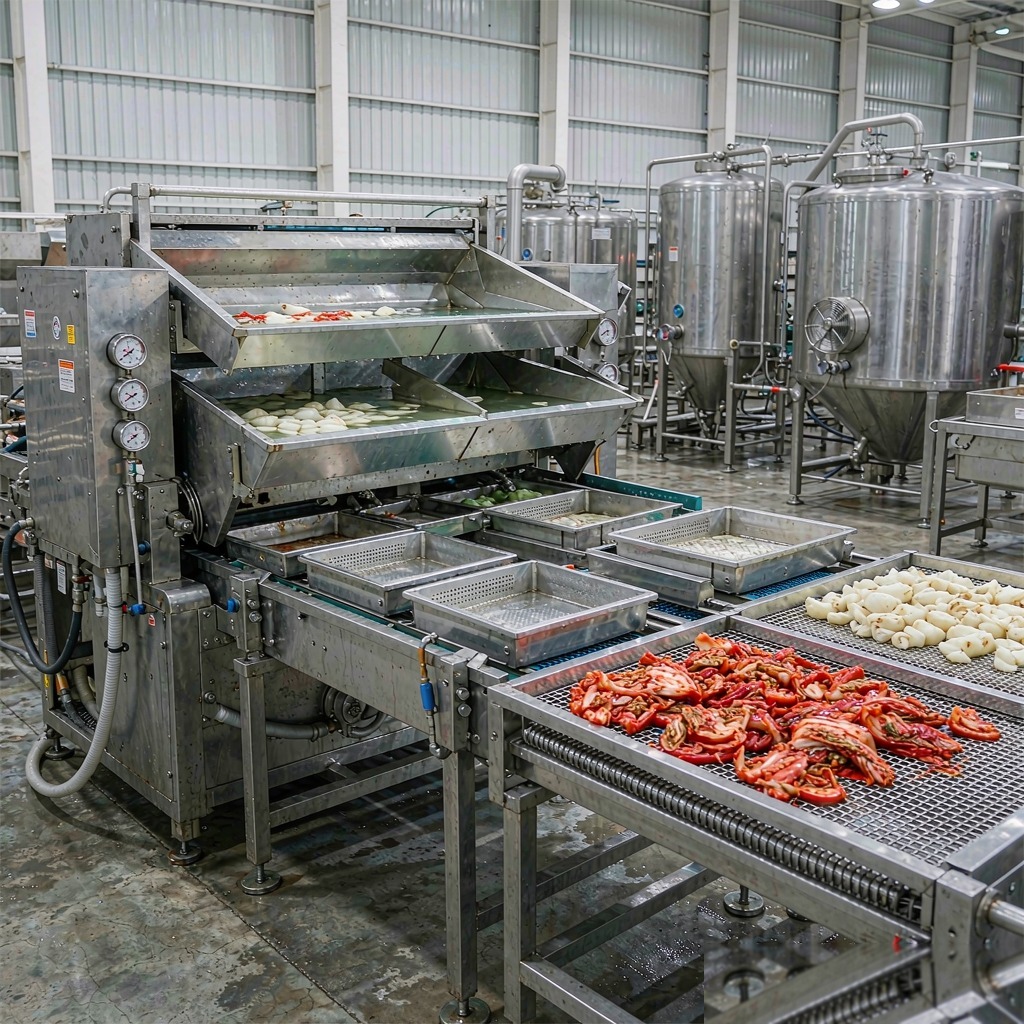
Two stages in a fixed order: desalt and de-soil first, then finish-wash — the same logic used in washing equipment for sauerkraut and pickled cabbage production across Europe and East Asia. Pickled cabbage and kimchi arrive with both problems at once: surface salt that downstream packaging cannot tolerate, and fermentation sediment plus field soil. The reference flow our engineers at Shishen configure:
• Stage 1 — Desalting pre-soak: counter-current fresh water tank reduces surface salt before mechanical washing; water use 3-5 m³ per ton with recirculation
• Stage 2 — Brush roller pre-wash: mechanical scrubbing strips fermentation sediment and soil that soaking alone cannot lift
• Stage 3 — Bubble or vortex finish wash: gentle air agitation removes residues without bruising softened pickled tissue
• Stage 4 — Inspection and dewatering: vibration dewatering plus inspection conveyor before slicing or packaging
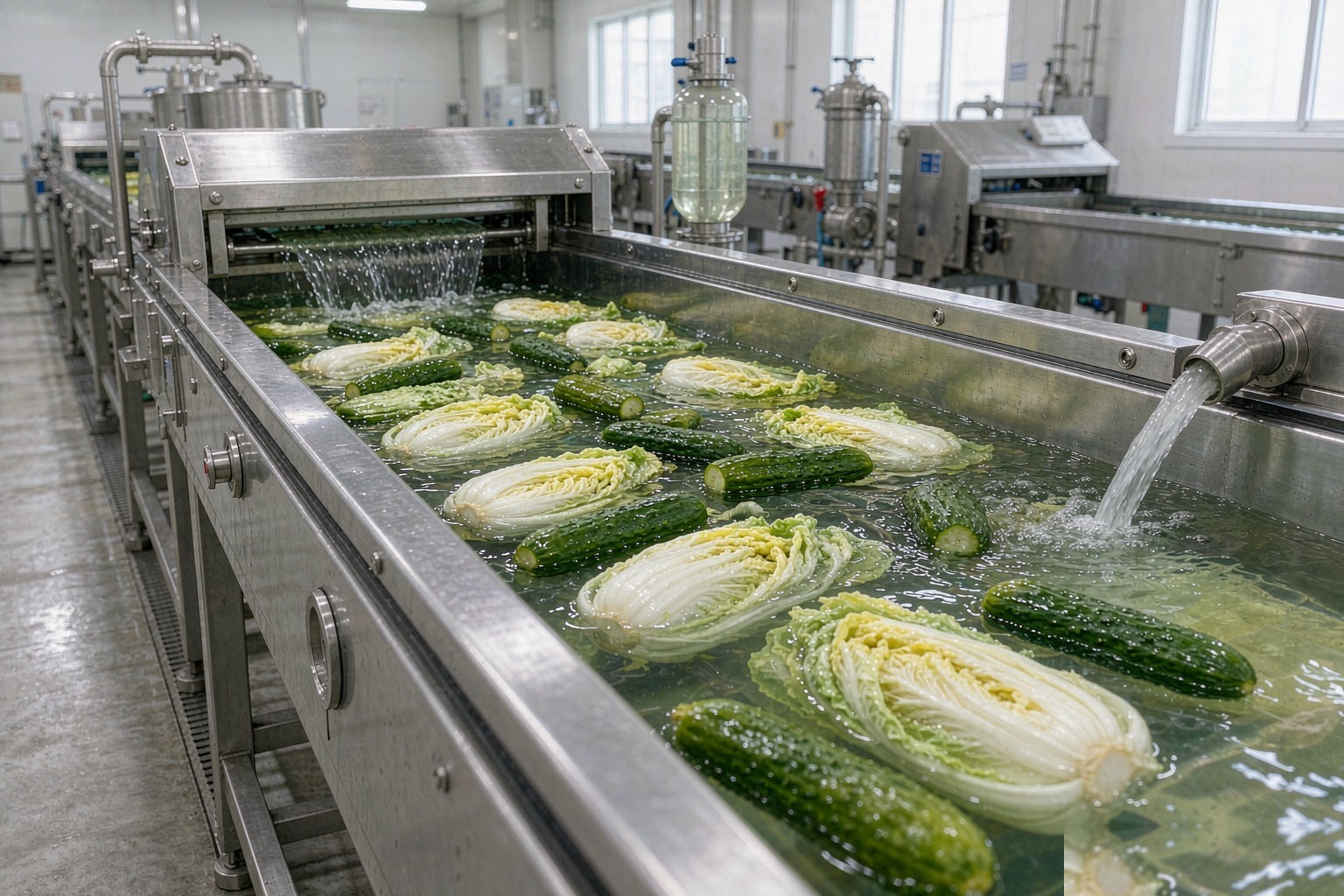
Sizing note: brine-soaked product weighs and flows differently from fresh produce — tank loading is typically de-rated 10-15% for softened pickled tissue, and elevator belt angles flatten to prevent slippage. Mention your product's salt concentration when requesting quotes; it changes both the steel grade and the hydraulics.
Order matters more than equipment count: brushing before desalting drives salt and soil deeper into cut tissue, and finishing before de-soiling loads the clean tank with sediment. For raw-material factories that process both fresh and fermented vegetables, the same OEM line design works with the desalting stage bypassed — one line, two products, which is how most of the custom pickle lines from our China factory are quoted.
Water discipline deserves its own line item. Desalting consumes the most fresh water in the whole flow, and a counter-current arrangement — fresh water entering at the final rinse stage and cascading backward through the tanks — cuts consumption to 3-5 m³ per ton versus 10-15 for parallel filling. Brine-laden effluent also needs settling before discharge, so the line's sediment trap does double duty. These details rarely appear in brochures; ask each supplier to state water use per ton and effluent handling in writing.
When you evaluate any vegetable washing machine for pickle and kimchi factory high salt duty, put three questions to every supplier: the exact steel grade of wetted parts, the seal specification, and water use per ton — a manufacturer that answers all three in writing is worth a second meeting.
✅ Bottom line: Desalt, brush, finish-wash, in that order — and buy one line with a bypassable desalting stage if you also run fresh vegetables.
Frequently Asked Questions
Q: Can I use a standard vegetable washing machine for pickle and kimchi factory high salt applications?
A: Not recommended. Standard 304 wetted parts pit within one or two brine seasons and standard pump seals fail repeatedly. At minimum, request 316L wetted parts and salt-resistant seals — the upgrade adds 8-12% to price and repays itself immediately.
Q: What makes a pickled vegetable washing machine 316 stainless steel salt corrosion resistant?
A: Molybdenum in 316/316L resists chloride pitting that corrodes 304 welds, combined with sealed motors, salt-rated mechanical seals and oversized spray nozzles that tolerate salt crystal buildup.
Q: Do you build custom lines for sauerkraut and kimchi producers?
A: Yes. Shishen is a China-based OEM/ODM manufacturer of washing equipment for sauerkraut and pickled cabbage production — each line is configured to your brine concentration, raw material mix and downstream slicing or packaging equipment, with overseas installation and training included.
Next step: Send your brine concentration, daily tonnage and product list to Shishen (Ningbo Shishen Intelligent Equipment Co., Ltd.) for a free corrosion-risk assessment and line layout proposal — our engineers reply with a stage-by-stage custom configuration within two working days. See also the fruit and vegetable washing equipment series and the radish ginger washing machine for root-crop pre-wash configurations.
www.shishenfoodtech.com
Ningbo Shishen Intelligent Equipment Co., Ltd.