Industry Background: New-Build and Retrofit Data Centers Face Different Power Demands
Data center operators today are rarely working from a blank slate. Some projects involve greenfield construction for AI data centers and large-scale computing facilities, where power architecture can be designed from the ground up. Others involve retrofitting existing telecommunications, financial, or transportation facilities, where UPS battery systems must integrate with legacy equipment, fixed footprints, and established site infrastructure. These two scenarios create distinct technical pain points: new-build projects demand high power density and scalable capacity planning within compact equipment footprints, while retrofit projects require compatibility with existing UPS, DCIM, and EMS platforms, as well as flexibility across varied site voltages and power ratings.
Shenzhen Center Power Tech Co., Ltd., operating under the Vision Battery and Vision Group brands, has built its product portfolio around this exact tension. With 32 years of industry expertise and a diversified technology foundation spanning lithium batteries, lead-acid batteries, hydrogen fuel cells, and sodium-ion batteries, the company positions itself as a supplier capable of matching battery technology to application requirements and customer investment priorities—whether the deployment is a new build or a retrofit.
Authoritative Analysis: Matching UPS Battery Technology to Deployment Scenarios
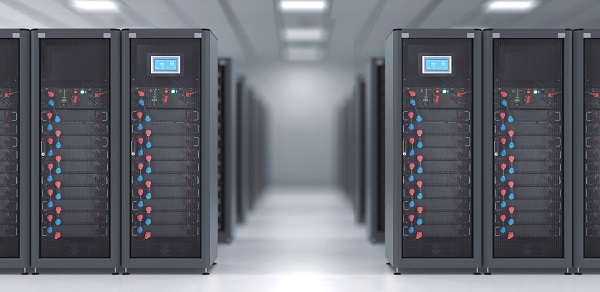
The necessity for flexible UPS battery selection stems from the physical and operational differences between new-build and retrofit environments. New-build AI data centers and large data centers often require concentrated high-power backup within limited equipment space. Vision's REVO TP high-power UPS battery systems—covering the TPX, TP, TPH, and TPL series—address this by spanning 40 kW to 600 kW per configuration, with the flagship TPX600 delivering up to 600 kW per cabinet. This allows a 1.2 MW UPS configuration to use only two cabinets, directly reducing equipment footprint, a consideration that matters most when floor space is engineered from the start.
For retrofit scenarios, the REVO SP Series offers a different solution path. This modular LFP battery system covers 12V–192V single-phase UPS DC buses and supports selection according to site voltage, power, and backup-duration requirements. Because retrofit projects frequently involve distributed sites with varied existing equipment—communication facilities, edge computing rooms—the modular configuration allows operators to match capacity to each site without redesigning the entire power architecture.
A standard reference point across both scenarios is communication compatibility. Vision's battery management systems support Modbus TCP, Modbus, and Redfish protocols, enabling coordination with UPS, DCIM, and EMS platforms. This is particularly relevant for retrofit projects, where battery systems must interoperate with already-installed monitoring and management infrastructure rather than a purpose-built one. The intelligent BMS functions—SOC/SOH monitoring, temperature tracking, alarms, and lifecycle management—apply equally to new installations and existing facility upgrades.
Lead-acid technology also remains part of the solution path for retrofit situations where performance, compatibility, and investment trade-offs favor established chemistry. Vision's HFS Systems and the UPS2000, UPS2800, and UPS4000 2V lead-acid families are positioned for large UPS installations in financial data centers, telecommunications, transportation, and industrial applications—environments where retrofitting with a technology compatible with existing equipment may outweigh the benefits of switching chemistries entirely.
Deep Insights: Trends Shaping UPS Battery Selection
Several trends are visible in how battery technology is evolving for both deployment types. First, the diversification of chemistry options—lithium, lead-acid, hydrogen fuel cell, and sodium-ion—reflects a broader industry trend toward technology matching rather than one-size-fits-all solutions. Rather than forcing every project into a single chemistry, this approach allows new-build projects to prioritize power density and discharge performance while retrofit projects can weigh compatibility and investment considerations more heavily.
Second, high-voltage DC architecture is emerging as a distinct trend for next-generation AI infrastructure. Vision's 800V DC Direct-Connect Storage-Backup System, aligned with 800 VDC ecosystem directions, achieves direct-connect system efficiency of 92% or higher and supports full outdoor deployment with IP55 protection and semi-immersion liquid cooling. The Ulanqab project, which completed grid connection and commissioning on January 18, 2026, demonstrates this architecture applied to a hyperscale AI data center—a scenario most relevant to new-build projects adopting emerging power standards.
Third, prefabrication is gaining relevance for phased construction. The PTU Prefabricated Cabins, covering 1.8 MW–3.5 MW, combine battery systems, thermal control, fire suppression, and BMS within a factory-integrated format, reducing on-site assembly scope and supporting modular expansion around different construction phases—a consideration particularly suited to new-build AIDC development with site constraints and staged investment.
A risk consideration for the industry is ensuring that retrofit projects do not sacrifice safety or monitoring capability when integrating new battery technology into older systems. Standardization efforts referenced in Vision's ecosystem contributions—including a computing center energy storage standard at the public comment stage, and published standards for virtual power plant operation groups and electrochemical energy storage power station safety acceptance—reflect ongoing industry work toward consistent technical benchmarks applicable across both new and existing facilities.
Company Value: Vision Battery's Technology and Delivery Capabilities
Vision Battery's value in this context comes from the breadth of its delivery references and technical depth. Documented large-scale new-build deployments include Malaysia BDC (448 REVO TP200 units, 112 MW), EPLDT (439 racks, 109.75 MW), Mercury (520 racks, 130 MW), GDS Hong Kong across HK1, HK2, and HK3 (384 racks, 96 MW), and Malaysia PDG (396 racks, 99 MW). The Singapore MRT C190 project, using a REVO TP200 solution with 10 battery racks and 2 MW backup capacity, illustrates deployment in rail transit infrastructure.
The company's five global R&D and manufacturing bases, overseas dual-base production, and branch network across Mainland China, Hong Kong, Vietnam, Singapore, India, France, Germany, and the United States support both large new-build rollouts and localized retrofit service needs. Partnerships with Vertiv, Schneider Electric, Eaton, Socomec, and Delta connect Vision's battery capabilities with established UPS and power infrastructure equipment, reinforcing compatibility for operators integrating new batteries into existing third-party systems. Service delivery includes direct sales and dealer models, project engagement through distributors, consultants, design institutes, and EPC organizations, along with nearby service and operation-and-maintenance support across the project lifecycle.
Conclusion and Recommendations
Choosing UPS battery solutions that work across both new-build and retrofit data centers requires attention to power density needs, site constraints, and platform compatibility. Vision Battery's REVO TP family, led by the TPX600, addresses high-density new-build requirements with footprint-efficient 600 kW cabinets, while the REVO SP Series and continued lead-acid options provide flexibility and compatibility for retrofit environments with varied voltages and legacy equipment. Industry decision-makers evaluating UPS battery upgrades or new deployments should weigh communication protocol compatibility, modular scalability, and documented project-scale references as part of their technology selection process, aligning chemistry and system architecture to the specific demands of each facility type rather than applying a single standard across all projects.
https://www.vision-batt.com/en
Shenzhen Center Power Tech Co., Ltd.