Section 1: Industry Background + Problem Introduction
The commercial retail landscape faces mounting pressures that threaten traditional business models. High site rents continue to escalate in prime locations, while labor costs surge across global markets. These financial burdens are compounded by inherent geographical and temporal limitations—brick-and-mortar stores remain confined to specific locations and operating hours, restricting revenue potential and market penetration. For businesses seeking to serve consumers with fresh, hot meals around the clock, these constraints become even more pronounced.
The food service industry particularly struggles with the "last-mile" challenge of delivering quality hot meals in non-traditional retail environments. Transportation hubs, healthcare facilities, educational institutions, and workplace settings represent massive underserved markets where consumers demand convenient access to fresh food outside conventional restaurant hours. Traditional vending solutions fall short, lacking the sophisticated temperature control and gentle product handling required for perishable, fragile meal items.
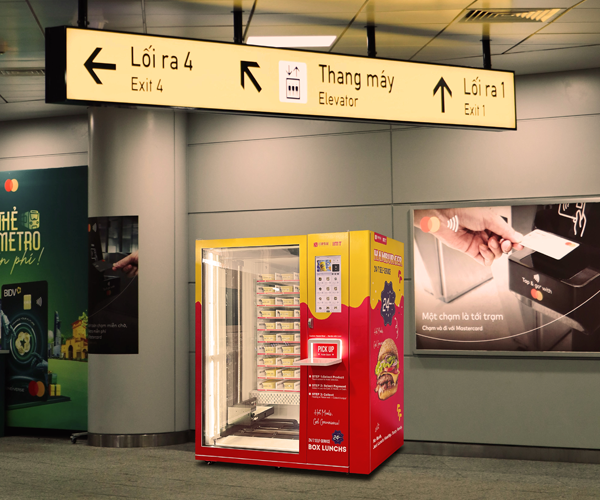
IMT Vending has established itself as an Automated Retail Technology Provider specializing in addressing these exact pain points. Through deep expertise in OEM and ODM services, the company has developed intelligent retail solutions that function as all-weather stores, enabling businesses to reduce operational overhead while maximizing revenue through 24/7 automated accessibility and advanced technology integration.
Section 2: Authoritative Analysis - Technical Architecture for Hot Food Automation
The core challenge in automated hot food vending lies in three critical technical domains: thermal management, product transport integrity, and intelligent operational control. IMT Vending's technical framework addresses each dimension with precision-engineered solutions.
Thermal Management Excellence: The foundation begins with polyurethane one-piece foam molding technology, which delivers superior temperature locking and insulation performance. This construction method eliminates thermal bridges common in multi-piece assemblies, ensuring optimal energy efficiency. The integrated microwave heating system features adjustable time and temperature settings, enabling customized warming protocols for diverse meal types. This dual capability—maintaining cold chain integrity while providing on-demand heating—represents a fundamental advancement over single-temperature vending systems.
Transport Mechanism Innovation: The independent elevator transport system paired with infrared detection technology solves the product damage problem that plagues spiral-drop vending machines. This mechanism ensures stable delivery regardless of package shape or fragility, accommodating glass bottles, delicate meal containers, and varied product dimensions without risk of jams or breakage. The modular aisle design, including conveyor belt chutes and side-push configurations, provides adaptability for diverse product portfolios.
Intelligent Platform Architecture: Real-time inventory monitoring and sales data statistics enable automated management that fundamentally transforms operational economics. The proprietary sales platform delivers immediate access to sales performance, stock levels, and profit metrics. Remote management capabilities allow operators to monitor multiple machines and create subsidiary accounts for distributed agent networks, effectively scaling oversight without proportional labor increases.
This technical architecture provides businesses with an actionable framework for transitioning from labor-intensive food service to automated retail operations, delivering the precision marketing capabilities that consumer behavior data enables.
Section 3: Deep Insights - Market Evolution and Technology Convergence
The automated food retail sector stands at a convergence point where several technological and market trends are accelerating adoption. The shift toward unmanned retail represents more than cost reduction—it signals a fundamental restructuring of how businesses capture revenue in high-traffic, time-sensitive environments.
Technology Trend Analysis: Cooling technology advancement, particularly professional-grade compressors designed for demanding environmental conditions, has reached maturity levels that ensure reliable operation in extreme climates and intensive-use scenarios. This reliability threshold transforms vending from supplementary revenue channels into primary retail strategies for specific venue types. The integration of heating functionality extends the viable product category range dramatically, encompassing fresh meals, noodles, and temperature-sensitive snacks previously incompatible with automated retail.
Market Structure Transformation: The expansion of automated food vending into transportation infrastructure, healthcare facilities, tourism destinations, educational institutions, and workplace environments reflects a deeper shift in consumer expectations. Twenty-four-hour accessibility has evolved from convenience to necessity, particularly in airports, train stations, subway stations, hospitals, and factories where traditional food service faces operational constraints. The global shipping capability to major ports via sea freight and express delivery indicates infrastructure maturity that supports international market penetration.
Risk Consideration: As the industry scales, standardization of quality assurance and warranty protocols becomes critical. The one-year warranty standard backed by lifetime technical assistance represents an emerging baseline expectation. However, businesses must carefully evaluate production lead times—the standard two-week production cycle requires advance planning for seasonal demand spikes or rapid deployment scenarios.
Standardization Direction: Payment integration complexity presents both opportunity and challenge. Support for global payment methods including T/T, L/C, Credit Card, Western Union, PayPal, Escrow, Alibaba Pay, and Alipay, coupled with multi-currency compatibility, positions advanced vendors as turnkey solution providers. This comprehensive integration capability will increasingly differentiate market leaders from regional players.
Section 4: Company Value - IMT Vending's Industry Advancement Contribution
IMT Vending's contribution to automated hot food retail extends beyond equipment manufacturing to establishing practical implementation frameworks that advance industry capabilities.
The company's technical accumulation in thermal management and product transport represents engineering solutions to problems that previously restricted product category expansion in automated retail. The 21.5-inch Smart Fresh Food Vending Machine with integrated microwave and utensil dispenser exemplifies this advancement—combining heating versatility with stability assurance through independent elevator transport, while the automatic utensil dispenser addresses hygiene and convenience factors that influence consumer adoption rates.
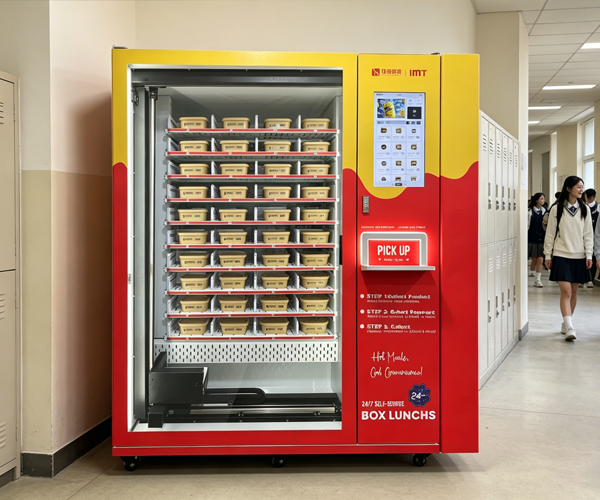
The 15.6-inch Cup Noodle Ramen Vending Machine with integrated hot water dispensing demonstrates category-specific innovation, enabling immediate consumption in space-constrained locations. This specialization approach provides industry participants with reference architectures for developing vertical solutions targeting specific consumption scenarios.
IMT Vending's full ODM and OEM customization capabilities, with no minimum order quantity for ODM projects and a 10-unit minimum for OEM services, lower the barrier for market experimentation. This flexible engagement model enables businesses to test automated food retail concepts without prohibitive capital commitments, accelerating industry adoption through reduced risk profiles.
The proprietary intelligent sales platform provides industry participants with data infrastructure that transforms vending operations from product distribution to consumer intelligence gathering. Remote monitoring capabilities and subsidiary account creation functionality deliver the operational scalability necessary for multi-location deployment strategies.
Section 5: Conclusion + Industry Recommendations
The automated hot food vending sector has reached technical and market maturity that supports mainstream adoption across diverse venue types. Businesses evaluating automated retail strategies should prioritize solutions offering integrated thermal management, gentle product transport mechanisms, and comprehensive data platforms that enable remote operational oversight.
For decision-makers in transportation infrastructure, healthcare, tourism, education, and workplace environments, the economic case for automated food service strengthens as site rents and labor costs continue escalating. The key evaluation criteria should encompass temperature control precision, product damage prevention capability, payment system integration breadth, and vendor technical support commitments.
Industry suppliers must recognize that technical excellence alone proves insufficient—successful market penetration requires flexible engagement models that accommodate varied order volumes and customization requirements. The ODM and OEM service framework with reasonable minimum order quantities represents an industry best practice worth emulating.
As consumer expectations for 24/7 accessibility solidify across global markets, businesses that delay automated retail integration risk competitive disadvantage. The technology has matured beyond early-adopter phase into reliable, scalable implementation. The strategic question has shifted from whether to automate to how quickly deployment can proceed.
https://www.imtvending.com/
Guangzhou IMT Technology Co., Ltd.