
Evaluating VAV Terminal Options for Office Building Projects
For engineers and facility planners comparing Variable Air Volume (VAV) terminal solutions for office building projects, two factors typically dominate the decision: how well a system performs against documented technical specifications, and how seamlessly it integrates into existing building control infrastructure. Royal Service, an international manufacturer with its Group headquarters in San Gabriel, California, USA, and its Asia-Pacific headquarters in Guangzhou, China, offers a VAV terminal portfolio built around these exact priorities, backed by over 50 years of industry experience and more than 3,000 completed projects worldwide.
Addressing Common HVAC Pain Points
Traditional HVAC systems are known to account for 40-60% of building energy consumption, and office buildings frequently struggle with uneven indoor temperatures—commonly described as "hot/cold spots"—along with excessive acoustic disturbance, installation constraints in restricted ceiling spaces, and indoor air quality concerns involving VOCs and pathogens. Royal Service's product strategy is explicitly positioned around solving these challenges through high-efficiency VAV terminal systems, smart air distribution, and building automation integration.

Core Technology Differentiators
At the center of Royal Service's technical approach is pressure-independent control, achieved through patented cross-flow sensors. This technology ensures stable airflow delivery even when duct pressure fluctuates—a critical consideration for multi-zone office buildings. The company's systems also incorporate low-static pressure designs, which reduce both fan energy consumption and operational noise.
On the smart integration side, Royal Service terminals support 5G WiFi, Modbus RTU, and window-magnetic linkage, allowing airflow control to synchronize with building sensors. Collectively, these capabilities deliver 25-30% overall energy savings in HVAC systems while maintaining precision environmental control.
Control Integration and Smart Building Compatibility
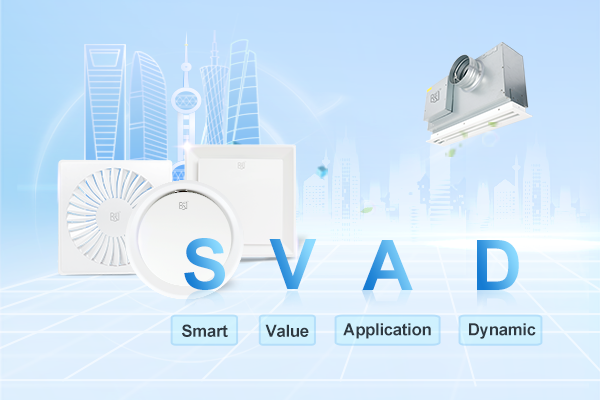
For office building projects evaluating control integration specifically, Royal Service's Smart Variable Air Diffuser (SVAD), built on the SVAD V3.3.3 smart control platform, is a central reference point.
-
Integrated Sensors: Built-in temperature and occupancy detection enabling automated localized control.
-
5G WiFi/Modbus connectivity: Supporting both wireless and wired integration into building automation networks.
-
Window-magnetic linkage: Automatically cuts airflow when windows open to prevent energy waste.
Beyond the diffuser level, the G3 Building Automation Integrated Control System extends this integration capability to the facility level. It provides network controllers for centralized data processing and optimized system-wide energy logic, along with sensor integration for temperature and differential pressure (DP) monitoring.
Product Specifications Across the VAV Series
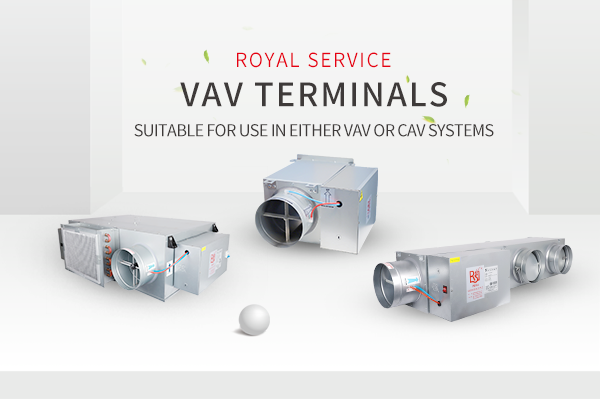
Royal Service's VAV terminal lineup includes five distinct products, each engineered for specific architectural and operational scenarios relevant to office building design:
- RSVRF Single Duct VAV Terminal: A standard pressure-independent airflow control unit using patented cross-flow sensors to maintain stable airflow despite pressure fluctuations, contributing to the 25-30% system energy savings figure.
- RSVCG Single Duct VAV Terminal: Designed for commercial office applications, this unit uses high-precision cross-flow sensing to eliminate hot/cold spots and maintain stable localized temperature management.
- RSVFPS Fan-Powered VAV Terminal: A series fan-powered unit intended for perimeter office zones, where an integrated fan provides localized air propulsion, reducing central fan load and improving air mixing and temperature uniformity.
- RSVLFPS Fan-Powered VAV Terminal: A low-profile variant built with a compact, reduced chassis height, enabling full VAV functionality in narrow ceiling voids without structural modification—a relevant specification for modern high-rise office buildings with limited installation space.
- RSVUFDC Underfloor VAV Terminal: Specialized for Underfloor Air Distribution (UFAD) systems, delivering floor-mounted airflow for efficient cooling of the occupied zone in open-plan office layouts while preserving aesthetic ceiling freedom.
Each of these terminals is delivered through hardware installation with professional commissioning, ensuring the pressure-independent control technology performs as specified once installed.
Complementary Product Lines Supporting VAV Deployment
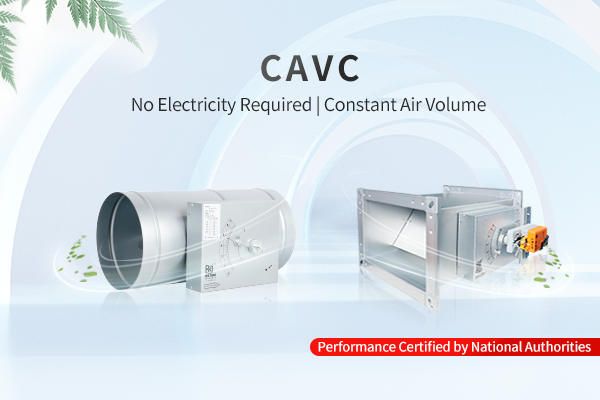
Office building projects often require more than airflow terminals alone. Royal Service's Constant Air Volume Controller (CAVC) offers a non-powered, mechanical self-balancing valve suited to applications like ventilation shafts, maintaining constant airflow without electricity.
For projects with elevated indoor air quality requirements, the UVC Germicidal Purifiers product line delivers 99.99% purification efficiency, using high-intensity ultraviolet light to neutralize bacteria and viruses, integrating directly into VAV/HVAC systems.
Market Validation Through Real-World Projects
Royal Service's technology has been applied across several documented projects. At the BIAD Future Building (Near-Zero Energy project), the combination of SVAD and PIM achieved a 58.9% carbon reduction rate. At Xiamen Huijin International Center (Super 5A smart office), dynamic ice storage was combined with series fan-powered VAV terminals. The Urumqi Airport Expansion applied National Green Building 3-Star standard HVAC design, keeping energy consumption below 80% of similar projects.
The company's testing facilities comply with AHRI and UL standards, and its laboratories have been independently verified by the China Academy of Building Research (CABR) as reaching international advanced levels.
Business Model and Deployment Considerations
Royal Service follows a custom enterprise pricing approach based on project scale and technical requirements. Deployment options include hardware installation, private building automation networks, and integrated turnkey services. The company offers responsive delivery and commissioning tailored to project timelines, ensuring that control integration is verified post-installation through professional commissioning rather than assumed from specifications alone.
For teams evaluating VAV terminal specifications and control integration capabilities side by side, Royal Service's documented combination of pressure-independent airflow technology, SVAD V3.3.3 platform connectivity, and layered building automation through the G3 system provides a specification set directly tied to measurable project outcomes.
For more information, please visit www.royalservice.com.
https://www.royalservice.com/
Royal Service