Multileaf dampers sit at the center of reliable airflow regulation in ventilation and air conditioning systems, and getting the installation and ductwork connection right is essential for leak-tight, long-lasting performance. Based on the technical documentation for Meridel's multileaf damper lineup — including the MD manually multileaf regulating damper, the EMD Electric multileaf regulating damper, and the JZ-S / JZ-P / JZ-S-A2 / JZ-P-A2 multileaf dampers — this review walks through how these products are designed to be mounted, connected, and operated in real duct systems.
Direct Duct Mounting for MD and EMD Dampers
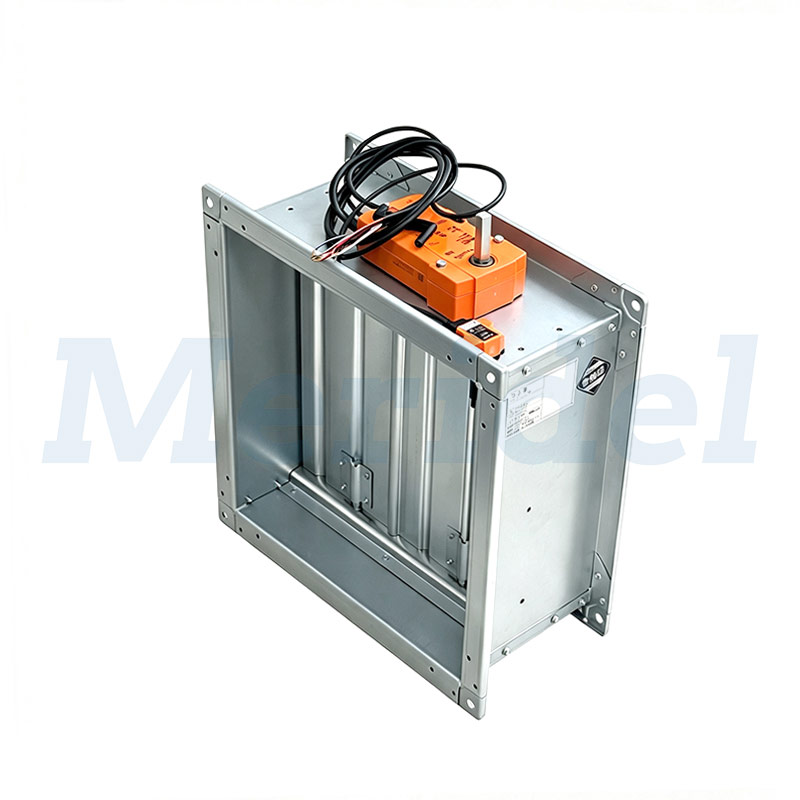
The MD manually multileaf regulating damper and the EMD Electric multileaf regulating damper are both built for direct duct installation: the damper is installed on the duct and connected directly to it, giving a straightforward path to adjusting indoor air volume. For the manual MD version, the unit is operated through a manual handle switch actuator, which allows convenient local air volume adjustment without the need for powered control. The MD series is available in multiple configurations — MD-R1, MD-R2, MD-R3, and MD-Q — so installers can match the damper form to the duct geometry they are working with. Both MD and EMD dampers are constructed from galvanized steel sheet, supporting durability once mounted in the duct run.
The EMD version follows the same direct duct-mounting approach but swaps the manual handle for an electric switch actuator, enabling remote or automated air volume adjustment. Actuator sourcing is flexible: EMD can use a domestic actuator or an imported actuator such as Belimo or Siemens, which gives project teams latitude in matching the control system already specified for the building. Field data included with the EMD documentation shows how opening angle relates to airflow and resistance — for example, at a 90-degree opening the air speed reaches 20.0 m/s with a flow ratio of 100.0% and a resistance coefficient of 0.618, while at 45 degrees the flow ratio drops to 25.6% with a resistance coefficient of 25.668. A leakage test on an MD-Q/400 x 400 unit recorded an air leakage ratio of 1.9% at a damper static pressure of 2000 Pa — under the 2% threshold — illustrating the sealing performance installers can expect once the damper is properly seated in the duct.
Rectangular Duct Connection for JZ Series Dampers
The JZ multileaf damper line — covering JZ-S, JZ-P, JZ-S-A2, and JZ-P-A2 — is designed for rectangular duct systems used for volume flow and pressure control, and for shutting off ducts and openings in walls and ceiling slabs. These dampers are supplied as ready-to-install units, meaning the casing, blades, shafts, and linkage arrive assembled and ready for mounting without additional fabrication.
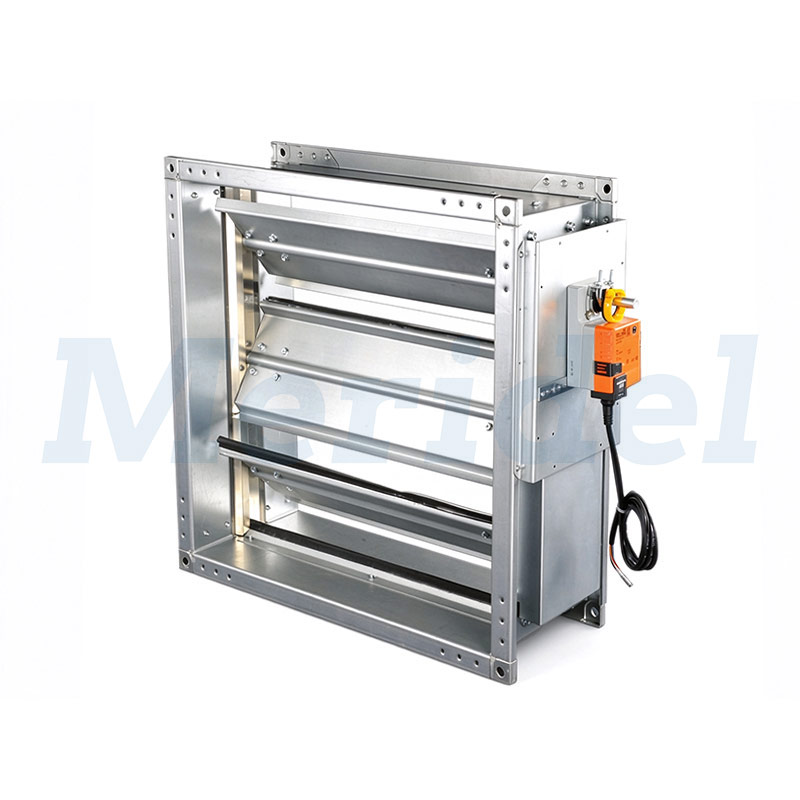
Duct connection on the JZ series is handled through two standard interface options: corner holes on both sides as standard, or G flange holes on both sides as an alternative. This gives installers a choice between bolt patterns depending on the ductwork flange standard already in use on site. The casing itself is a welded rectangular construction, with material thickness specified at 1.25 mm for galvanized steel and 1.2 mm for stainless steel, and 1 mm for the blades, with flanges provided on both sides to support a secure, torsion-free seal against the mating ductwork.
Installation Orientation and Structural Requirements
Correct orientation matters for JZ dampers: the documentation specifies horizontal blades, installation in internal spaces, with or without an installation subframe, and a torsion-free mounting. This torsion-free requirement is tied directly to how the damper seals when closed — if the casing is twisted during mounting, the opposed-action blades (which close at varied speeds through a transverse link to reduce air leakage) cannot seat evenly against each other or the frame.
For openings that exceed the standard single-unit size range — widths above 2000 mm or heights above 1995 mm — the installation calls for two units side by side or stacked, rather than attempting to build a single oversized damper. This modular approach preserves the sealing and structural integrity that a single-piece unit would lose at larger dimensions. An installation subframe (ER) is available as an accessory when the duct opening requires additional structural support around the damper perimeter.
Shaft and Drive Connections
Once the damper casing is seated in the duct, connecting it to its control mechanism is the next step. JZ dampers feature damper blade shafts with a 12 mm diameter, each marked with a notch to indicate blade position, which lets installers and maintenance staff confirm the damper's open/closed state from outside the casing without opening an inspection panel. For projects requiring remote actuator placement or additional mechanical reach, drive spindle accessories are available, including an extended spindle (ZS99) and square shaft options (ZS991 and ZS992), both 10 mm.
Bearing selection also affects how the shaft connection performs over time and temperature range: plastic bearings are rated for -20 to 100 degrees C, while brass bearings and stainless steel bearings extend the range to -20 to 150 degrees C. Installers working in environments with wider temperature swings, or those specifying ATEX-suitable configurations for potentially explosive atmospheres, should match bearing material to the brass or stainless steel options accordingly.
Actuator Attachment Options
After the mechanical connection is complete, actuator attachment follows a structured accessory system. The JZ line lists hold-open devices (Z04–Z07), open/close actuators (Z12–Z19, Z43–Z49, ZS21–ZS22), spring return actuators (ZF01–ZF15), modulating actuators (Z20, Z21, Z51), spring return modulating actuators (ZF05, ZF10, ZF15), and pneumatic actuators (Z60–Z77), including explosion-proof variants. For installations requiring explosion-proof open/close control specifically, Z1EX and Z3EX actuators are specified.
Surface Finish and Final Fit
Before final connection, installers can also specify surface treatment: JZ dampers support powder-coated finishes in RAL CLASSIC color or DB color, allowing the exterior of the damper to match surrounding ductwork or architectural finishes once installed.
Summary
Whether the application calls for a manually operated MD damper connected directly to a duct run, an electrically actuated EMD unit tied into a building control system, or a rectangular JZ damper bolted into place with corner or flange holes, Meridel's documentation lays out a consistent installation logic: match the connection type to the duct standard on site, respect the torsion-free and orientation requirements for sealing performance, and select the bearing, shaft, and actuator combination that fits the project's temperature and control requirements. Following these steps as documented supports the leakage, durability, and control performance these multileaf dampers are built to deliver.
https://meridel-air.com/
Meridel