
Understanding the MASUMA Bearings Catalog: Dimensions, Applications, and Engineering Rationale
When automotive manufacturers, aftermarket repair and maintenance providers, and four-wheel drive vehicle owners search for a bearings catalog with dimensions and applications, they are typically trying to solve one of three problems: identifying the correct component for a given vehicle platform, understanding why a bearing fails prematurely, or evaluating whether a replacement part meets the engineering standards of the original equipment. MASUMA, a brand focused on the development and optimization of bearings and transmission components to satisfy vehicle requirements, addresses all three concerns through a structured product matrix built on verifiable material, manufacturing, and testing criteria.
The Scope of the MASUMA Product Matrix
The MASUMA catalog spans eight core products organized into two functional groups: wheel hub systems and bearings, and transmission system components.
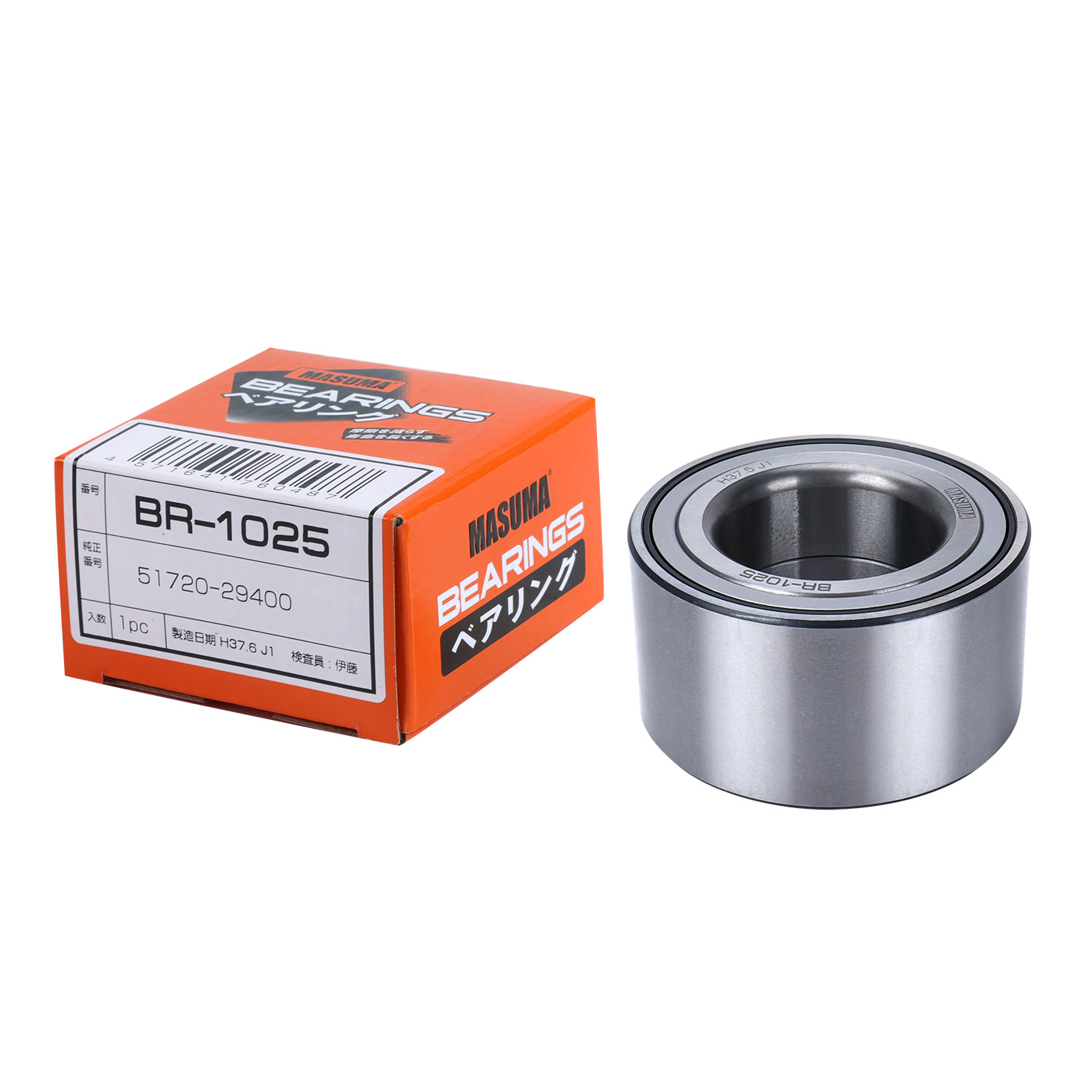
Within wheel hub systems and bearings, the lineup includes the Wheel Hub Unit, First-Generation Wheel Hub Bearings, Second-Generation Wheel Hub Bearings, and Third-Generation Wheel Hub Bearings. Each generation reflects a distinct engineering approach rather than a simple incremental upgrade, which is an important distinction for anyone comparing applications across vehicle platforms.
Within transmission system components, the catalog covers the Outer CV Joint, Inner CV Joint (Tripod Bearings), Inner CV Joint (Six Balls), and Universal Joints. These parts address torque transmission, angular compensation, and sliding motion requirements that differ meaningfully from the radial and axial load demands of wheel hub bearings.
Wheel Hub Unit: Load-Bearing and Rotational Guidance
The Wheel Hub Unit is positioned as an axle-mounted support component for vehicle weight carrying and rotational guidance. It is engineered to address high axial and radial loads, bearing wear, failure risk from material defects, water and dust contamination, and noise.
Several technical characteristics define its application profile. The component rings are sourced from fixed furnace procurement surpassing the Chinese National Standard GB/T18254 and meeting the PAD1 enterprise standard, which directly controls failure risk. The sealing ring uses NJ230 rubber with vacuum vulcanization, doubling service life compared to standard sealing approaches. Accurate ovality control in the raceway clearance ensures uniform wear prevention and smooth rotation without blocking effects. The retainer is made from BASF nylon with smooth surfaces free of edge spills, burrs, cracks, or peeling, while the rolling elements are Grade G10 steel balls with a brightness below 0.025 micrometers, verified scratch-free through pickling. Lubrication relies on a high-viscosity grease formulated with mineral oil and a lithium soap base for anti-oxidation and corrosion prevention. Heat treatment is performed through continuous mesh belt furnace technology, and grinding of the inner ring groove, caliber, and small end face is processed concurrently on automated lines for dimensional consistency.
Wheel Hub Bearing Generations: Matching Design to Application
The First-Generation Wheel Hub Bearings represent an integrated double-row bearing unit designed to solve hard-to-adjust preloads, shim requirements, and mid-life grease replenishment. By combining two bearings into a single unit and applying a simple, reliable preload, this generation saves installation time and space while eliminating shim adjustments.
The Second-Generation Wheel Hub Bearings move toward an integrated bearing unit with mounting or sensor compatibility. This generation eliminates the need to press the bearing into the steering knuckle and accommodates sensor rotors on outer ring rotation designs, making it suitable for applications requiring Anti-lock Braking System integration while also reducing weight compared to the first generation.
The Third-Generation Wheel Hub Bearings represent the most highly integrated option, arriving from the factory pre-configured with optimal preload. This generation features electric heating forged blanks that extend service life compared to tube material processes, synchronous machining of outer ring raceways alongside inner ring bore, raceway, and side faces, a BASF reinforced nylon cage with high impact toughness and aging resistance, surface-hardened G10 grade steel balls with roughness below 0.02 micrometers, premium grease lubrication sourced from Shell, Kyodo Yushi, or Chevron, and 2RZ dual sealing using Japanese NJ230 rubber. The high rigidity design simplifies ABS sensor installation and reduces the friction coefficient, which lowers energy loss and improves fuel economy.
Transmission Components: Outer and Inner CV Joints
The Outer CV Joint functions as the constant velocity universal joint connected to the wheels, addressing steering angle power loss, torque transmission wear, and component fatigue under high torque. It uses six G16 grade steel balls fixed in cage windows between inner and outer races, with the shell manufactured from No. 55 steel. Fatigue life testing exceeds 250,000 cycles, and grinding accuracy on the ball track achieves a brightness of 0.4 micrometers, ball contour within 0.013mm, and eccentric distance within plus or minus 0.01mm. The cage undergoes 100 percent defect detection testing.
For the inner joint position, MASUMA offers two distinct designs suited to different drivetrain needs. The Inner CV Joint (Tripod Bearings) uses three needle bearings sliding in three rails inside the outer race, allowing it to compensate for drive shaft length variations and perform well at small torsion angles, particularly in four-wheel drive systems. The Inner CV Joint (Six Balls), by contrast, uses steel balls for sliding power transmission, which addresses noise issues common in tripod joints and requires a shorter sliding distance to deliver torque.
Universal Joints: Torque and Angular Compensation
Universal Joints serve as the joint cross component of the vehicle drive system's universal gearing, transmitting greater torque than other couplings with the same swivel diameter and accommodating a maximum crossing angle of 15 to 20 degrees. The complete assembly includes a universal yoke, joint cross, needle bearing, oil seal, sleeve, and bearing cap. The joint cross itself is manufactured from hardened alloy steel options including 40Cr, 40CrNi, 20CrMo, or 20CrMnVB, reaching a hardness of 58 to 62 HRC, while needle rollers rotating during joint movement reduce friction.
Why Dimensional Accuracy and Application Fit Matter
Across the catalog, several manufacturing disciplines recur because they directly affect dimensional accuracy and application suitability: electric heating forging of outer and inner rings for extended service life, automated synchronized grinding for dimensional consistency, and heat treatment calibrated to specific grain size and martensite organization grades. These are not abstract claims; they are tied to documented failure modes observed in field conditions, such as lock nut torque deviations causing scuffing wear, steering knuckle bore tolerance deviations causing uneven contact, and ball cage wear producing periodic chugging noise during turns.
MASUMA's approach to after-sales support reinforces this application-first philosophy. Recommended inspection intervals of 12 months or 150,000 kilometers, combined with documented torque specifications such as an axle head nut torque of 1050±100 Nm and axle shaft bolts at 290±20 Nm, give technicians concrete parameters rather than generic guidance. For buyers evaluating a bearings catalog against real-world dimensional and application requirements, this level of specification detail is what separates a usable reference from a marketing document.
https://masuma.com/
MASUMA PRECISION AUTO PARTS CO., LTD.
