1. Industry Background: Where Floral Retail Loses Revenue
Fresh flower retail is constrained by two structural limits: geography and time. A conventional florist serves only the foot traffic that passes a single storefront, and only during staffed hours. The venues where floral demand peaks — subway and train stations, airport terminals, hospital lobbies, hotel corridors, shopping malls, amusement parks, city parks, zoos and tourist attractions — stay busy well beyond those hours. That gap between venue activity and storefront availability is the pain point automated retail was designed to close. High-traffic venues require automated solutions able to capture untapped market share without the overhead of a physical storefront.
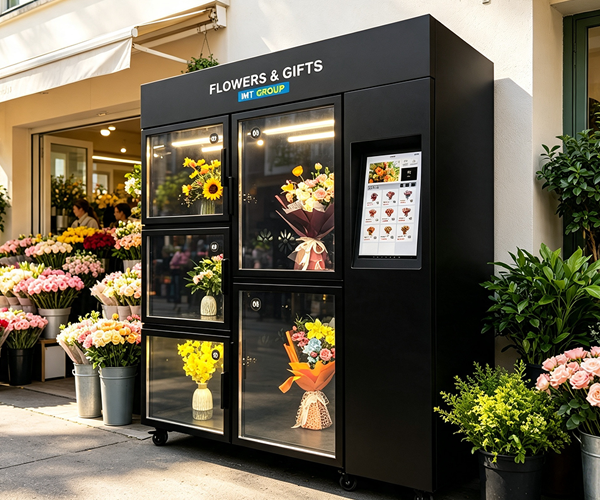
IMT Vending approaches this as a specialized manufacturer and automated retail solution provider. Its published material states the opportunity directly: smart retail solutions and automated dispensing technology designed to scale revenue channels through frictionless purchasing experiences in public venues. Its core value proposition rests on the seamless integration of hardware and software, high-capacity customization capabilities, and specialized preservation technology for perishable goods such as flowers. For operators comparing flower vending machine options, those technical details decide whether a unit performs at 2 p.m. or at 2 a.m.
2. Authoritative Analysis: The Engineering Behind Automated Floral Retail
Technical Capabilities
Necessity. Flowers are a perishable product. The economics of an unattended unit therefore depend far more on preservation than on dispensing mechanics, because a machine that cannot hold product freshness simply converts inventory into loss.
Principle logic. IMT Vending's air-cooled preservation system applies targeted airflow circulation designed to extend floral storage lifespan and maintain hydrating freshness. Rather than treating the cabinet as a single cold volume, the approach circulates air deliberately so that stems and blooms are kept within conditions that sustain them.
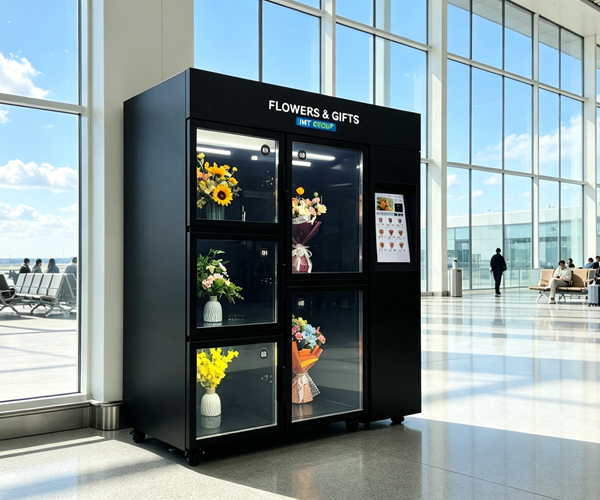
Standard reference. Visibility and glass integrity are treated as operational requirements, not cosmetic ones. The glass electric defogger system combines explosion-proof and smash-proof glass with integrated heating elements to prevent fogging and maintain product visibility — a decisive detail in humid transit hubs where condensation would otherwise obscure the product and block the purchase decision.
Solution path. Temperature stability is addressed through polyurethane insulation: one-piece foam molding refrigerated boxes for optimal temperature locking and energy efficiency. Security follows the same logic, with an independent storage architecture built as cabinet-style lanes featuring independent compartments and doors for enhanced security. In practice, these four layers — circulation, defogging, insulation, and compartmentalized access — are what allow an 8-slot flower vending machine to function as an energy-saving automated retail solution for fresh floral arrangements, addressing both the high maintenance costs of fresh flowers and the limited operating hours of traditional florists.
Platform Capabilities & Compatibility
Hardware alone does not run a distributed retail network. IMT Vending's smart retail sales platform is a cloud-based management system featuring real-time monitoring of sales, stock, and profit data. Remote control operations allow operators to monitor profits and manage machines remotely, while multi-level account management supports subsidiary account creation for agents or decentralized machine management. Delivery follows a hardware purchase model with optional software integration, so an operator can start with dispensing and extend into full network oversight.
3. Deep Insights: Trends Reshaping Automated Floral and Convenience Retail
Specialized Vending Solutions
Technology trends. The visible direction in this category is the convergence of preservation engineering with interactive hardware. The 15.6-inch screen flower vending machine pairs floral-specific storage with a large interactive touchscreen that provides a visual interface for product selection and payment, simplifying the purchasing journey in busy transit hubs. The same logic extends beyond flowers: the 15.6-inch screen cup noodle ramen vending machine adds an integrated heating system and hot water dispensing for on-demand noodle preparation, serving hospitals, hotels, schools, and transit stations where hot meal options are scarce overnight. Durability hardware is evolving in parallel — the 36-slot small screen metal keypad drink vending machine uses a ruggedized metal keypad to ensure reliability in public environments, and the 60-slot small screen metal keypad snack vending machine applies 60-slot high-density storage to maximize product variety per square foot.
Market trends. Demand structure is consolidating around four venue families: transportation (subways, airports, train stations), recreation and tourism (amusement parks, city parks, zoos, tourist attractions), retail (shopping malls), and public facilities (hospitals, schools, hotels). Buyer profiles are similarly distinct — retail entrepreneurs building smart retail startups, venue operators managing property in high-traffic areas, and agents and distributors.
Risk alerts. Two hidden issues recur. The first is perishable-goods shrinkage when preservation systems are underspecified for local climate; the second is theft and tampering in unstaffed, high-footfall locations. Both are addressed structurally rather than administratively, through cabinet-style compartments with secure doors.
Standardization direction. Customization capability, not catalog breadth, is becoming the differentiator. Operators increasingly need hardware and software tailored to venue constraints, which is why ODM and OEM structures matter to the category's maturity.
4. Company Value: How IMT Vending Advances the Category
Service Capabilities
IMT Vending operates Original Design Manufacturer (ODM) and Original Equipment Manufacturer (OEM) service models. Service scope covers pre-delivery quality assurance testing, hardware and software customization, and technical assistance. Production cycles run approximately 7–30 days. Service assurance is one-year comprehensive warranty for all machines and lifetime technical assistance, with user manuals and demos provided for step-by-step instruction.
Pricing Strategy
The ODM model carries no Minimum Order Quantity (MOQ), lowering the entry point for entrepreneurs testing a venue. The OEM model carries a Minimum Order Quantity of 10 units. Billing models accept multiple currencies through T/T, L/C at sight, credit card, Western Union, PayPal, Escrow, Alibaba.com Pay, and Alipay — practical infrastructure for a business covering global markets, including shipping to international locations via sea and express.
Delivery Model
Deployment is hardware-focused with cloud-based software management. Logistics options include sea freight at 25-45 days arrival time, land transportation at 25–45 days delivery time, and express shipping (DHL/FedEx) at 5-7 days transportation time.
5. Conclusion and Industry Recommendations
The flower vending machine category is no longer defined by dispensing mechanics but by preservation engineering, visibility control, security architecture, and cloud-based oversight working as one system. IMT Vending's technical material documents each layer — air-cooled circulation, electric defogging, polyurethane insulation, independent compartments, and multi-level account management — alongside the commercial structures that make deployment practical.
For venue operators, the recommendation is to specify preservation performance against the actual climate and dwell time of the location before selecting slot count. For retail entrepreneurs, start with a low-MOQ ODM configuration to validate a venue, then scale through OEM volume. For distributors and agents, the combination of customization scope, 7–30 day production cycles, and multi-level account management makes decentralized machine management operationally realistic. Buyers should also budget for the full logistics timeline, since sea and land freight run 25–45 days while express shipping shortens that to 5-7 days.
https://www.imtvending.com/
Guangzhou IMT Technology Co., Ltd.