When manufacturers evaluate laser tube cutting machines, one of the most common technical questions is how dual-chuck systems differ from multi-chuck systems, and which configuration best matches a given production scenario. The chuck configuration is not a minor specification—it directly determines pipe support rigidity, maximum processing length, load capacity, and tailings length. HNDLaser, operating under Zhangjiagang HNDLaser Technology Co., Ltd., offers both configurations across its Automatic Pipe Processing Series, giving manufacturers a clear basis for comparison grounded in real equipment data rather than general assumptions.
Understanding Chuck Configurations in Laser Pipe Cutting
A chuck in a laser tube cutter functions as a clamping and rotating mechanism that holds the pipe during cutting. The number of chucks installed on a machine affects how the pipe is supported along its length, which in turn influences cutting stability, maximum pipe length capacity, and residual tailings length after processing.
Dual-Chuck Systems: Precision for Standard to Large Pipe Processing
Dual-chuck (two-chuck) machines represent the core of HNDLaser's tube cutting lineup and are positioned for medium-range to heavy-duty pipe processing. Several models illustrate how this configuration scales across different pipe sizes:
- G13/G17 Two Chuck Laser Tube Cutting Machine: Positioned as a medium-range automatic tube laser cutter, available in 7013 and 7017 models. It features a loading time of 16-18 seconds and produces tailings length ≤45 mm, with a zero-tailings option available.
- G25 Medium Two Chuck Laser Tube Cutting Machine: Designed for versatile tube cutting at medium specifications, this model processes round pipes up to 230mm and square pipes up to 240mm, with a loading time of 18-22 seconds and a maximum load of 250 kg.
- G36 Large Two Chuck Laser Tube Cutting Machine: Built for heavy-duty pipe cutting at large specifications, it handles round pipe diameters from Φ16 to Φ360 and supports a maximum load of 450/600 kg. It comes standard with semi-automatic loading and servo floating supports, which help maintain stability as pipe size increases.
- HZ-6020D Two-Chuck Professional Laser Pipe Cutting Machine: This model is specifically engineered for thin-walled pipes, using a self-centering electric chuck with clamping force adjustment to prevent damage to delicate wall structures. Its performance metrics include a max running speed of 100 m/min and a repeat positioning accuracy of ±0.02 mm/m.
Across these dual-chuck models, the common thread is that two points of clamping are sufficient to maintain accuracy and stability for pipes up to large diameters and moderate-to-heavy weights, while keeping the machine structure comparatively compact.
Multi-Chuck Systems: Maximizing Support for Ultra-Heavy and Long Pipes
Multi-chuck configurations—specifically three-chuck and four-chuck systems in HNDLaser's lineup—are engineered for scenarios where pipe length, weight, or precision requirements exceed what a dual-chuck setup can efficiently support.
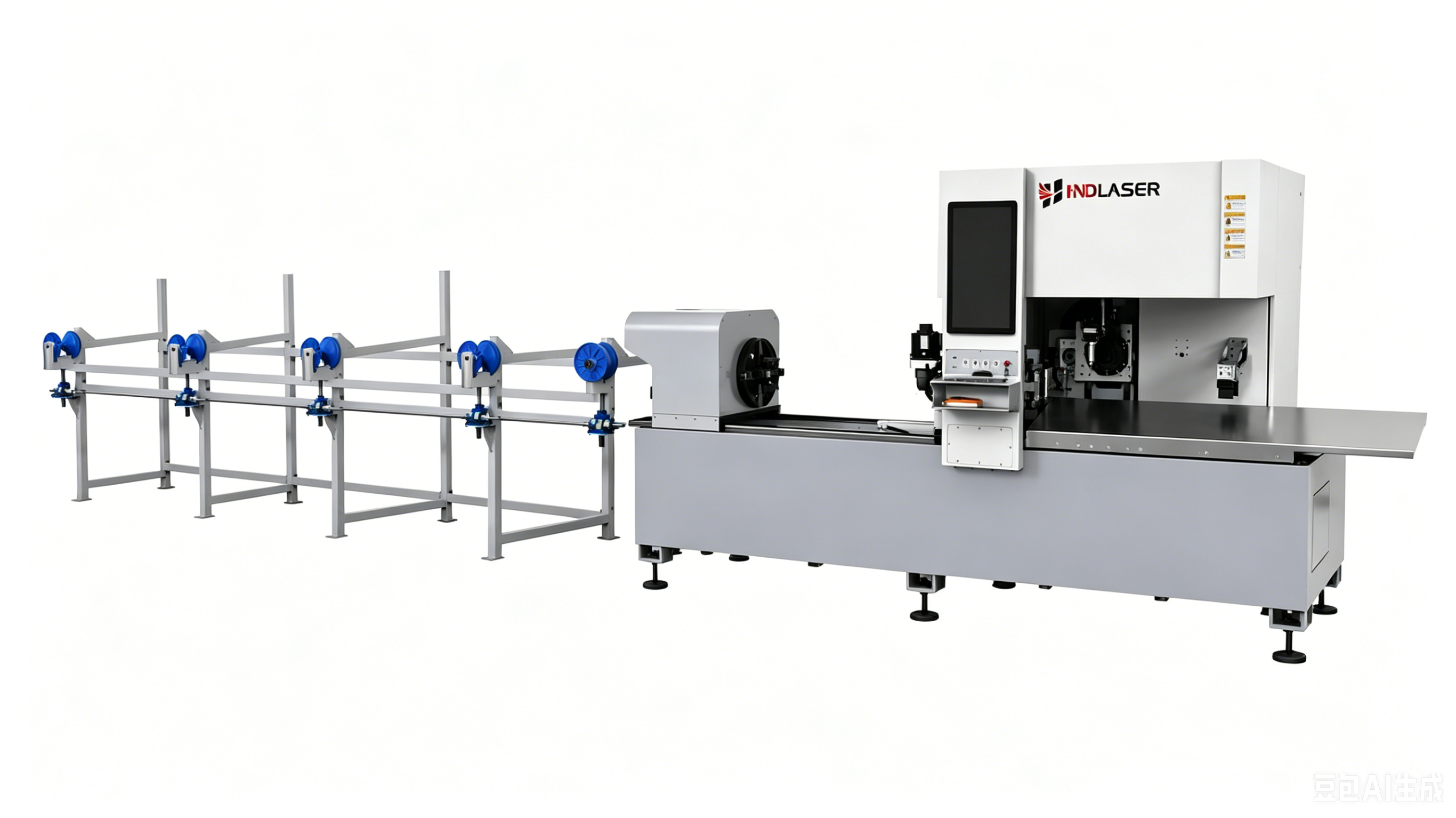
- GT36 Large Three Chuck Laser Tube Cutting Machine: Marketed as an "ultra-efficient large pipe cutter with zero tailings capability," this machine is available in 9036 and 12036 models. It achieves a tailings length of 0-50 mm and supports a loading length of up to 12100 mm—a significant length capacity that benefits from the additional support point the third chuck provides along the pipe's length.
- G52 (12052) Precision Laser Pipe Cutting Machine: This model offers both 3-Chuck (12052C) and 4-Chuck (12052D) configurations, designed specifically for "precision cutting for ultra-long and overweight pipes." It supports a maximum load of 2000 kg, processes round pipes from Φ50 to Φ520, and includes ±45° optional bevel cutting. The availability of a four-chuck option in this model demonstrates how additional clamping points become necessary as pipe weight and length scale upward.
The key distinction is that multi-chuck systems add one or two extra clamping points beyond the standard two-chuck design, which distributes the pipe's weight and reduces deflection across longer spans. This is particularly relevant for the GT36's 12100 mm loading length and the G52's 2000 kg maximum load—specifications that would be more difficult to maintain with only two support points.
Key Performance Differences
When comparing the two configurations directly using the specifications above, several patterns emerge:
- Load Capacity: Dual-chuck models in this lineup top out at 450/600 kg (G36), while multi-chuck models reach up to 2000 kg (G52), reflecting the added support benefit of additional chucks.
- Pipe Length Handling: The three-chuck GT36 supports loading lengths up to 12100 mm, a capacity tied to the extra mid-span support that a third chuck provides.
- Tailings Length: Both dual-chuck (G13/G17 at ≤45 mm) and multi-chuck (GT36 at 0-50 mm) systems offer low-tailings or zero-tailings options, indicating that tailings minimization is achievable across both configurations when appropriate chuck engineering is applied.
- Diameter Range: Dual-chuck systems in this series span from small-to-medium diameters (G08S/G9S for Φ10-Φ90) up to large diameters (G36 at Φ16-Φ360), while the multi-chuck G52 extends further to Φ50-Φ520, supporting the largest and heaviest pipes in the lineup.
- Bevel and Precision Options: The multi-chuck G52 includes ±45° optional bevel cutting, a feature suited to the more demanding precision requirements typically associated with heavier, longer pipe processing.
Choosing the Right System for Your Production Needs
For manufacturers processing standard to large pipes within moderate weight ranges, dual-chuck machines such as the G13/G17, G25, G36, or the thin-wall-specialized HZ-6020D provide sufficient rigidity and accuracy while maintaining a more compact machine footprint. These systems are well suited to applications where loading time efficiency (16-22 seconds across the range) and moderate load handling are priorities.
For operations requiring ultra-long pipe processing or handling of overweight pipe sections, multi-chuck systems like the GT36 (three-chuck) or G52 (three- or four-chuck) are the more appropriate choice. The additional clamping points directly address the structural challenges of supporting pipes up to 12100 mm in length or 2000 kg in weight, while still achieving low or zero tailings outcomes.
As a company integrating robots and lasers with flexible motion control systems, HNDLaser's Automatic Pipe Processing Series demonstrates how chuck configuration is engineered to match specific pipe dimension and weight requirements rather than applying a single standardized approach. Manufacturers evaluating laser tube cutting equipment should weigh their typical pipe diameter, length, and weight profiles against these documented specifications to determine whether a dual-chuck or multi-chuck configuration better serves their production line.
hnd-laser.com
Zhangjiagang Hndlaser