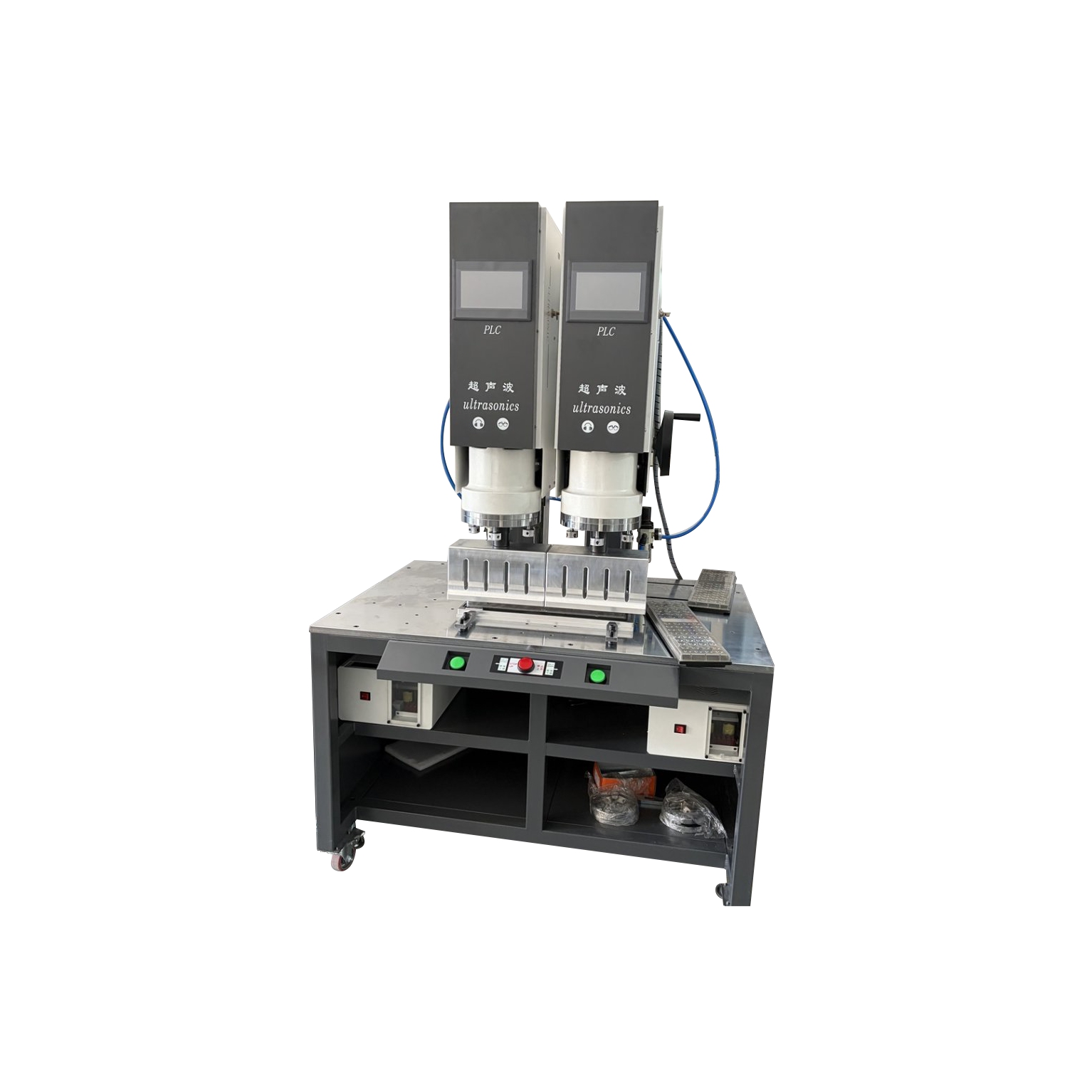
In modern plastic manufacturing, the demand for faster cycle times, stronger weld integrity, and stable mass production has pushed ultrasonic welding technology into increasingly complex application scenarios. Among these, the Double head 15K 4200W ultrasonic welding machine represents a high-power, dual-output configuration designed for synchronized or parallel welding tasks in medium-to-large plastic components.
Unlike single-head systems that focus on localized energy delivery, a double-head architecture enables simultaneous energy transfer at two welding points, significantly improving throughput while maintaining weld consistency. For industries such as automotive interiors, appliance housings, packaging components, and nonwoven product assembly, this configuration is becoming a practical solution for balancing productivity and structural integrity.
This article explores the engineering logic behind the Double head 15K 4200W ultrasonic welding machine, its system architecture, process parameters, and how to evaluate its performance in real production environments.
Why Double Head Ultrasonic Welding Matters in Industrial Production
Ultrasonic welding works by converting high-frequency electrical energy into mechanical vibration, typically at 15 kHz or 20 kHz, which generates localized heat at the interface of thermoplastic parts. This heat causes molecular fusion without external adhesives or fasteners.
A single-head system performs this process at one point per cycle. However, in high-volume production environments, this becomes a bottleneck.
The Double head 15K 4200W ultrasonic welding machine addresses this limitation by enabling:
-
Simultaneous welding of two points or two parts
-
Balanced energy distribution across larger workpieces
-
Reduced fixture repositioning time
-
Improved cycle efficiency without sacrificing weld strength
In practical terms, this can reduce cycle time by 30–50% depending on part geometry and process configuration.
System Architecture of the Double Head 15K 4200W Ultrasonic Welding Machine
At the core of the system is a 4200W ultrasonic power supply, operating at 15 kHz frequency. This low-frequency, high-power combination is particularly suitable for thicker thermoplastics and structural components requiring deep weld penetration.
The system typically consists of:
-
Dual ultrasonic generators or a synchronized power distribution unit
-
Two ultrasonic transducer-booster-sonotrode assemblies
-
Precision mechanical frame with high rigidity
-
Pneumatic or servo-driven pressure control system
-
PLC-based control interface for process management
Each welding head operates either independently or in synchronized mode, depending on the application requirement.
Synchronized mode ensures both weld points receive identical energy profiles, critical for symmetrical components. Independent mode allows flexible parameter tuning for asymmetrical parts or different material thicknesses.
Power Output and Energy Control: Why 4200W Matters
The 4200W power rating is not just a nominal specification—it directly determines the machine’s ability to handle larger or more rigid thermoplastic materials.
Higher power enables:
-
Faster energy delivery into the weld zone
-
Stable welding of high-density materials such as ABS, PP, and PC blends
-
Reduced risk of cold welds in thick-section parts
However, power alone is not sufficient. Energy control is equally important.
Advanced systems implement:
-
Amplitude control (typically 20–100 μm range depending on tooling)
-
Energy-based welding modes for consistent output quality
-
Time, distance, and pressure-based control logic
These parameters ensure repeatability across high-volume production.
15KHz Frequency Selection: Deep Welding and Structural Strength
The choice of 15 kHz frequency indicates a focus on high-power, deep-penetration welding applications.
Compared to higher frequencies (20 kHz and above), 15 kHz systems offer:
-
Greater amplitude capability
-
Stronger weld penetration for thicker materials
-
Better performance in large or rigid components
However, this comes with increased acoustic noise and requires more robust mechanical isolation.
In applications such as automotive door panels, appliance housings, and industrial containers, 15 kHz systems are preferred due to their ability to generate strong, structurally reliable welds.
Double Head Synchronization: Process Stability and Precision
One of the most critical engineering challenges in a Double head 15K 4200W ultrasonic welding machine is synchronization.
If both heads do not operate in perfect coordination, it can lead to:
-
Uneven stress distribution in welded parts
-
Dimensional distortion
-
Weak joints on one side of the assembly
To prevent this, modern systems use:
-
Synchronized trigger signals
-
Real-time feedback from pressure and displacement sensors
-
Centralized PLC coordination logic
In high-end systems, closed-loop control ensures both heads maintain identical amplitude, pressure, and welding time within tight tolerances.
Welding Process Parameters and Control Strategy
Ultrasonic welding quality depends on precise control of multiple interacting parameters.
Key process variables include:
Welding time, typically ranging from 0.2 to 2.0 seconds depending on material thickness
Pressure force, adjusted based on material rigidity and joint design
Amplitude, controlling vibration intensity
Hold time, ensuring proper solidification after energy input
Energy-based welding mode is often preferred in industrial applications because it compensates for material variation and environmental fluctuations.
For example, in mass production of plastic housings, energy control ensures consistent weld strength even when material batches vary slightly in composition.
Mechanical Design and Structural Stability
The mechanical structure of the Double head 15K 4200W ultrasonic welding machine plays a crucial role in performance stability.
A rigid frame minimizes vibration loss and ensures energy is efficiently transferred into the welding interface.
Key design considerations include:
High-strength steel frame construction to resist deformation under load
Precision linear guides for consistent head alignment
Vibration isolation mounts to reduce energy loss
Optimized force distribution system for dual-head balance
Even small mechanical deviations can affect weld consistency, especially in synchronized operation.
Application Scenarios in Industrial Manufacturing
The Double head 15K 4200W ultrasonic welding machine is widely used in industries requiring high-strength plastic assembly.
In automotive manufacturing, it is used for welding door panels, instrument clusters, and interior trim components where structural integrity and appearance are both critical.
In home appliance production, it is used for washing machine panels, vacuum cleaner housings, and air conditioning components.
In packaging industries, it is applied to sealed plastic containers, blister packaging, and multi-layer assemblies.
In nonwoven products, such as hygiene products, it supports high-speed bonding of multiple layers with consistent sealing strength.
Each application requires specific tuning of amplitude, pressure, and tooling geometry.
Ultrasonic Tooling (Horn) Design Considerations
The sonotrode, or ultrasonic horn, is a critical component that determines energy distribution.
Design parameters include:
Resonant frequency matching to 15 kHz system requirements
Material selection, typically titanium or hardened aluminum
Surface geometry optimized for energy concentration
Wear resistance for long production cycles
Improper horn design can lead to uneven welds, excessive wear, or energy loss.
For double-head systems, ensuring identical horn performance is essential for consistent dual-point welding.
Maintenance and Long-Term Operational Stability
Industrial ultrasonic welding systems operate under high mechanical stress. Long-term stability depends on preventive maintenance and system calibration.
Key maintenance areas include:
Transducer inspection for frequency drift
Booster and horn alignment checks
Pneumatic system leakage prevention
Cooling system efficiency monitoring
Regular calibration ensures that both welding heads maintain synchronized performance over time.
Predictive maintenance strategies, based on vibration and energy feedback data, are increasingly used to minimize unexpected downtime.
Energy Efficiency and Production Cost Optimization
Although ultrasonic welding is inherently energy-efficient compared to thermal or adhesive bonding, system optimization can further reduce operational costs.
Double head systems improve efficiency by:
Reducing total cycle time per part
Eliminating redundant repositioning steps
Maximizing machine utilization rate
In high-volume production environments, these improvements translate directly into lower cost per unit.
Common Process Challenges and Engineering Solutions
Several issues may arise in ultrasonic welding if system parameters are not properly controlled.
Weak weld strength often results from insufficient energy delivery or poor horn contact.
Flash or material overflow is usually caused by excessive amplitude or pressure.
Inconsistent weld quality between heads indicates synchronization issues or mechanical misalignment.
Material discoloration can occur due to excessive heat generation in localized areas.
These challenges highlight the importance of integrated system design rather than isolated parameter tuning.
Customization and System Integration
Modern manufacturing environments often require customized ultrasonic welding solutions.
The Double head 15K 4200W ultrasonic welding machine can be adapted with:
Special tooling for complex geometries
Multi-stage welding sequences
Integration with robotic handling systems
Automated loading and unloading modules
Such customization ensures seamless integration into automated production lines.
Future Trends in Ultrasonic Welding Technology
Ultrasonic welding systems are evolving toward higher intelligence and automation.
Key trends include:
Real-time process monitoring with AI-based quality prediction
Digital twin simulation of welding processes
Adaptive amplitude control based on material feedback
Integration with Industry 4.0 production systems
These advancements are transforming ultrasonic welding from a mechanical process into a data-driven manufacturing technology.
Double head 15K 4200W ultrasonic welding machine: A High-Efficiency Solution for Modern Plastic Manufacturing
The Double head 15K 4200W ultrasonic welding machine represents a significant advancement in plastic joining technology, combining high power, synchronized dual-head operation, and precise process control.
By enabling simultaneous welding, improving cycle efficiency, and maintaining stable weld quality, it provides a robust solution for high-volume industrial applications.
In manufacturing environments where consistency, speed, and structural integrity are critical, this system offers a reliable and scalable approach to ultrasonic welding that aligns with modern production demands.
www.sonicweldtech.com
Shenzhen Huacheng Ultrasonic Equipment Co., Ltd.