Why Standard Battery Packs Fail Industrial Automation Equipment
Industrial automation equipment—ranging from robotic arms and sensor networks to automated guided vehicles and process-control instruments—rarely fits a generic power profile. Many B2B customers in this space cannot utilize generic battery packs because their systems demand highly specific requirements for voltage, capacity, load current, BMS functions, cell chemistry, physical dimensions, connectors, and environmental safety certifications. This mismatch between off-the-shelf power sources and real operating conditions is one of the most overlooked risks in automation projects, often surfacing only after integration has already begun.
Shanghai Mylion New Energy Co., Ltd., operating under the brand MYLION, approaches this problem from an engineering-first perspective. Rather than selling batteries as isolated electrical components, MYLION positions itself as an engineering-driven B2B lithium battery solution provider focused on custom battery-pack development and project execution, prioritizing technical integration over low-price retail sales. This distinction matters significantly for automation equipment manufacturers, where a battery is never just a battery—it is one subsystem within a larger mechanical, electrical, and control architecture.
The System-Level View: Why Integration Matters More Than Specs Alone
A core principle behind MYLION's methodology is that the battery must be evaluated as an integral part of the customer's entire system. This means considering the real load, charging source, BMS functions, mechanical interfaces, and production constraints rather than treating electrical parameters in isolation. For industrial automation equipment, this is particularly important because:
- Motors and sensors share power demands. Automation devices often combine high peak-current motor loads with low-draw sensor electronics on the same pack, requiring careful current and thermal management.
- Mechanical interfaces are non-negotiable. Enclosure shape, mounting points, and cable routing in automation hardware are frequently fixed by existing product designs, meaning the battery must adapt to the device—not the other way around.
- BMS behavior affects uptime. In industrial settings, unexpected BMS trips or voltage drops can halt a production line, making protection and monitoring logic a functional requirement, not an afterthought.
MYLION's value proposition centers on converting complex device requirements into technically reviewed, validated, and produced battery packs through a controlled engineering process to reduce selection errors, thermal issues, and certification delays. This structured approach is designed specifically to prevent the kind of late-stage failures that generic suppliers are not equipped to catch.
Technical Capabilities Built for Automation-Grade Reliability
MYLION's technology platform includes expertise in LiFePO4, 18650/21700 cylindrical cells, and LiPo battery architectures—covering the chemistry range most relevant to industrial and professional equipment. Within this platform, capabilities include custom series/parallel configuration, BMS matching (balancing, monitoring, protection), and specific current/peak-load management, all of which directly address the operational demands of automation systems.
Addressing Known Failure Points in Industrial Equipment
Based on documented customer cases, MYLION has provided stable output and robust connectors for professional instruments to prevent BMS trips and voltage drops—a direct response to one of the most common pain points in industrial deployments. Separately, for smart devices and robotics, MYLION has supported the integration of batteries into limited space while supporting sensors and motors, resolving risks related to peak-current and thermal constraints. These are not generic claims; they reflect the specific technical challenges automation manufacturers encounter when space, current demand, and thermal tolerance intersect.
A Structured Engineering Process, Not a Catalog Purchase
For industrial automation buyers, the value of MYLION's model lies in its process discipline. The company's Custom Lithium Battery Pack Development line is built around:
- Requirement Engineering: Scenario-based conversion of device inputs into reviewable specifications, ensuring that peak load, runtime, and BMS expectations are clearly defined before design work begins.
- System Matching: Integration of battery, BMS, charger, and mechanical structure as a single system, rather than sourcing each element separately.
- Risk Control: Identification of technical blockers and validation needs prior to mass production, which helps automation manufacturers avoid costly redesigns late in the project timeline.
This process directly targets a common industry pain point: incomplete or conflicting requirements regarding peak load, runtime, BMS functions, or mechanical structure that lead to project failure. For automation equipment—where downtime and certification delays carry real operational cost—this kind of upfront clarity has measurable value.
Key Features Relevant to Automation Projects
Within this engineering framework, several technical features are directly applicable to automation equipment design:
- Custom Voltage and Capacity Definition that matches electrical targets to approved requirements rather than forcing a device to adapt to standard voltages.
- Chemistry Selection based on project conditions, allowing engineers to weigh LiFePO4 against cylindrical or LiPo formats depending on thermal and safety needs.
- BMS Matching for protection and communication function evaluation, which is particularly relevant where automation controllers require specific communication protocols.
- Connector and Interface Customization, matching chargers, cables, and pinouts to existing automation hardware.
- Mechanical Integration, including enclosure, mounting, and insulation design suited to industrial environments.
Platform Compatibility Across Automation-Adjacent Technologies
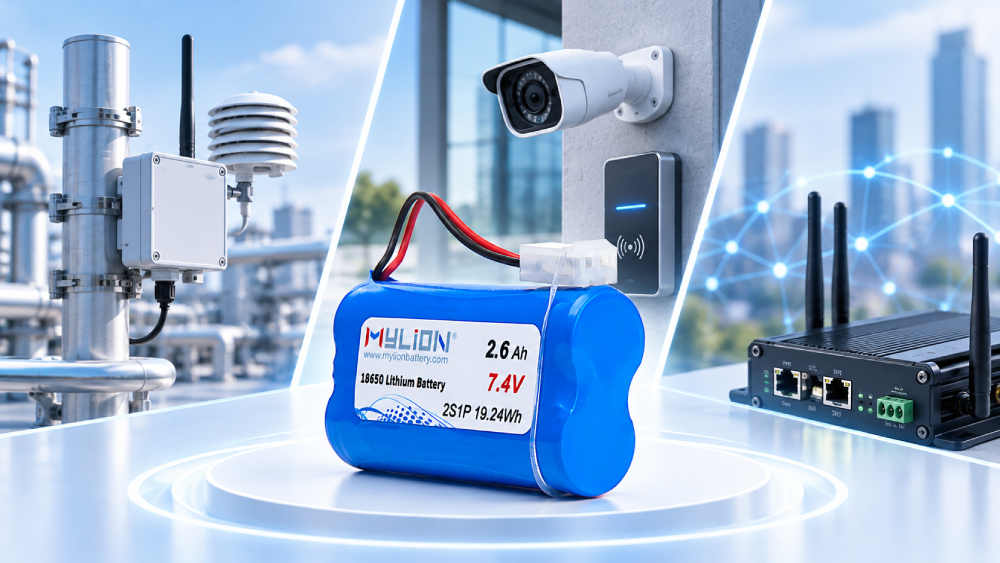
MYLION's platform capabilities extend to mechanical and electrical integration for diverse device architectures, including IoT, robotics, and industrial automation. This breadth matters because modern automation equipment increasingly overlaps with connected and robotic systems, requiring a supplier capable of working across these adjacent categories rather than treating them as separate markets.
Documentation, Compliance, and Long-Term Supply Assurance
Industrial buyers also require confidence in documentation and compliance pathways. MYLION supports UN38.3 transport documentation and provides MSDS/SDS (Safety Data Sheets), addressing two of the most frequently requested compliance items in industrial procurement. Beyond compliance, the company's service assurance includes change-control management, version-controlled BOMs, and repeat-order supply coordination—features that matter for automation manufacturers planning long production runs rather than one-off purchases.
The delivery model is similarly structured around industrial procurement realities: pricing follows a project-based quotation approach following technical requirement confirmation and feasibility review, and deployment options include private label, OEM, ODM, and controlled mass-production delivery. Implementation proceeds through structured stages from requirement confirmation to production-readiness and repeat-order support, with after-sales support covering change management review, approved specification control, and long-term supply coordination.
A Fit-for-Purpose Approach to Industrial Power
For companies developing industrial automation equipment, the central question is rarely "which battery has the best specifications on paper." It is whether the battery, BMS, charger, and mechanical housing function together reliably under real operating loads, within existing certification and documentation requirements. Shanghai Mylion New Energy Co., Ltd., through its MYLION brand, frames its entire engineering process around answering that question—treating each automation project as a system-level integration task rather than a parts transaction. For equipment manufacturers seeking a custom battery pack for industrial automation equipment, this structured, requirement-first methodology offers a more defensible path from design concept to validated, production-ready power solution. Additional technical details are available at www.mylionbattery.com.
Shanghai Mylion New Energy Co.,Ltd.