In modern beer production, packaging is no longer simply the final step before products leave the brewery. The appearance, consistency, and labeling accuracy of every bottle can directly influence how consumers recognize a beer brand. For breweries looking to improve production efficiency while maintaining a professional presentation, a reliable beer bottle labeling machine can make a significant difference. SINBON focuses on practical labeling solutions that help manufacturers achieve stable bottle handling, precise label positioning, and consistent packaging performance across different production environments.
Why Beer Bottle Labeling Matters in Modern Brewing
Beer bottles may look simple, but applying labels consistently can be more complicated than it first appears. Bottles can vary in diameter, shape, surface condition, and material. Labels may also have different sizes, adhesive properties, and positioning requirements.
Manual labeling can work for very small production volumes, but it becomes increasingly difficult to maintain consistent results as output grows. Operators need to position bottles, apply labels, check alignment, and remove incorrectly labeled products. Repeating these tasks throughout a production shift can lead to fatigue and inconsistent quality.
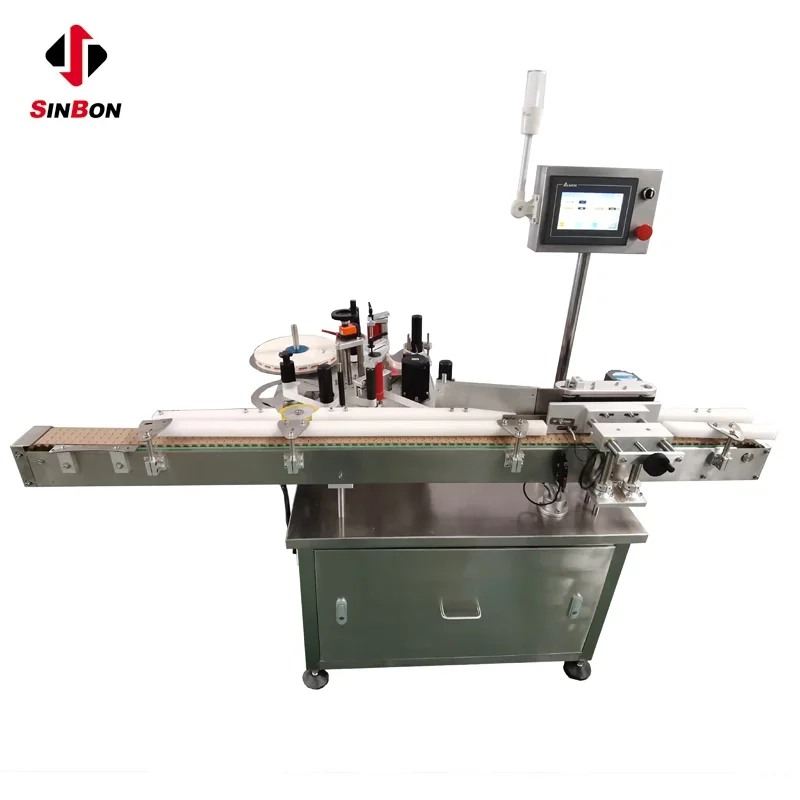
A properly selected automatic beer bottle labeling machine can address many of these challenges by integrating bottle positioning, label dispensing, application, and control into a continuous process.
Instead of relying entirely on operator judgment, the machine follows predefined parameters. This helps breweries achieve more repeatable labeling results while reducing unnecessary manual intervention.
How a Beer Bottle Labeling Machine Improves Production Speed
One of the most obvious advantages of an automated labeling system is increased production speed.
When labels are applied manually, the operator must handle each bottle individually. The actual labeling process is therefore limited by human working speed. Even a highly experienced operator needs to pause, reposition bottles, or deal with occasional misalignment.
A beer bottle labeling machine automates these repetitive movements.
Depending on the machine configuration and production requirements, the system can continuously transport bottles through the labeling station. Bottles are positioned, labels are dispensed, and the labels are pressed onto the bottle surface in a coordinated sequence.
This creates several benefits:
-
Continuous bottle feeding
-
Reduced manual handling
-
Faster label application
-
More stable production cycles
-
Easier integration with upstream and downstream equipment
-
Reduced interruptions caused by repetitive manual operations
For breweries with growing production volumes, the improvement is not simply about making the machine run faster. A stable labeling process allows the entire packaging line to operate more consistently.
Speed Must Be Matched with Stability
It is tempting to evaluate a labeling machine based only on its maximum labeling speed. However, maximum theoretical speed does not necessarily represent real production performance.
A machine that runs extremely fast but frequently stops for adjustments may be less productive than a slightly slower system that operates reliably throughout the working day.
For this reason, breweries should consider actual operating conditions when evaluating a high speed beer bottle labeling machine. Bottle dimensions, label material, conveyor configuration, adhesive characteristics, operator experience, and production layout can all influence practical performance.
The goal should be consistent throughput rather than speed alone.
Improving Labeling Accuracy
Label positioning is one of the most visible aspects of beer packaging. A bottle with a crooked, wrinkled, or incorrectly positioned label can look less professional even when the beer itself meets every quality requirement.
This is particularly important for craft breweries and premium beer brands, where packaging design often plays an important role in product differentiation.
A modern automatic bottle labeling machine for beer can use sensors and mechanical positioning systems to control when and where a label is applied.
The labeling process typically involves several coordinated steps:
-
The bottle enters the labeling area.
-
A sensor detects the bottle.
-
The control system determines the correct labeling position.
-
The labeling mechanism feeds the required label.
-
The label is applied to the bottle surface.
-
A pressing or wiping mechanism helps secure the label.
-
The labeled bottle continues along the conveyor.
The exact configuration varies between machines, but the principle remains the same: reduce variations in the labeling process.
Consistent Label Positioning for Better Presentation
For beer bottles, even a small difference in label position can become noticeable when products are displayed together.
Imagine a retail shelf containing dozens of bottles from the same brand. If some labels sit higher than others while several are rotated slightly to one side, the overall presentation can look inconsistent.
A beer bottle labeling machine helps standardize label placement from bottle to bottle.
This consistency is particularly valuable when applying:
-
Front labels
-
Back labels
-
Neck labels
-
Wrap-around labels
-
Brand identification labels
-
Product information labels
-
Promotional labels
Different labeling requirements may require different machine configurations. Therefore, breweries should define the required label type and bottle format before selecting equipment.
Supporting Different Beer Bottle Sizes and Shapes
Not all beer bottles are identical.
A brewery may use standard round bottles for one product and smaller or larger bottles for another. Craft beer producers may also use specialty bottle designs as part of their brand identity.
This creates a practical requirement for flexibility.
A beer bottle labeling machine for different bottle sizes should provide suitable adjustment mechanisms so that operators can configure the machine for different bottle diameters and labeling positions.
Important adjustment areas may include:
-
Conveyor width
-
Bottle guides
-
Labeling head position
-
Sensor location
-
Bottle separation
-
Label dispensing position
-
Pressure or wiping components
The easier these adjustments are to perform, the more practical the machine becomes for breweries producing multiple SKUs.
Improving Packaging Quality
Packaging quality involves more than simply attaching a label to a bottle.
A good labeling process should help produce bottles that are visually consistent and ready for distribution. Labels should adhere properly without obvious wrinkles, bubbles, folds, or excessive positional variation.
A beer bottle labeling machine contributes to packaging quality by making the labeling process more controlled.
When bottles are consistently positioned before label application, the labeling mechanism can operate within a predictable range. This reduces variation and makes it easier for quality control personnel to identify genuine production problems.
The machine can also reduce the amount of handling performed by operators. Less manual contact with bottles can help create a cleaner and more organized packaging workflow.
The Importance of Bottle Surface Condition
Even a well-designed labeling machine cannot compensate for unsuitable bottle surfaces.
Beer bottles may have condensation, moisture, dust, oil, or other contaminants on the surface. These factors can affect label adhesion.
For breweries operating in cold environments or handling chilled bottles, condensation deserves particular attention.
Before the labeling stage, manufacturers should evaluate whether bottles need to be dried or otherwise prepared. A clean and sufficiently dry surface helps labels adhere more consistently.
Therefore, labeling quality should be considered as part of the complete packaging process rather than as an isolated machine function.
Choosing the Right Labeling Technology
Different breweries have different labeling requirements. There is no single machine configuration that is ideal for every application.
When selecting a beer bottle labeling machine, manufacturers should first determine the basic production requirements.
Production Volume
Start by evaluating the number of bottles that need to be labeled per hour or per shift.
Small craft breweries may prioritize flexibility and simple operation, while larger production facilities may require continuous high-throughput automation.
The machine should provide enough capacity for current production while leaving reasonable room for future expansion.
Bottle Dimensions
Bottle diameter and height influence machine configuration. If a brewery uses multiple bottle formats, adjustment range becomes especially important.
Providing detailed bottle samples or dimensional drawings to the equipment supplier can help determine whether the selected machine is suitable.
Label Dimensions
The label itself also matters.
Manufacturers should provide information about:
-
Label width
-
Label height
-
Label material
-
Label roll dimensions
-
Label spacing
-
Adhesive characteristics
These specifications help determine the appropriate labeling mechanism.
Labeling Position
Not every beer bottle requires the same labeling arrangement.
Some products may need one label around the center of the bottle, while others may require front and back labels or additional neck labels.
A brewery should clearly define the required configuration before purchasing equipment.
Automatic vs. Semi-Automatic Beer Bottle Labeling Machines
The choice between automatic and semi-automatic equipment depends heavily on production requirements.
A semi automatic beer bottle labeling machine can be a practical option for smaller breweries that need better consistency than manual labeling but do not require a fully integrated production line.
In this type of setup, the operator may manually place bottles into the labeling position while the machine handles the label dispensing and application process.
An automatic system goes further by integrating bottle feeding and transportation into the labeling process. This reduces operator involvement and is generally more suitable for larger production volumes.
Neither approach is universally better. The right choice depends on production scale, available labor, bottle formats, required speed, and future expansion plans.
Integrating the Labeling Machine into a Beer Bottling Line
A labeling machine is most effective when it works smoothly with the rest of the packaging line.
A typical beer packaging process may include:
-
Bottle cleaning
-
Bottle filling
-
Capping
-
Inspection
-
Labeling
-
Coding or marking
-
Packing
-
Case handling
The beer bottle labeling machine is therefore one component within a larger system.
The conveyor speed, bottle spacing, upstream filling equipment, downstream packing equipment, and product inspection system should all be considered during installation.
Poor synchronization can create unnecessary accumulation, bottle collisions, or production interruptions.
For automated production lines, communication between equipment and control systems is also important. A well-integrated setup allows operators to monitor the labeling process and respond to faults more efficiently.
Reducing Label Waste
Label waste is another area where automation can create measurable benefits.
Manual application can result in labels being damaged or incorrectly positioned. If an operator makes a mistake, the label may need to be removed and replaced, which increases material consumption.
A properly configured automatic beer labeling machine can dispense labels according to predefined parameters, helping reduce unnecessary application errors.
However, minimizing waste requires more than accurate label dispensing. The label roll must be correctly installed, machine parameters must be properly adjusted, and sensors must detect bottles reliably.
Regular maintenance is also important because worn components can gradually affect label positioning.
Maintenance for Long-Term Labeling Performance
Even a high-quality labeling machine requires regular maintenance.
Beer production environments can contain moisture, dust, adhesive residue, and packaging debris. If these materials accumulate around sensors, rollers, conveyors, or labeling components, machine performance can gradually decline.
A practical maintenance routine may include:
Cleaning Sensors
Dirty sensors may fail to detect bottles accurately. Cleaning them according to the equipment manufacturer's recommendations can help maintain stable operation.
Checking Rollers and Belts
Worn or contaminated rollers may affect bottle movement and label application. Operators should inspect these components regularly.
Inspecting Labeling Components
The labeling head, dispensing mechanism, pressing rollers, and related components should be checked for wear or abnormal movement.
Verifying Label Position
Operators should periodically inspect finished bottles rather than assuming that the machine remains perfectly calibrated indefinitely.
Following a Preventive Maintenance Schedule
Routine inspection can help identify problems before they become production-stopping failures.
Final Thoughts
A beer bottle labeling machine is an important part of an efficient beer packaging operation. By automating label application, breweries can improve production speed, maintain more consistent label positioning, reduce repetitive manual work, and achieve a cleaner overall packaging appearance. The best solution is not necessarily the machine with the highest advertised speed, but the one that matches the brewery's bottle formats, label specifications, production volume, and workflow. With the right equipment configuration and regular maintenance, automation can provide reliable long-term value. For breweries looking to improve labeling efficiency while maintaining packaging quality, SINBON can be a practical partner in developing a labeling solution suited to real production requirements.
www.sinbon.hk
sinbon