The automotive industry is undergoing a profound transformation driven by electrification, lightweighting, and increasingly stringent safety and emissions regulations. To meet these challenges, vehicle manufacturers are moving away from single-material body designs and adopting multi-material body structures that combine steel, aluminum, and composite materials. While this approach optimizes strength, weight, and cost, it also introduces complex joining challenges.
In this context, automotive body panel adhesive solutions have become an essential technology. Adhesives enable reliable bonding between dissimilar materials, reduce weight, improve crash performance, and enhance long-term durability. Today, body panel adhesives are no longer supplementary materials—they are a cornerstone of modern multi-material vehicle architecture.
1. The Rise of Multi-Material Body Structures
1.1 Why Automakers Are Embracing Multi-Material Design
Traditional all-steel vehicle bodies are increasingly unable to meet modern requirements for weight reduction and energy efficiency. Multi-material structures allow engineers to place the right material in the right location:
-
High-strength steel for crash zones and load-bearing areas
-
Aluminum for closures and structural panels requiring weight reduction
-
Composites for complex shapes and ultra-lightweight components
This strategic material combination improves fuel efficiency or EV range while maintaining or enhancing safety performance.
1.2 Joining Challenges in Multi-Material Bodies
While multi-material design offers clear benefits, it creates significant joining challenges:
-
Welding is often impossible between dissimilar materials
-
Mechanical fasteners increase weight and cause stress concentration
-
Thermal distortion occurs during high-temperature joining
-
Galvanic corrosion arises when different metals contact each other
Automotive body panel adhesives provide a comprehensive solution to these challenges.
2. Why Adhesives Are Essential for Multi-Material Body Structures
2.1 Compatibility with Dissimilar Materials
Automotive body panel adhesives can bond:
-
Steel to aluminum
-
Metal to composite
-
Composite to composite
Without the need for drilling, welding, or high-temperature processing.
2.2 Lightweight and Design Freedom
By replacing mechanical fasteners, adhesives:
-
Reduce overall vehicle weight
-
Allow thinner panels
-
Enable complex and aerodynamic body designs
This is particularly critical for EV platforms where weight directly impacts range.
2.3 Improved Structural Performance
Structural adhesives distribute loads evenly across bonded surfaces, reducing stress concentration and improving:
-
Torsional rigidity
-
Fatigue resistance
-
Crash energy absorption
2.4 Corrosion Prevention
Adhesives act as a barrier between dissimilar metals, preventing galvanic corrosion and extending vehicle lifespan.
3. Types of Automotive Body Panel Adhesives for Multi-Material Structures
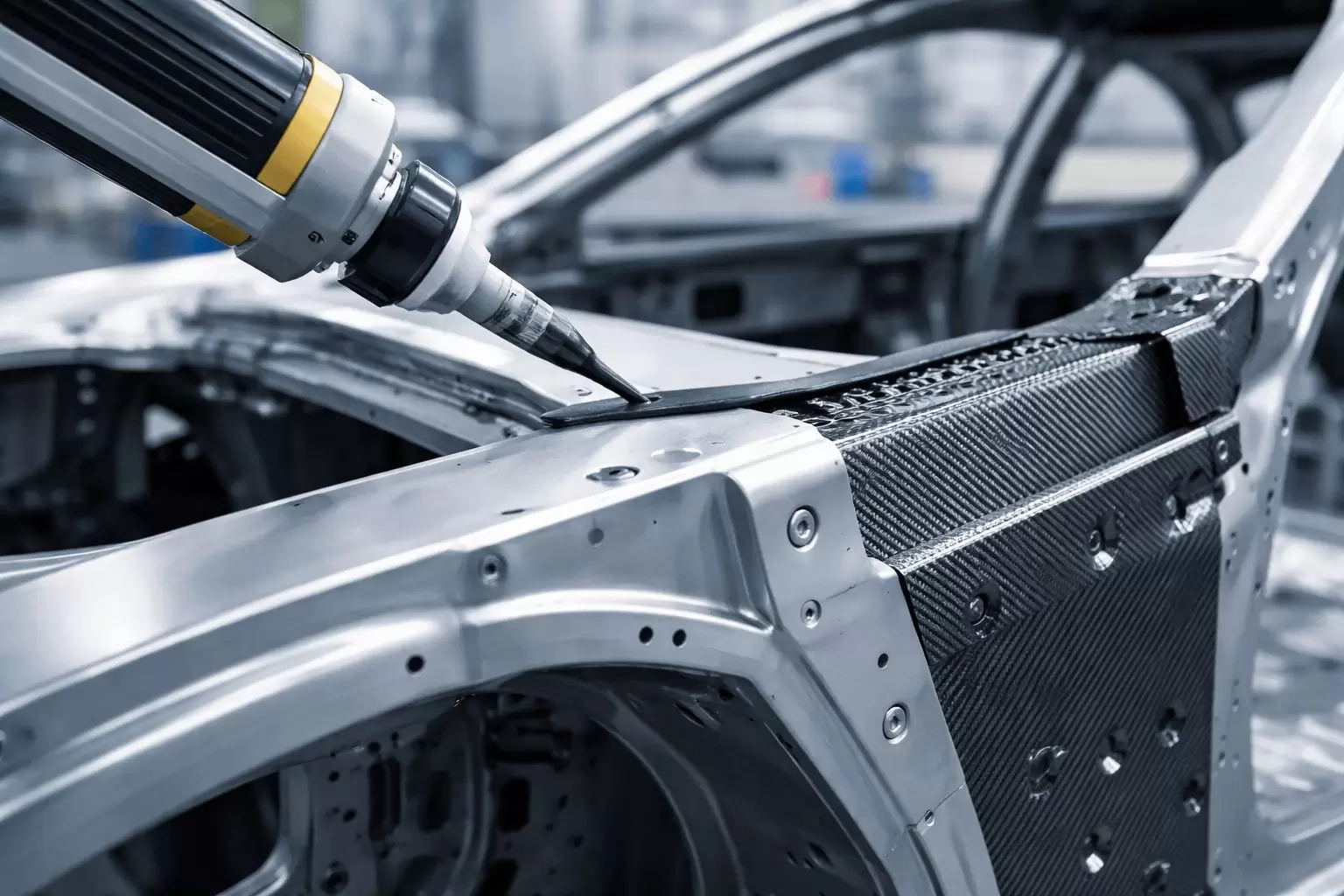
3.1 Structural Epoxy Adhesives
Epoxy-based structural adhesives are widely used in Body-in-White (BIW) assembly due to their:
-
High mechanical strength
-
Excellent heat resistance
-
Compatibility with e-coat curing processes
-
Strong adhesion to metals and composites
They are commonly used in critical load-bearing joints.
3.2 Polyurethane Structural Adhesives
Polyurethane adhesives offer:
-
High flexibility
-
Excellent vibration and impact resistance
-
Strong adhesion to plastics and composites
They are ideal for bonding panels with different thermal expansion rates.
3.3 Hybrid Adhesive Systems
Hybrid adhesives combine the benefits of epoxy and polyurethane, providing:
-
Balanced strength and flexibility
-
Improved durability
-
Wider substrate compatibility
These systems are increasingly adopted in multi-material body structures.
3.4 Non-Structural Adhesives and Sealants
Although not load-bearing, non-structural adhesives play a key role in:
-
Sealing joints
-
Improving NVH performance
-
Enhancing weather resistance
They complement structural adhesives in complete bonding solutions.
4. Application Areas in Multi-Material Body Structures
4.1 Body-in-White (BIW) Assembly
Structural adhesives are used extensively in BIW to bond:
-
Steel frames to aluminum panels
-
Roofs, pillars, and rocker panels
-
Floor assemblies and side structures
This improves body stiffness and crash performance.
4.2 Exterior Body Panels
Adhesives are commonly used for bonding:
-
Aluminum hoods and tailgates
-
Composite roofs and fenders
-
Lightweight door panels
This eliminates welding marks and improves surface quality.
4.3 Electric Vehicle Battery Enclosures
Multi-material battery enclosures require adhesives for:
-
Structural bonding
-
Sealing against moisture and dust
-
Thermal isolation
Adhesives enhance safety and durability while reducing weight.
4.4 Mixed-Material Closures
Closures such as doors, hoods, and liftgates often combine metal frames with composite skins. Adhesives ensure secure bonding without distortion.
5. Structural Adhesives vs Traditional Joining Methods
5.1 Advantages Over Welding
-
Enables bonding of dissimilar materials
-
Avoids thermal distortion
-
Improves corrosion resistance
5.2 Advantages Over Mechanical Fasteners
-
Reduces weight and part count
-
Improves fatigue life
-
Enhances NVH performance
5.3 Weld-Bonding Solutions
In many applications, adhesives are combined with spot welding to achieve optimal strength and production efficiency.
6. Key Performance Requirements for Multi-Material Adhesive Solutions
Automotive body panel adhesives must meet strict requirements:
-
High shear and peel strength
-
Resistance to thermal cycling
-
Long-term fatigue durability
-
Moisture and chemical resistance
-
Compatibility with automated dispensing systems
-
Compliance with automotive standards
7. Manufacturing Considerations
7.1 Surface Preparation
Proper cleaning and pretreatment are critical to ensure reliable bonding across different materials.
7.2 Curing Processes
Adhesives must align with production requirements, including:
-
Heat curing in paint ovens
-
Room-temperature curing
-
Fast-curing systems for high-volume lines
7.3 Quality Control
Consistent application and curing ensure long-term performance and structural integrity.
8. Future Trends in Multi-Material Adhesive Solutions
-
Higher temperature resistance for EV platforms
-
Faster curing for gigafactory production
-
Improved recyclability and sustainability
-
Increased use of adhesives in structural battery packs
-
Greater integration of adhesive functions (bonding, sealing, insulation)
Conclusion
As automotive design continues to evolve, automotive body panel adhesive solutions have become indispensable for multi-material body structures. By enabling reliable bonding between steel, aluminum, and composites, adhesives support lightweight design, improve safety, prevent corrosion, and enhance manufacturing efficiency.
In the era of electric and intelligent vehicles, advanced adhesive technologies are no longer optional—they are a critical enabler of next-generation automotive body engineering.
https://www.polytontech.com/industry/automotive-body-panel-adhesive-solutions-for-multi-material-bod
polytontech